voices quoted
Quoted in this piece
What Goes in an AI Visibility Report, and What Must Not
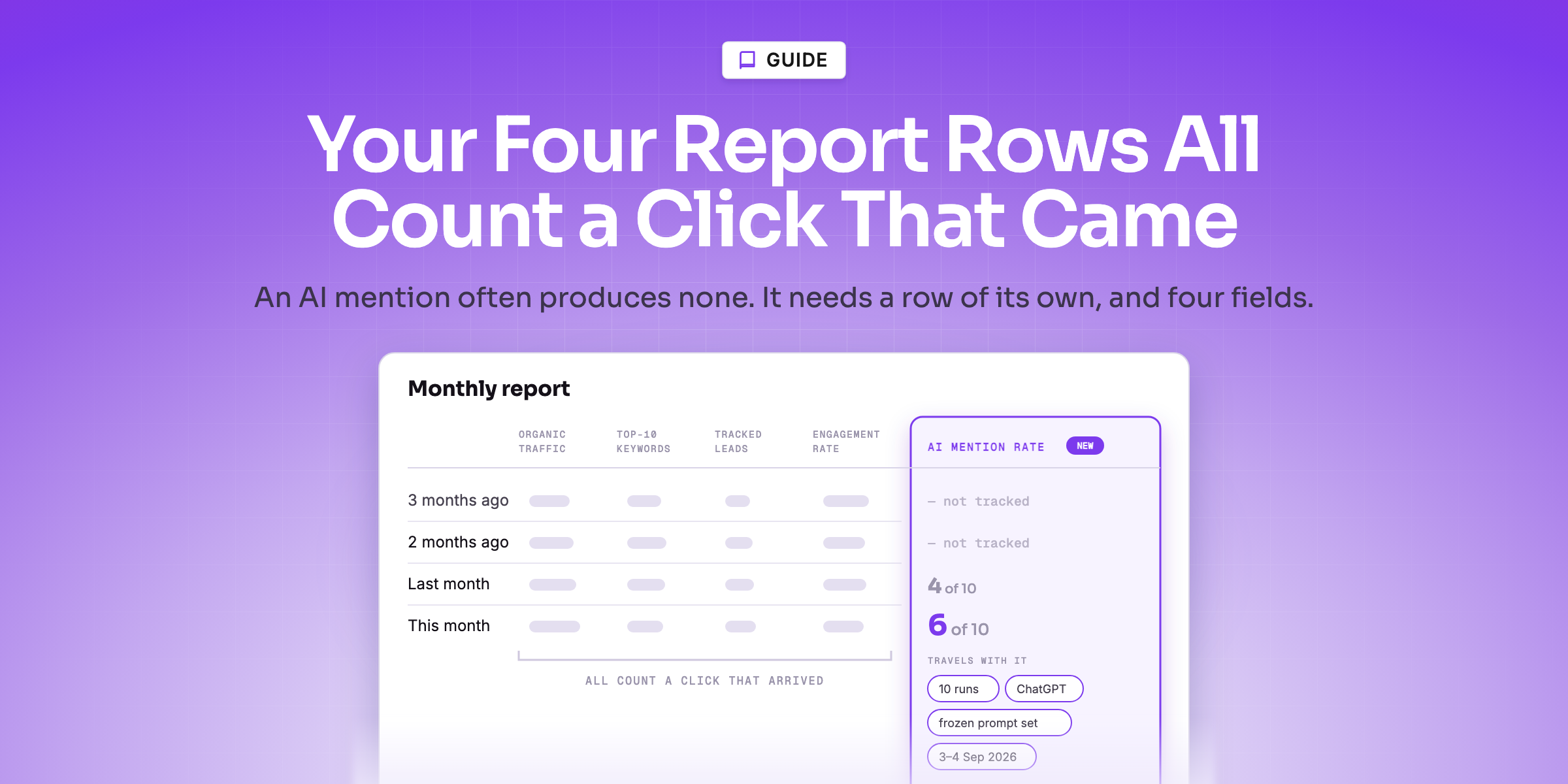
Your four reporting rows all count clicks, and an AI mention often produces none. Add one row, with the rate, the prompt set, the run count and the date.

The short version
The four rows on your monthly report all count a click that arrived, and an AI mention often produces no click at all. So nothing gets replaced — one row gets added, and it is not a rank. It survives a client asking "says who" only if four fields travel with it: the rate as a fraction, the frozen prompt set, the run count and the date.
Key highlights
- 1 Traffic, rankings and leads all count clicks, so none can see a mention
- 2 This is not a replacement metric and it is not a better rank
- 3 Report the fraction, not the percentage — 6 of 10, not 60%
- 4 Name and freeze the prompt set; it is the field everyone skips
- 5 The test is whether the client could re-run it themselves
- 6 Put the competitor names in the row, not in a footnote
- 7 One row per question per engine — never one score for the account
- 8 Write buyer questions from sales calls, not from keyword tools
- 9 State the limits on the page before anyone has to ask
- 10 Never report a position, and never a score you cannot decompose
Your monthly report has four rows on it: traffic, keywords in the top three, keywords in the top ten, leads. They have worked for years and they still fill the page.
All four of them count a click that arrived. That is the problem, because the thing your client is now asking about produces no click at all.
For the past 2 years, we have always reported the following on a monthly basis to our SEO clients: traffic, keywords (top 3 and top 10), tracked leads, engagement rate. […] Of course with AI becoming our definite future, it is about time that we start changing how we are monitoring and reporting success.
That post has eight replies and no answer in it. Very little published advice tells agencies what the new row actually looks like, because the truthful version is smaller and less impressive than what a dashboard offers.
Nothing on that list needs replacing. One row gets added, and it is not a rank. This piece is what that row is, the four fields that make it survive a client asking "says who", and the two things that must never appear beside it.
Why the Four Rows You Have Cannot Carry It
An AI mention is your brand being named inside a generated answer. Often no link is attached, so nobody clicks, so nothing arrives anywhere your existing rows can see it.
| Row you report today | What it counts | Can it show an AI mention? |
|---|---|---|
| organic traffic | sessions that arrived | only if a link was attached and clicked |
| keywords in the top 3 / 10 | position in a list of links | no — a generated answer is not a list |
| tracked leads | a conversion that already happened | far downstream, and unattributable |
| engagement rate | behaviour of people already on the site | no |
None of those four is broken. They are accurate about what they measure, and what they measure is the tail end of a journey that now often ends before it starts. A mention, a citation and a visit are three different objects, and only the third one shows up in analytics.
So the honest framing for the client is short: this is not a replacement metric, and it is not a better version of rank. It is a different question — are we in the answer — and it needs a row of its own.
The Row, and the Four Fields on It
The row is a rate. You take one buying question, run it a fixed number of times, and count how many of those answers named the client. That fraction is the number.
The number on its own is worth nothing. It becomes defensible when four fields travel with it:
- The rate, as a fraction. "6 of 10", not "60%". A fraction can be checked; a percentage has already thrown away the sample size.
- The prompt set, named and frozen. Which questions, written down, unchanged between reports. This is the field everybody skips and the one every argument is actually about.
- The run count. How many times each question was asked. Ten runs of one question is a rate; two runs is an anecdote with a percentage sign.
- The date, and the window. Not the date you wrote the report — the date the runs happened, and how long they took.
The test for whether you have all four is whether the client could re-run it. Hand the report to someone who did not do the work and ask if they could reproduce your number. If they cannot, you have not reported a measurement, you have reported a claim.
What the Row Actually Looks Like on the Page
Small, boring and specific. That is the point.
| Field | This month |
|---|---|
| question | "best expense tool for a 20-person team" |
| engine | ChatGPT, web search on |
| runs | 10 |
| named the client | 6 |
| rate | 6 of 10 |
| also named | four competitor names, listed |
| location, account | UK, logged out |
| window | 3–4 September 2026 |
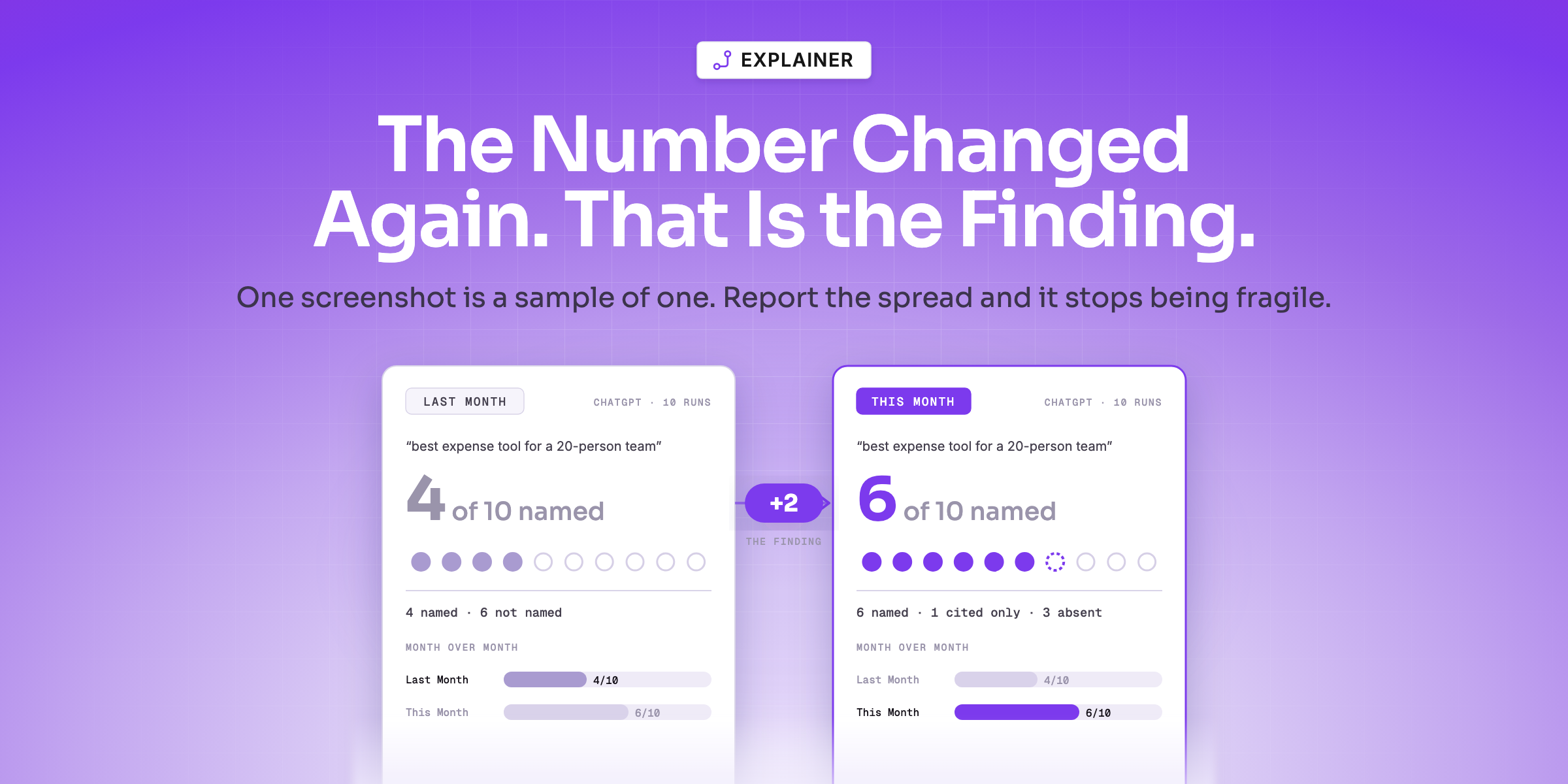
| last month | 4 of 10 |
The competitor names are not decoration. They are the part a client recognises instantly, and they turn an abstract number into a conversation about who is winning the question. A client who has never thought about their AI visibility will still have an opinion about the four companies the engine recommended instead of them, and that opinion is where next quarter's work comes from.
Notice also what the row does not contain: no score, no grade, no arrow, no colour. Every one of those is a summary of the fields beside it, and a summary is the first thing to be quoted out of context.
- Keep one row per question, not one score for the account. Five questions means five rows, and the pattern across them is the insight.
- Keep one row per engine. ChatGPT and Perplexity are not two samples of the same thing, and averaging them hides the one that moved.
- Show last month beside this month. The comparison is the only benchmark that exists — there is no public baseline to measure against.
- Put the window in the row, not in a footnote. Anyone reading a number without its window will assume it is current, and one day they will be wrong.

Setting It up so the First Report is Not the Last
Most of the work happens once, before any report exists. Get it wrong and every month afterwards is uncomparable.
- Write the questions from real buyer language. Sales call notes, support tickets, the questions that arrive in the client's inbox. Not keywords — sentences. Nobody types a keyword into a chatbot.
- Freeze the list and version it. v1 is fixed. When you add questions, they become v2, and you keep reporting v1 alongside until v2 has enough runs to stand on its own.
- Pick the engines and write down the mode. "ChatGPT" is not specific enough when one mode searches the web and another answers from memory. Name the mode in the report.
- Fix the location and the account state. Logged out, or a clean account kept only for this. An account that has been discussing the client's industry for a year is not a neutral instrument.
- Keep one control question you expect to win. If the control comes back empty, the run broke — you have not discovered anything about the client.
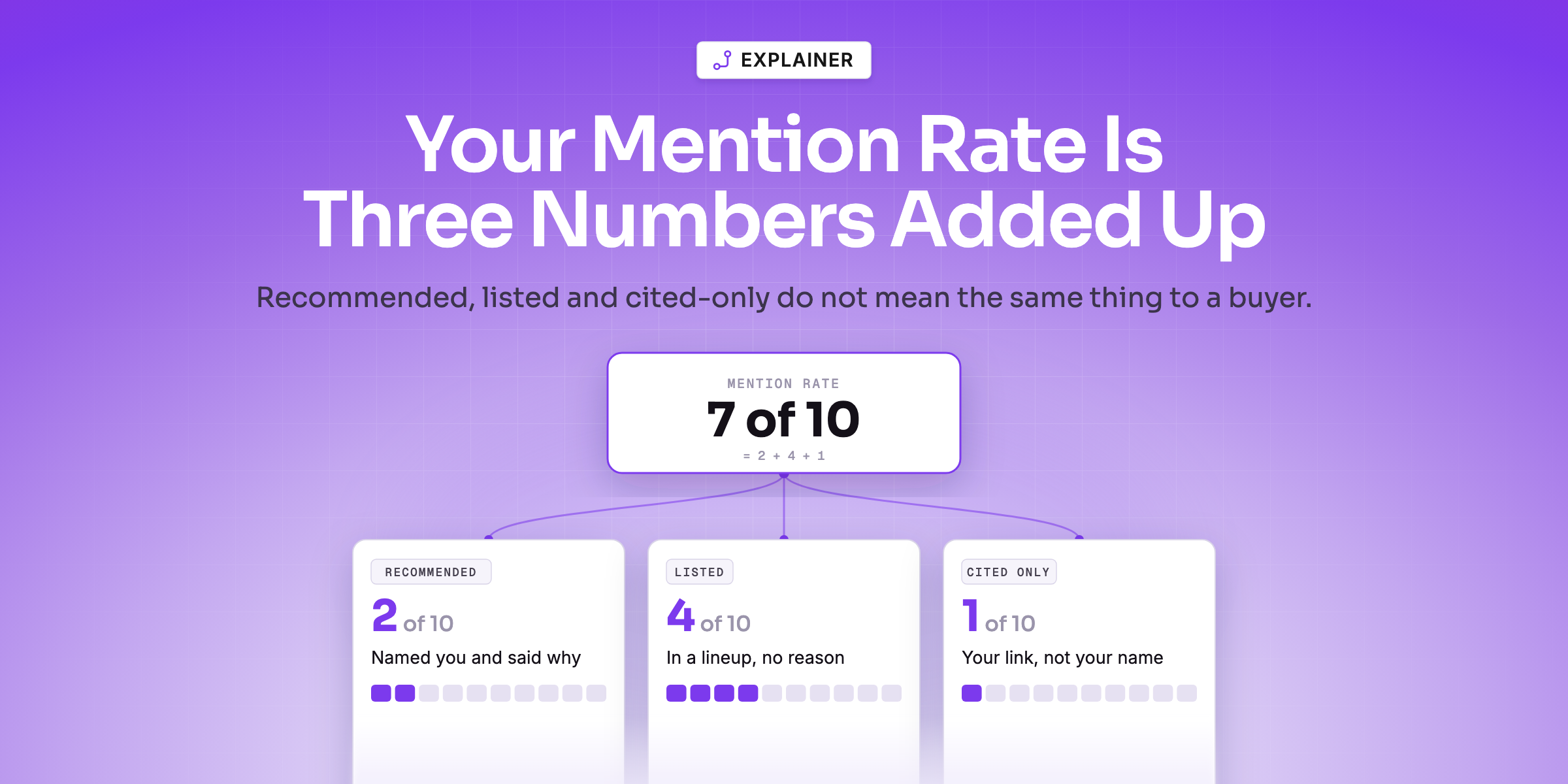
- Decide what counts as a hit before you run it. Named in the conclusion with a reason, listed among options, or cited with no name in the text are three different outcomes. Write your rule at the top of the sheet and apply it every month.
That last one settles more arguments than anything else on the list. Two people counting the same ten answers will disagree unless the rule was written down first, and the disagreement always surfaces in front of the client.
Alongside the rate, there is a second number worth carrying that costs nothing: referral traffic from the AI hosts. It sits a few clicks deep in GA4 and in your server log, and it counts only the mentions that carried a link and got clicked. Report it as a floor, never as the total, and label it that way on the page.
What the Number Does Not Tell You, and Saying So
A report that overclaims once is discounted forever, so put the limits on the page before anybody has to ask.
- It is your prompt set, not the market. The rate describes how the brand does on the questions you chose. It is not a share of everything anyone asks.
- There is no benchmark. No credible public baseline exists for a good rate, so the only honest comparison is to the client's own previous month.
- It does not attribute revenue. A mention influences a decision you cannot see. Anyone connecting this row to pipeline is guessing, and the guess will be checked.
- It moves for reasons outside the work. Model updates and index refreshes shift results without anybody touching the site. Say that in month one, not in the month it happens.
Stating all four costs a paragraph and buys the number its credibility. The alternative is a client discovering one of them on their own.
Two Things That Must Never Go on the Page
Both are tempting because they look like the reports everybody already understands. Both will fail the first time somebody serious reads them.
A position. "We rank third in ChatGPT" is not a softer version of the truth, it is a category error — the answer is a paragraph, not an ordered list, and there is no third place in it to occupy. Put a position on a client report and you have promised to move something that does not exist.
A blended score whose denominator you cannot state. A single figure covering several engines and an unnamed prompt set cannot be checked, argued with, or acted on. When it moves, you will not know why, and the client will ask.
The general rule underneath both: if you cannot say what the number is out of, it does not go on the page.
Reporting a Vendor's Score Without Inheriting It
Plenty of agencies are pulling a figure from a paid tool and putting it straight into the deck. You can do that. What you cannot do is present it as the client's standing.
A vendor score is produced by running the vendor's prompt set. They chose the questions, so they chose the denominator, and a different vendor running a different set will hand you a different number for the same brand in the same week. Both are arithmetically correct and neither is about your client's questions.
- Attribute it in the sentence. "Tool X's own prompt set put the brand in 34% of its answers" is honest and survives being challenged.
- Never put it in the same column as your own measurement. Different denominators do not belong in one trend line.
- Keep your own frozen question list regardless. The tool becomes a way to run your list faster. It does not get to supply the list.
The list is the asset. The score is what falls out of it, and it is the part that will be different next quarter.
There is a commercial reason to be firm about this. An agency whose reporting depends on one vendor's number has outsourced the thing it is being paid for. When the vendor changes its methodology — and they do, quietly — every month of history in your deck becomes uncomparable, and you will be the one explaining it. A frozen question list you own survives a tool change, a price rise, and the tool going away.
Conclusion
Keep your existing rows — they still measure clicks that arrived. Add one more, and make it a fraction with its prompt set, run count and date attached, plus the names of whoever was recommended instead. Keep a position and a blended score off the page entirely. If you cannot say what the number is out of, it does not belong in front of a client.
AI Visibility Reporting: Frequently Asked Questions
What KPIs should I report for AI search?
Can I report an AI visibility score out of 100?
Should I report AI rankings to clients?
How do I show progress month to month?
Is it enough to screenshot ChatGPT answers for the client?
How many questions should be in a client's prompt set?
Find the exact growth leak in your business — in 2 minutes.
Paste your URL. Our AI agent crawls your site, diagnoses what's broken, and ships a step-by-step fix plan. Free, no signup.
Run free audit