voices quoted
Quoted in this piece
How Long Until AI Cites You? Nobody Can Honestly Tell You
There is no published baseline for time-to-citation. What logged evidence exists suggests a citation is an event that mostly does not repeat.

The short version
Nobody can honestly give you a timeline, and every competing page will. There is no published baseline, the logged evidence comes from individual operators on their own query sets, and read together it suggests the question is built wrong — a citation looks like an event that mostly does not repeat, not a state you arrive at and hold.
Key highlights
- 1 "How long until" assumes citation is a state you reach and keep
- 2 One 60-day sample found 52% of cited URLs appeared once and never returned
- 3 Recurrence, not first citation, is the thing worth measuring
- 4 Informational queries held their sources; commercial ones churned hardest
- 5 The questions that pay are the ones reported to move most
- 6 A three-week experiment recorded zero citations across six engines
- 7 A flat result after one change is the expected outcome, not a failure
- 8 No baseline exists, and the metric drifts under the measurement
- 9 A confident timeline is a sales figure until the method is shown
- 10 Promise a measurement discipline and a review point, never a date
Someone has asked you for a timeline. A client, a founder, a board. How long before we start showing up in these answers?
Every competing page will give you a number. Six weeks. Three months. Ninety days to first citation. None of those numbers has a published method behind it, and the reason they exist is that a confident window closes a deal. What you can give them instead is a way to check whether AI mentions your brand and watch the rate move.
Here is the truthful version, which is less satisfying and more useful. There is no baseline. What logged evidence exists comes from individual operators on their own query sets, and read together it suggests the question itself is built wrong.
The Question Assumes Something That is Probably False
"How long until I get cited" treats a citation as a state you arrive at and then occupy — the way a ranking works. You climb to position three, and position three is where you live until something moves you.
The evidence available does not describe that at all. It describes an event that happens, often once, and frequently does not repeat. If that is right, then "how long until" is the wrong axis entirely, and a team that reaches its first citation on schedule can still have nothing three weeks later.
Three logged experiments point the same way. None of them is ours, all of them are single operators, and each is quoted here as an account rather than a finding.
That framing matters more here than on most pages. This is a question where the evidence is thin and the demand for a confident answer is enormous, which is exactly the condition that produces invented statistics. If a number below turns out to be wrong, the argument it supports should still stand — and where it would not, we have said so.
More Than Half Appeared Once and Never Came Back
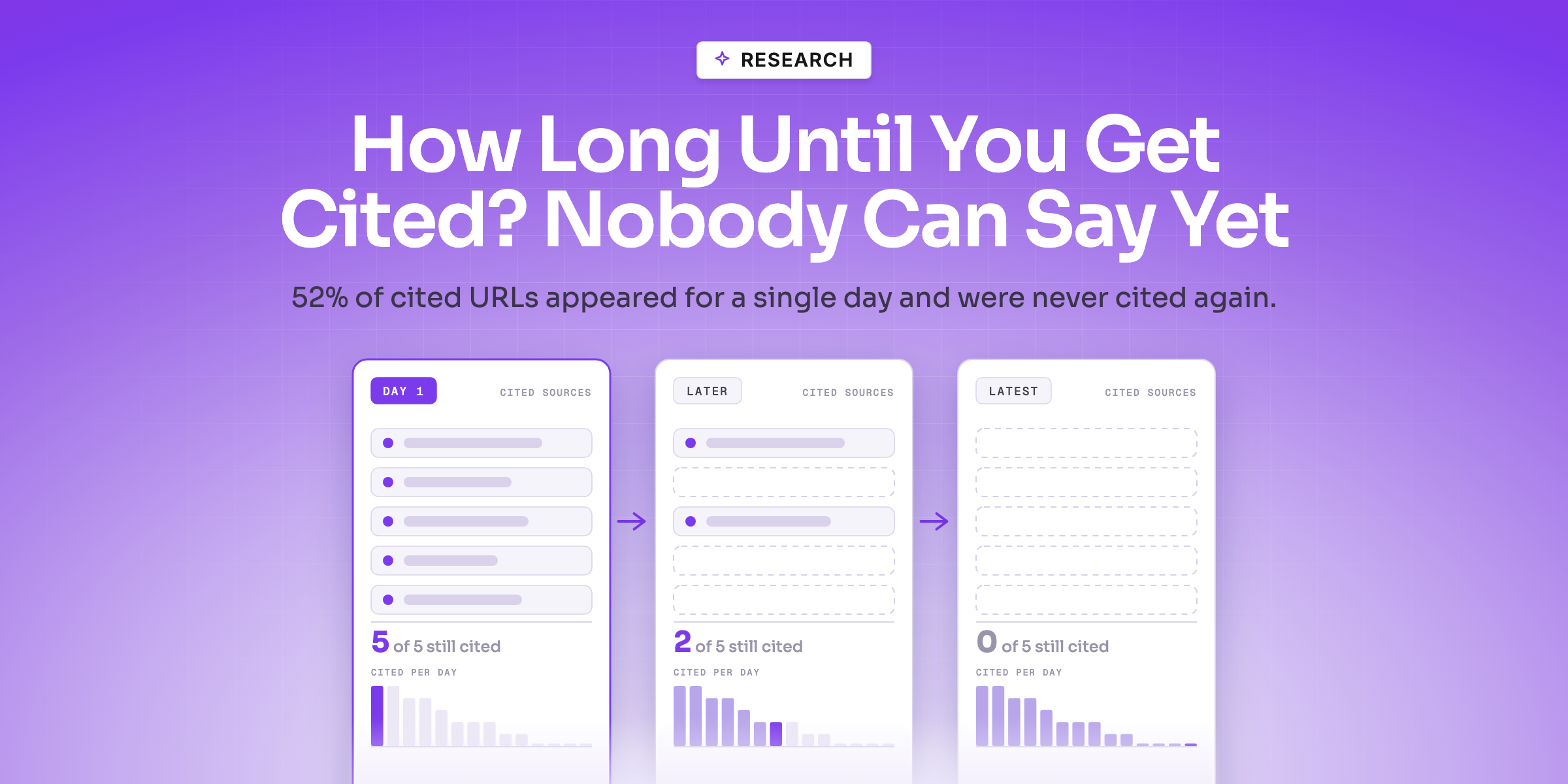
The biggest finding surprised me: 52% of all cited URLs appeared for one day and were never cited again. More than half. And that was true even for well-known, high-authority platforms. […] Owned website content: 41 days · Press wire content: 27 days · Academic sources: 19 days · Reddit: 11 days
That is one operator's 60-day sample of 15,661 URLs. We did not run it, it has not been replicated, and it describes whatever content mix happened to be in that sample. Treat the exact percentage as unverified.
What it changes, if the shape holds, is which question is worth asking:
- First citation is a weak milestone. It is easy to celebrate and, on this evidence, quite likely to be a one-day event.
- Recurrence is the thing worth measuring. Did it come back next week, next month, on a re-run of the same question.
- A single screenshot proves less than it appears to. It may be documenting an appearance that never happened again.
- Any timeline framed around "first" is measuring the least durable thing available.
So a better target than "cited by March" is "named in the majority of runs of these five questions, three months running". That is harder to promise and much harder to fake.
It also changes what counts as progress in the meantime. If the first citation is a one-day event for most URLs, then a month where you appeared twice and vanished twice is not a failure — it is a signal that you are inside the candidate pool and not yet the default answer. Those are different problems with different fixes, and a timeline built around a single first appearance cannot tell them apart.
It Depends What Kind of Question You are Cited On
The second experiment split the results by query type and got two very different answers:
Informational queries: rock solid. 74% of cited sources on informational queries stayed the same across all 21 days. The same pages kept getting pulled.
Again: one team, 600 queries a day, three weeks, unreplicated. And again the shape is the useful part.
| Kind of question | What that run reported | What it means for a timeline |
|---|---|---|
| informational — "what is X" | most citations held across three weeks | relatively stable, easier to hold |
| commercial — "best X for Y" | most citations churned | unstable, and this is the one that pays |
The queries that produce revenue are the ones reported to churn hardest. That is unwelcome and it is the single most important line in this piece. A timeline quoted without naming the query type has averaged a stable population with a volatile one, and the average describes neither.
- Ask which questions any promised timeline refers to. If the answer is "AI visibility" in general, the number has already been averaged into uselessness.
- Track your commercial and informational questions separately. They behave differently enough that mixing them will hide both signals.
- Expect to hold informational ground more easily than commercial ground. Plan the effort accordingly rather than being surprised by it.
One Change is Not Expected to Move It
The third experiment is a live log of someone changing one variable a week and recording the result:
This week's variable was external authority: I added the first off-site mention of the project. Result: zero citations again. […] all six engines retrieve live web fine. The barrier isn't reachability — it's authority and retrieval ranking. One fresh mention doesn't move it, because authority is cumulative, not a switch. 3 weeks, 0/6, fully logged.
Three weeks, zero citations across six engines, with the page retrievable throughout. Reachability was never the barrier — the engines could read it and did not pick it.
This is the most useful negative result available, because it tells you how to read your own silence:
- A flat result after one change is the expected outcome, not evidence that the work failed.
- Do not conclude anything from three weeks of one variable. The experiment above did exactly that, carefully, and the fair reading is that it is still running.
- Reachability and selection are different problems. Being fetched is easy; being chosen is not, and the first is often mistaken for progress on the second.
- Changing several things at once buys you a result you cannot interpret. If it moves, you will not know which change did it.
The uncomfortable corollary: a plan that promises visible movement inside a month is promising something no logged experiment has demonstrated.
Why No Honest Number Exists
Four reasons, and they compound.
- There is no published baseline. Nobody has established a time-to-first-citation figure against a defined population. Without a baseline, every quoted window is one sample described as a norm.
- The samples that exist are single operators. One site, one query set, one window, usually one engine. Useful, not generalisable, and almost never re-run by anybody else.
- The metric drifts underneath the measurement. Model updates, index refreshes and product changes move results without anyone touching the site. A three-month experiment is measuring a moving target with a moving ruler.
- Your starting point is unlike anyone else's. Domain age, existing coverage, category competitiveness and whether the question has an obvious incumbent all change the answer, and none of them are held constant in any figure you have been quoted.
Put together: a confident timeline is not a finding, it is a sales figure. The correct response to "how long will it take" is to say nobody knows, then say what you will measure instead — which is a stronger position than it feels like, because everyone in the meeting has already been burned by a number that did not hold.
What the Promised Windows Actually Rest On
Look at where the numbers you are being quoted come from. The sources are more limited than the confidence suggests.
| The claim you were given | What is usually behind it |
|---|---|
| "90 days to first citation" | no cited method — a round number that fits a quarterly cycle |
| "six weeks, we've seen it" | one client, one category, unrepeated, favourable |
| "it depends, roughly 3-6 months" | a shrug wearing a range |
| "our data shows X weeks" | a vendor's own sample, denominators unstated |
The third row is the only one that is not misleading, and it is also the only one that will lose a pitch. That asymmetry is why the field is full of numbers nobody can source: the honest answer is commercially weaker than the invented one, so the invented one spreads.
Two consequences worth carrying into any conversation about this:
- The person quoting you a window is usually repeating one, not producing one. Ask where it came from and the chain generally ends within two steps, at nothing.
- A range is not a hedge if the endpoints are made up. "Three to six months" sounds cautious and carries exactly as much evidence as "six weeks" — which is none.
What to Promise Instead
You still have to say something. Say these, all of which you can actually deliver:
- A frozen question list within two weeks. Real buying questions, written down, owned by you.
- A baseline measurement from that list. Where the brand stands today, per engine, as a fraction with a date on it.
- A monthly re-run of the identical set. Same questions, same run count, same engine, same location.
- The competitor list every month. Who is being recommended instead, which is the part that drives the next piece of work.
- A stated review point — three months — with no promised outcome attached to it. At that point there will be three readings and a direction, which is the earliest anything can honestly be said.
What you are promising is a measurement discipline, not a result. That is what a supplier can truthfully commit to when the underlying behaviour belongs to somebody else's product.
There is a version of this conversation that goes well, and it starts by naming the constraint out loud. "The engines change what they cite on their own schedule and nobody publishes a reliable timeline. What I can commit to is that in three months you will know exactly where you stand on your twenty real buying questions, on each engine, with the competitors named — and that is more than anyone in your category currently has." Most people accept that, because most people have already paid for a promised date that did not arrive.
What it also does is set up the review honestly. At three months you will have three readings. Three readings show a direction, not a trend, and saying that in month one is what stops it being an argument in month three.
If the number moves and you want to know whether the movement is real or noise, that is a separate question with its own answer — one reading is a sample of one, and the fix is a rate, not a screenshot. And if you have not yet checked what the engines are doing to your site while you wait, your server log and GA4 already hold part of it.
Conclusion
Any specific window you have been quoted has no published method behind it. What you can commit to instead is a frozen question list, a dated baseline, a monthly re-run of the identical set and the names of whoever is recommended in your place — with a three-month review and no promised outcome attached to it. That is a smaller promise and the only one that survives being checked.
Keep reading: Do ChatGPT and Perplexity Cite the Same Sources? Not Really · How to Measure AI Visibility: Count a Rate, Not a Position
How Long AI Visibility Takes: Frequently Asked Questions
How long does it take to get cited by ChatGPT?
Is there a typical timeline for GEO or AEO results?
I got cited once and then nothing. Is that normal?
Why do my commercial keywords lose citations faster?
I made a change and nothing happened. Did it fail?
What should I promise a client about AI visibility timelines?
Find the exact growth leak in your business — in 2 minutes.
Paste your URL. Our AI agent crawls your site, diagnoses what's broken, and ships a step-by-step fix plan. Free, no signup.
Run free audit