voices quoted
Quoted in this piece
Do ChatGPT and Perplexity Cite the Same Sources? Not Really
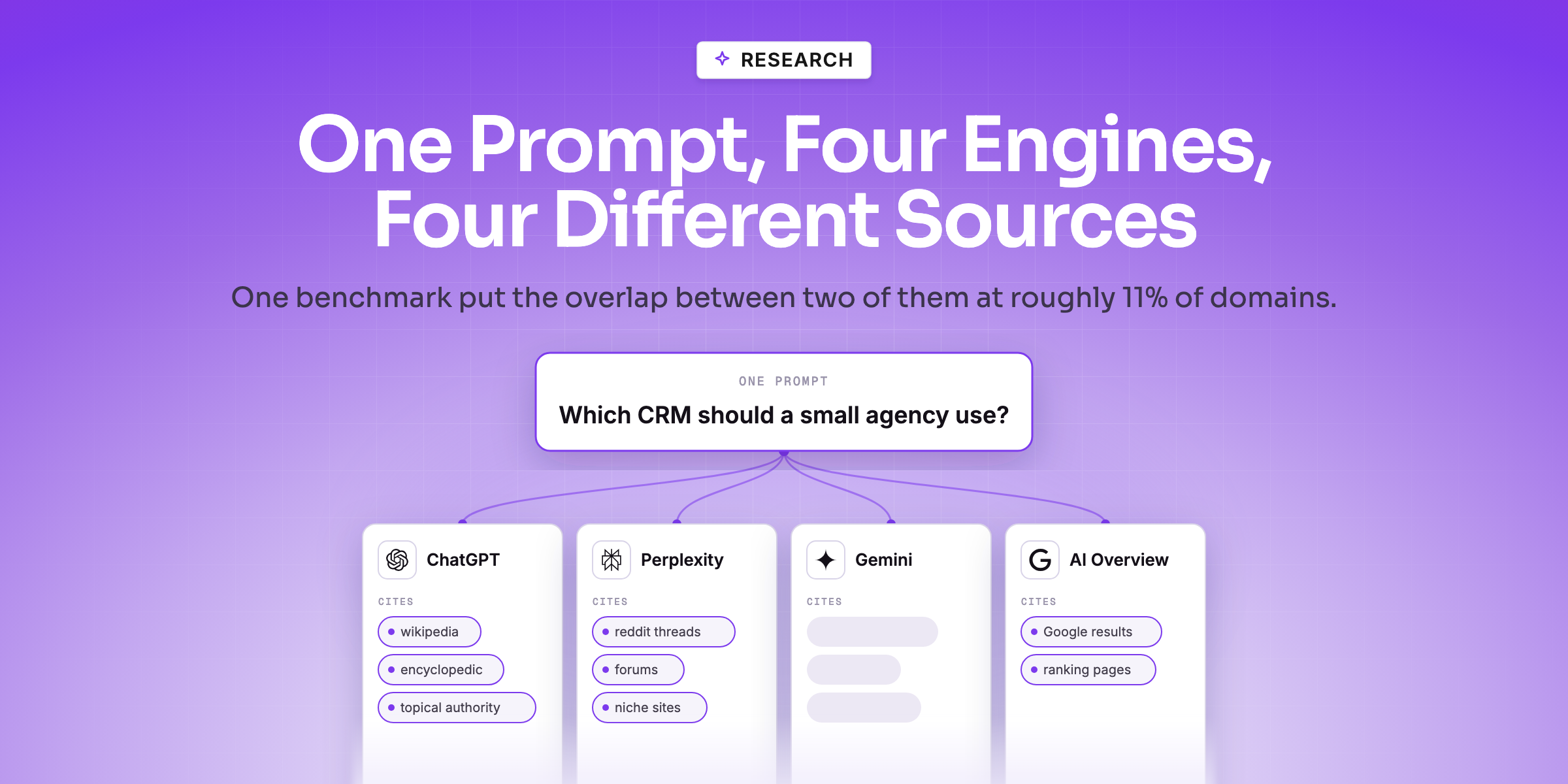
One benchmark found roughly 11% of domains cited by both. Winning one engine predicts very little about the next, so keep one rate per engine.

The short version
Each engine runs its own retrieval over its own index with its own ranking, so "cited by AI" was never one event. One practitioner's benchmark found roughly 11% of domains appearing in both ChatGPT and Perplexity. That figure is unreplicated and we have not run our own comparison — but the shape holds however far off the decimal is: winning one engine predicts very little about the next.
Key highlights
- 1 Index, search provider, query rewrite and selection rule all differ
- 2 Four compounding differences mean agreement would be the surprise
- 3 One benchmark found about 11% of domains cited by both engines
- 4 The conclusion holds even if the true overlap is several times higher
- 5 Overlap on cited domains is not the same as overlap on brand mentions
- 6 The engines are described as reaching for different kinds of source
- 7 A blended score is a weighted average whose weights you did not choose
- 8 A rise on one engine and a fall on another nets out to a flat line
- 9 Fifteen answers across three engines gives you your own overlap figure
- 10 We have not run this experiment, and every number here is somebody else's
You checked ChatGPT and you were named. You ran the same question through Perplexity and you were not, and Gemini named two companies neither of the others mentioned.
The instinct is to work out which engine is the accurate one. There is no accurate one. Each engine runs its own retrieval over its own index with its own ranking, so "cited by AI" was never a single event — it is four different events that happen to share a name. Comparing engines is one of the checks in our guide to checking whether AI mentions your brand.
That has a direct consequence for anyone reporting a number. A single AI visibility score is an average of populations that, by at least one practitioner's count, barely overlap.
The Same Prompt, Three Engines, Three Answers
Practitioners describe this constantly, usually while trying to work out what is broken:
I'll run the same prompt across ChatGPT, Perplexity, and Gemini and get three completely different cited sources. Then I'll run the exact same prompt on ChatGPT twice and get different citations. So what exactly am I tracking?
Nothing is broken. Four things differ between any two engines, and each of them is enough on its own to produce a different answer:
- The index. Different engines read different corpora, refreshed on different schedules, with different coverage of small and new sites.
- The search provider. Some lean on a partner's web index, some on their own crawl, some on a mix that changes.
- The rewrite. None of them searches your sentence. Each one turns the question into its own set of queries, and those queries are not the same across engines.
- The selection rule. Given the same candidate pages, they weigh freshness, authority and source type differently.
Four differences compounding means the surprise would be agreement, not disagreement. The reason it feels like an instrument fault is that the previous decade trained everyone on a single scoreboard.
That habit is worth naming, because it costs money. In search, one index meant one answer to "where do we stand", and a rank tracker could give it to you. There is no equivalent object now. Any product offering you one has, somewhere inside it, made a choice about how to blend four disagreeing systems — and that choice is doing more work than your content is.
How Little They Overlap, by One Operator's Count
Someone ran the comparison and published the result:
Only 11% of domains appear in both. ChatGPT leans heavily on Wikipedia and encyclopedic content (nearly 48% of top citations), while Perplexity pulls almost half its citations from Reddit threads.
Read that carefully before you use it. It is one practitioner's benchmark, on one query set, in one window. We have not reproduced it, nobody we know of has re-run it, and it should not be quoted as a constant of the field. Take the figure as an account and the shape as the finding.
The shape is what matters and it survives even if the exact number is off by a lot:
| If the true overlap is | Then winning one engine means |
|---|---|
| about 11% | almost nothing about the others |
| double that | still less than a quarter carries over |
| half of everything | you would need to check anyway to know which half |
There is no version of this where one engine's result stands in for the rest. That is the practical claim, and it does not depend on the decimal.
It is worth being precise about what was compared, too. That count is about domains appearing in both engines, which is not the same as your brand being named in both. A domain can be cited without your name appearing in the answer text at all, and your name can appear with no source attached. Overlap measured on citations and overlap measured on mentions are two different numbers, and most published comparisons quietly use the first while readers assume the second.
They are Reading Different Libraries
The mechanism underneath the overlap is that the engines have different tastes in sources:
ChatGPT seems to pull from whatever has strong topical authority. like if you've written extensively about one thing, you show up more. […] Perplexity is way more source-diverse. forums, reddit, niche sites. freshness matters a lot there
Seventy-nine votes and fifty-one replies on that thread. That is a lot of people agreeing with a read rather than with a measurement, and it is exactly how to treat it.
| Engine | What that account describes it reaching for |
|---|---|
| ChatGPT | encyclopedic and topically authoritative sources |
| Perplexity | source-diverse, including forums and niche sites, with freshness weighted heavily |
| AI Overviews | closely tied to what already performs in Google's own results |
Three practical readings follow, and none of them requires the description to be exactly right:
- A page can be excellent for one engine and invisible to another without anything being wrong with the page.
- The engine you personally use is not the engine your buyer uses. Checking one is checking a quarter of the question.
- "Optimise for AI" is not a coherent instruction. The engines want different things, so the only version that generalises is being the clearest, best-evidenced answer to the specific question — which every engine is trying to find, however differently.
What This Does to a Single Visibility Score
If the populations barely overlap, a single blended figure is a weighted average whose weights you did not choose and cannot see.
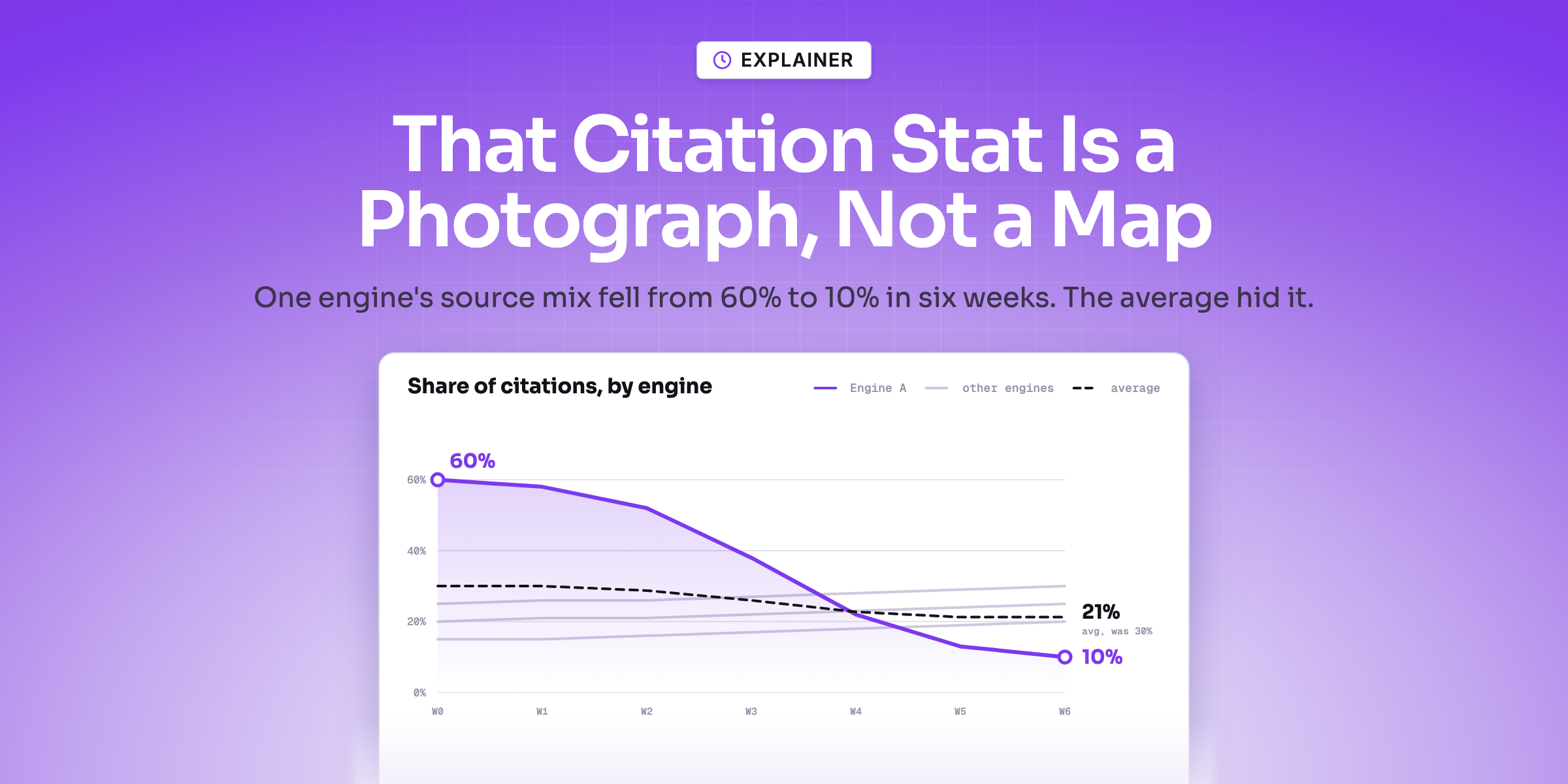
Say your tool reports 30%. That number is some mix of four engines. Which mix? Whatever the vendor decided, weighted however their sample happened to land. Move the weighting and the same underlying reality reports as 20% or 45%, with nothing about your brand having changed.
The failure is not that the average is imprecise. It is that it cannot be acted on:
- You cannot tell which engine moved. A rise on one and a fall on another nets out to a flat line, and flat is the one reading that suggests doing nothing.
- You cannot tell where the gains came from, so you cannot scale whatever produced them.
- You cannot diagnose a loss. The one engine you have stopped appearing on is the one the average is hiding.
- You cannot compare two tools' numbers, because they are averaging different sets with different weights.
So report four rates, or report one and name the mix that produced it. A number you cannot decompose is not a measurement, it is a mood.
The same logic applies to the advice you read. A study of "AI citations" that does not name the engine has averaged four different retrieval systems and reported the average as a property of the field. Whatever it concluded, the conclusion is about a blend nobody uses — real buyers ask one engine at a time.
- Ask which engine before you act on any finding. If the answer is "AI", the finding has already thrown away the part you needed.
- Weight your own effort by where your buyers actually are, not by which engine publishes the most research about itself.
- Treat a per-engine split as the deliverable, not as the appendix. The split is the insight; the average is the packaging.
Checking It Yourself, This Afternoon
You do not have to take anyone's overlap figure, including the ones above. The comparison is small enough to run by hand, and running it once on your own category is worth more than any published number.
- Pick one real buying question. A sentence a buyer would actually type, not a keyword. "Best X for a team of twenty" rather than "X software".
- Run it on three engines, five times each. Same wording, same session, logged out, one location. Fifteen answers in total.
- For each answer, write down two things — whether you were named, and which companies were. The second column is the one that will surprise you.
- Count the domains cited, per engine, and compare the lists. How many appear in more than one? That is your overlap, on your question, on today's date.
- Repeat with one commercial question and one informational one. They behave differently often enough that mixing them will muddy the read.
An afternoon of that gives you something no vendor can sell you: a figure whose denominator you chose, on questions your buyers actually ask, dated. It is a small number and it is yours.
- Do not average the three engines into one. The whole point of the exercise is the difference between them.
- Keep the competitor lists. Who gets recommended instead of you, per engine, is the most actionable thing in the whole run.
- Write the date on it. Everything here moves, and a reading with no date cannot be compared to the next one.
- Expect the engines to disagree with themselves too. Running the same question twice on one engine will also produce different answers — that is a separate axis and it is why five runs, not one.
Before you start, it is worth being clear about what you are counting. A mention, a citation and a visit are three different objects, and the overlap you measure will depend on which of the three you decided to record. Counting cited domains and counting named brands give different answers to the same question.
It also helps to know what usually gets picked in the first place. We counted twenty-three AI Overviews and every source they used, and the pattern there — being read is not the same as being cited — applies to every engine in this comparison.
What We Have Not Run
Everything above is other people's work, and it would be dishonest to leave that in a footnote.
We have not run our own engine-comparison experiment. The design is not complicated — one frozen prompt set, four engines, a fixed number of runs each, everything logged — and until that exists we have no overlap figure of our own to offer. What we have is a shape supported by several independent accounts pointing the same way, which is enough to argue from and not enough to quote as a finding.
That distinction is the whole discipline. If you are reading anyone's engine-overlap number this quarter, ask three things:
- Whose query set was it? The answer determines the entire result, and it is almost never published.
- When was it measured? Retrieval behaviour moves in weeks. A figure with no window is history presented as news.
- Has anybody re-run it? One dataset that nobody has reproduced is a starting point, not a fact.
Apply those to the numbers in this piece too. They do not survive all three, and we have said so rather than hoping you would not check.
Conclusion
There is no version of this where one engine's result stands in for the rest. Keep one rate per engine, compare each to its own last reading, and treat any overlap figure — including the ones on this page — as one unreplicated dataset until somebody re-runs it. Whose query set, measured when, and has anyone repeated it are the three questions worth asking of every number in this area.
Keep reading: Why AI Citation Statistics Expire Faster Than You Think
Do the AI Engines Agree: Frequently Asked Questions
Do ChatGPT and Perplexity cite the same sources?
Should I track AI visibility separately for each engine?
Why does my brand appear in ChatGPT but not in Google's AI Overviews?
Which AI engine should I optimise for?
Is one AI visibility score across engines useful at all?
Has anyone measured engine overlap properly?
Find the exact growth leak in your business — in 2 minutes.
Paste your URL. Our AI agent crawls your site, diagnoses what's broken, and ships a step-by-step fix plan. Free, no signup.
Run free audit