Generative Engine Optimization Services: Skip the Fee
GEO services get your brand cited inside AI answers. Here's what the work includes, what agencies bill for it, and how to audit yours free.

The short version
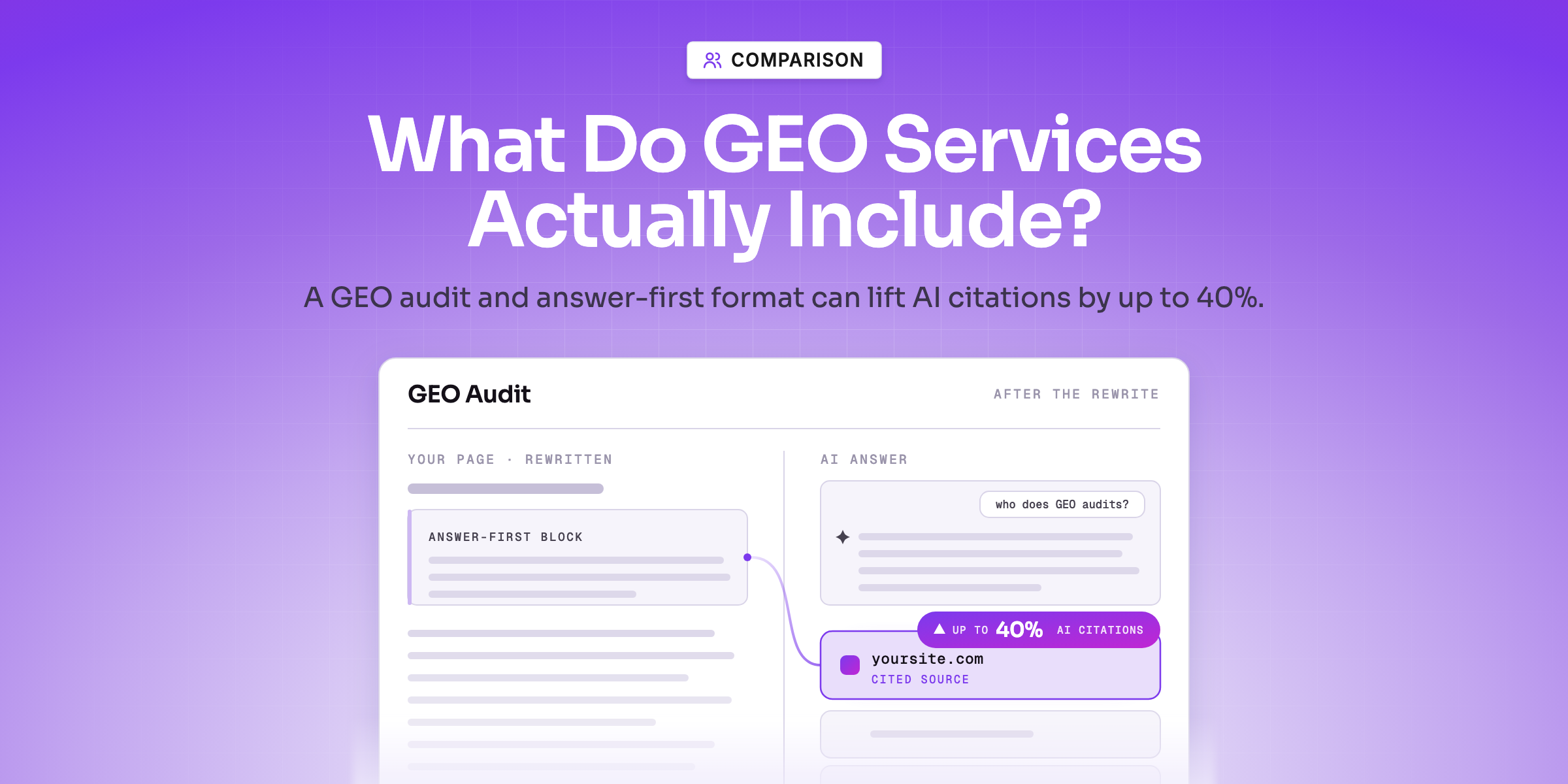
Generative engine optimization services make your brand a cited source inside AI answers rather than a blue link. They audit which sources ChatGPT, Gemini and Perplexity already quote in your category, then restructure your pages to qualify — answer-first formatting alone lifts citations by up to 40%.
Key highlights
- 1 What GEO actually is, in one sentence
- 2 GEO vs SEO vs AEO — what each one actually moves
- 3 Why AI answers are eating the top of your funnel
- 4 What a GEO service actually delivers
- 5 The deliverables worth paying for, and the ones that are filler
- 6 Why a ₹5L retainer costs 500x a ₹999 scan
- 7 The confidence tax nobody puts on the invoice
- 8 The five-step GEO workflow you can run yourself
- 9 How to tell whether any of it is working
- 10 When to hire a GEO agency, and when not to
What is Generative Engine Optimization (GEO)?
Generative Engine Optimization is the method for structuring your business content to appear directly within the AI-powered answer boxes of tools like ChatGPT, Gemini, and Microsoft Copilot, because that's increasingly where your customers now start their search—it’s about optimizing for the generative engine’s unique reasoning process, not just a web index.
While SEO targets traditional search engine results pages (SERPs), GEO focuses on the emerging landscape of AI search agents. The goal is not a blue link to your website but a direct citation of your product, service, or data as the AI's answer. The "service" part typically involves an agency analyzing your business, structuring your key information into a format these agents can parse, and then systematically submitting this data to be considered as a source. The fundamental difference? Traditional optimization chases clicks; generative engine optimization chases citations as the final answer.
What generative engine optimization services actually include
When you hire a firm for generative engine optimization services, you're not paying for keyword density. You're paying for a specialized research and submission process that is manual, technical, and time-consuming. A provider will typically audit your business to distill its core claims, product features, and proprietary data into structured, agent-friendly formats. They then use developer-level access or specialized platforms to submit this content for ingestion by the generative engines’ training pipelines. This is a one-to-many, non-guaranteed distribution play. The service fee, often starting at a five-figure monthly retainer for agencies pitching this, is anchored against the manual labor of this audit-submission cycle. They are selling a new kind of editorial placement service for an AI-native web.
GEO vs traditional search optimization in one sentence
Think of it as the difference between optimizing for a library's card catalog (traditional SEO) versus optimizing to be the book a scholar’s AI research assistant directly quotes in its thesis (GEO).
This shift matters because the pain point isn't just visibility—it's cost displacement. If an AI answer satisfies a customer's query without a click, you lose not just a visit but the entire downstream conversion. If your organic traffic currently drives, for example, ₹5 lakh per month in revenue, and a growing portion of those queries are being intercepted by AI, that's not a vague threat—it's a quantifiable leak in your revenue pipeline. The agency's solution is to sell you a service to plug that leak, often for a premium. Our data from running 263 deep business analyses in a recent three-week period shows this pattern clearly: founders are spending cycles on manual audits to understand this very risk, which is precisely the labor a generative engine optimization GEO service monetizes. The alternative isn't to ignore the shift; it's to own the audit and distribution process yourself, skipping the service fee and running your own AI search radar.
GEO vs SEO vs AEO: Understanding the Differences

Let's cut through the alphabet soup. SEO, AEO, and GEO are all about getting found, but they target different search engines and, more importantly, different user intents. The cost of getting this wrong isn't abstract—it's the difference between paying for a service that chases last decade's traffic and one that builds a moat for where queries are headed.
Here’s the breakdown:
| SEO (Search Engine Optimization) | AEO (Answer Engine Optimization) | GEO (Generative Engine Optimization) | |
|---|---|---|---|
| Target | Google, Bing (traditional SERPs) | Google's "Featured Snippet" & "People Also Ask" | ChatGPT, Gemini, Copilot, Perplexity |
| Goal | Rank in the top 10 blue links | Own the "position zero" answer box | Be cited as a source in the AI's generated answer |
| Content Shape | Comprehensive page, often long-form | Concise, direct answer to a specific question | Authoritative, credible source material for synthesis |
| Success Metric | Organic traffic, clicks | Impression share for the snippet | Citations, attributed quotes, brand as a source |
What SEO Still Does That GEO Doesn't
SEO is your foundation for transactional and commercial intent. When someone types "best CRM software India price," they're in buying mode, and they're likely still clicking a blue link. GEO doesn't replace this. An agency might charge ~₹50k/month to chase these high-intent keywords because they directly convert. GEO, for now, is terrible at driving that "buy now" click—it's about building top-of-funnel authority and being the source the AI trusts before the user even knows what to search for commercially.
What AEO Adds on Top of GEO
Think of AEO as a hybrid. It targets Google's answer boxes, which are themselves a primitive form of generative output. The tactic is similar to GEO—structure content for direct answers—but the battlefield is different. Winning the snippet often means aggressively targeting "how to" and "what is" queries on your own site. The key distinction? AEO is about owning a single, definitive answer. GEO is about being a trusted ingredient in a longer, synthesized AI response that could answer a complex, multi-part query. You're not giving the final answer; you're providing the evidence that makes the final answer credible.
And here’s the critical GEO insight: most of the web isn't credible enough to be that evidence. In our own analysis of over 158,000 sources that our agents scored for credibility, 65% landed in the lowest tier. This is the hidden pain. You could be spending ~₹1-2L on an agency audit for content that an AI simply won't cite because it lacks authoritative weight. GEO isn't just about being present; it's about building the kind of cited, reference-grade content that cuts through that noise. This is where the reframe hits: instead of paying a five-figure monthly retainer for a "GEO service," you need a system—a radar—to continuously audit and upgrade your content's credibility for AI, which is exactly what a tool like DoableClaw at ₹999/month enables you to do yourself.
Why This Matters: Getting Found Where Customers Search in ChatGPT and AI Answers
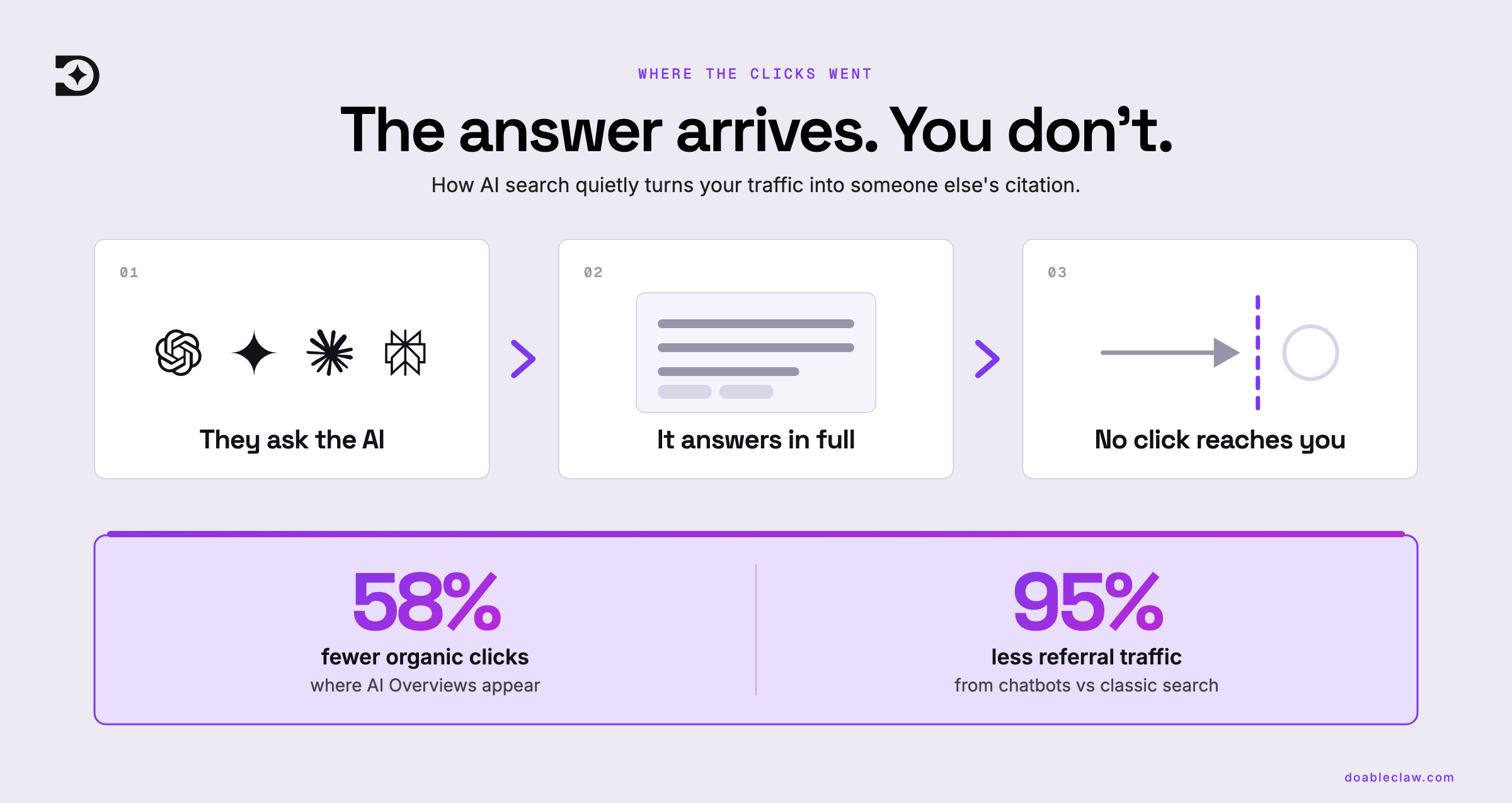
The point isn't that AI search is the future. The point is that it's already the present for a chunk of your customers, and being invisible there has a direct, calculable cost to your pipeline. You're not just missing "traffic"; you're missing the specific, high-intent conversations where buying decisions are being made.
Where buying decisions are actually happening now
Think about the last time you needed a business tool. Did you scroll through ten blue links, or did you ask ChatGPT for a "comparison of the top three CRM platforms for a small SaaS team"? That's the shift. The search is moving from a list of links to a synthesized answer. If your product isn't in that answer, you're not in the consideration set. Period.
The traffic drop is brutal. According to an analysis by Foundra, Google's AI Overviews cut organic clicks by ~58% where they appear, and chatbots send ~95% less referral traffic than classic search. That's not a hypothetical; that's a ~58% hole punched in your current acquisition channel. If your organic search drives, say, ₹5 lakh in monthly revenue, that's a ~₹2.9 lakh monthly leak you're now trying to plug with more expensive ads.
This is why the old "SEO services" playbook fails here. GEO isn't about backlinks and meta tags. It's about becoming a primary, citable source for the AI's synthesis. It's about ensuring your unique selling points, your data, and your authority are structured so the AI has to pull you into its answer. A generic agency will charge you a five-figure retainer (often ₹50k+/month) to "optimize for AI," but they're often just repackaging SEO tactics. They can't run the deep, multi-source research needed because a human analyst simply can't scale to the required depth.
DoableClaw internal data from 263 analysis runs shows what's needed: each of our AI-research runs synthesizes ~199 sources across ~12.2 categories, processed by 5 specialized agents. That's the radar sweep required to map the landscape an AI is drawing from. And crucially, our own verification layer flagged an average of ~34 claims per report as overstated or low-confidence across 115 AI-generated research runs. Blindly trusting raw AI output—or an agency's surface-level report—means building your strategy on sand.
The business cost isn't an agency fee. It's the cost of not being where your customers are asking. Skip the service fee. Run the AI Search Radar yourself, with a tool built for the depth and verification this new search reality demands.
What You Get with Generative Engine Optimization Services
When you sign a contract for generative engine optimization services, you’re buying a bundle of deliverables designed to get your facts, products, and experts surfaced in AI-powered answers. Understanding the package—and the bill—means looking past the jargon at what you’ll actually hold in your hands.
Typical deliverables in a GEO services package
The service layer is built on a few core outputs. This isn't magic; it's a process you can audit.
The AI Search Audit: This is the foundational report. A good one doesn't just list your current web rankings; it simulates how major AI models (think ChatGPT, Gemini, Perplexity) perceive your business. It answers: What questions should your business answer? What entities (your product categories, key people, core methodologies) are you currently linked to, and which are you missing? The goal is a gap analysis between where AI search is looking and where you're currently visible. Without this, you're optimizing blind.
The Entity & Citation Map: GEO is less about keywords and more about authoritative mentions. This deliverable is a living spreadsheet. It maps the key entities in your space (competitors, industry bodies, publications, technical terms) and outlines a plan to get your brand cited alongside them in reputable sources. This could mean getting listed in relevant AI-indexed directories, contributing to industry reports, or securing expert quotes in trade publications. Each citation acts as a vote of confidence for the AI.
Content Strategy for AI Referrals: Forget generic blog posts. This is a targeted playbook for creating "source material" that AI models will want to cite. It specifies the formats (comprehensive guides, data-driven industry reports, transparent pricing pages), the factual tone, and the specific data points (prices, specs, case study results) that need to be embedded and structured clearly on your site. The focus is on becoming the definitive, linkable source for the questions your customers are asking AI.
Performance Tracking & Reporting: You'll get a dashboard or monthly report tracking not just website traffic, but "AI visibility." This might include tracking your brand's appearance in AI answer snippets, monitoring referral traffic from AI platforms (which, as Foundra notes, is currently ~95% less than classic search but is the new frontier), and measuring conversions from those specific channels. The stark reality from data like Foundra's—that Google's AI Overviews can cut organic clicks by ~58% where they appear—is exactly why this new tracking layer is now a line item.
Where the ₹5L agency retainer actually goes
So how does a typical agency justify a retainer that can easily hit ₹5 lakh? It’s not just for the PDFs. The fee covers the human machinery to execute that map.
- The Analyst Hours: A human has to run those initial audits, interpret the data, and build the strategy. At an agency’s blended rate of, say, ~₹5,000/hour, even 40 hours of deep analysis and strategy work is a ~₹2L chunk. This is the "expertise tax."
- The Execution Grind: Implementing the entity map is laborious. It means outreach for citations, managing content production (often at ~₹15k-30k per deep-dive article if outsourced), and technical on-site markup. This is ongoing, retainer-based work.
- The "Trust" Premium: You're paying for the brand name and the promise of accountability. The agency becomes a single point of contact, managing the workflow across specialists you don't have to hire. For a founder, that peace of mind has a price tag, but it's often the largest component of the fee.
Here’s the operator truth they won't tell you: the core, analytical heavy-lifting—synthesizing vast information to find gaps—is now a job uniquely suited to AI, not a junior analyst. In our own runs at DoableClaw, each AI-research analysis synthesizes ~199 sources across ~12.2 categories—a depth of field a single human analyst, working on a retainer clock, rarely matches. Furthermore, this research is run through 5 specialized agents (for company, market, competitors, etc.), each checking the other. But raw AI output isn't gospel. Across 115 of our own AI-generated research reports, our verification layer flagged an average of ~34 claims per report as overstated or low-confidence, with some reports having up to 489 flags. This proves the necessity of a system that doesn't just generate insights, but ruthlessly fact-checks them against itself.
That's the reframe: the expensive part of a GEO service is the cognitive labor of research and synthesis. If you can get that depth of analysis without the retainer clock—through a system built to do exactly that, then verified—you keep the strategic insight and skip the service-fee machinery. You move from buying a black-box service to running your own AI search radar.
Skip the Service Fee: Run the AI Search Radar Instead

The pitch from a Generative Engine Optimization agency is simple: they’ll handle the complexity of AI search for you. The reality is simpler: they’ll run a process you can run yourself, then bill you for months of their labor. That process is the AI Search Radar—a systematic scan of how AI models see your market, your competitors, and your own content. Agencies package this as proprietary magic and attach a five or six-figure retainer. We’ve built it into a ₹999 tool.
What the AI Search Radar Checks That Agencies Charge For
An agency’s "discovery phase" or "competitive landscape audit" is just the Radar. They’re checking the same things any founder needs to know:
- Query Intent Mapping: What are people actually asking AI tools in your space? Not just keywords, but the full-sentence, problem-oriented prompts that trigger answers.
- Source Visibility: Which websites, reports, and tools do models like ChatGPT or Gemini consistently cite as authoritative sources for those queries? If it’s never your site, you’re invisible.
- Claim Saturation: What specific facts, data points, and opinions are being repeated across AI answers? This shows you what the consensus narrative is—and where there might be gaps or outdated information you can correct.
- Competitor Footprint: How are your direct rivals (and adjacent players) being represented? Are they cited as solutions, or are their weaknesses highlighted?
The output isn’t a vague strategy deck. It’s a concrete map: "For the top 5 customer jobs-to-be-done in our category, the AI cites Competitor A for speed, Blog B for cost-analysis, but has zero mention of modern security protocols—a hole we can fill."
The agency sells this map as weeks of expert labor. But the labor is largely automated. DoableClaw internal data from 263 analyses shows one complete Radar run fires approximately 193 LLM calls and 136 tool calls—the raw compute an agency bills days of "analyst time" for. The tool does the grunt work; your job is to interpret the terrain it reveals.
₹999 Tool vs. ₹5L Agency: The Real Math
Let’s anchor with the numbers we can use: our tool is ₹999. A full-service GEO agency might charge ~₹5,00,000 for an annual retainer. Where does that ~500x price multiplier go?
- The Labor Markup: The agency isn’t paying ₹5L per engineer for API calls. They’re paying for account managers, strategy directors, and presentation designers to wrap the automated Radar output in PowerPoint. You’re funding their overhead, not their tech.
- The Confidence Tax: This is the hidden, expensive part. Agencies present findings with absolute certainty. But AI research is notoriously brittle—models hallucinate, sources conflict, and a single flawed assumption can derail a strategy. DoableClaw internal data, from 3,850 flagged claims across our verification runs, shows the single most common failure mode is overstated confidence. Roughly 73% of the claims our system flagged were exactly that, and 88% of those were high-severity, meaning acting on them would waste real money. An agency has little incentive to highlight this uncertainty; it undermines their value. A tool shows you the raw data and the confidence flags, so you can pressure-test the insights yourself.
- The Dependency Lock-in: The agency model requires you to keep paying to re-run the Radar. Markets shift, AI models update, and you need fresh scans. At ~₹50k/month (a common retainer point), that’s ~₹6L a year for what becomes a recurring reporting service.
Contrast this with the outcome. The goal isn’t to "hire a GEO service." The goal is to turn AI search visibility into revenue. Take the case of Gumlet, which turned ChatGPT mentions into roughly 20% of inbound revenue. They achieved that by understanding their AI search landscape, not by outsourcing it indefinitely. The Radar provides the understanding; the execution is yours.
The math isn’t about cheap vs. expensive. It’s about paying for automated computation and a clear interface (₹999) versus paying for human packaging, confidence theater, and a recurring dependency (~₹5L). For a founder, the former is a capital-efficient lever. The latter is a cost center.
Skip the service fee. Run your own AI Search Radar in DoableClaw. Get the same map, see the same gaps, and keep the leverage—and the budget—for the execution only you can do.

The GEO Workflow That Actually Works (Step by Step)
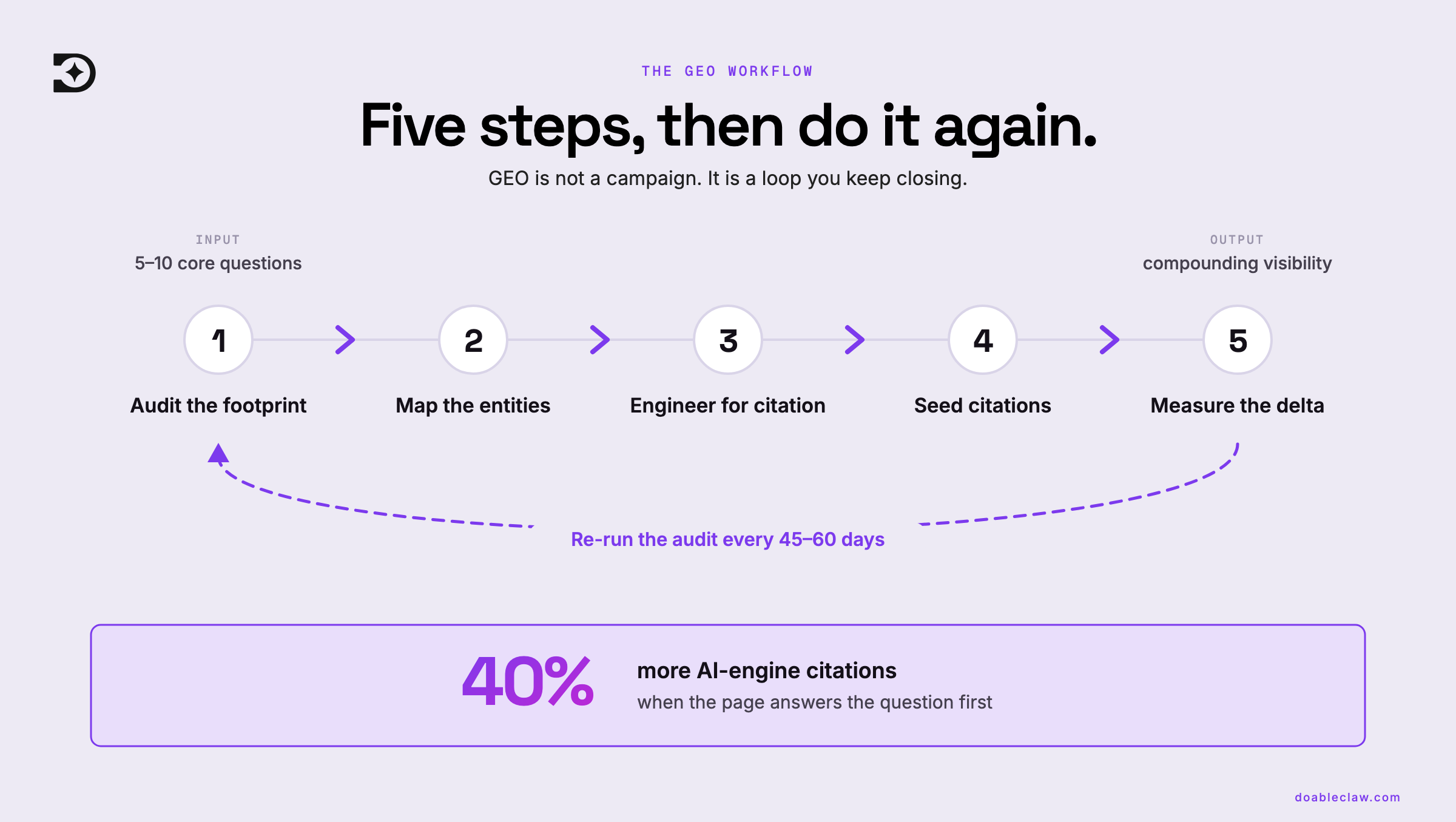
Forget the vague “strategies” sold by agencies. This is the exact, five-step workflow you run to get your brand, product, or data cited in AI answers. It’s what a ₹5L agency would do, but you’re doing it yourself with a ₹999 radar. Each step quantifies a cost you’re avoiding or a misstep you’re fixing.
1) Intake and Audit: Map Your Current AI Footprint (Cost of Blindness: ~₹50k in Wasted Content)
You don’t start by writing. You start by listening. The goal here is to answer one question: When an AI engine answers a question in my category, does it mention me? If you skip this, you’re optimizing blind—a common agency trick to bill you for “foundational research” that often costs ~₹50k and delivers a generic report.
The Action:
- Pick Your Battleground: Choose 5-10 core customer questions. Not keywords—questions. “What is the best CRM for a small SaaS?” not “CRM software.”
- Run the Queries: Plug each question into ChatGPT, Gemini, Perplexity, and Bing Copilot. Use fresh sessions to avoid personalization bias.
- Audit the Answers: For each answer, note: Are you cited? Who is cited? What sources are linked? What’s the tone and structure?
- Gap Analysis: This is your “AI SERP.” If you’re absent, you have a visibility gap. If a competitor is consistently cited, they own that mental real estate. The cost of that gap isn’t abstract—if that answer drives even 10 qualified leads a month and your close rate is 20%, that’s a recurring revenue leak you can now quantify.
Use a fresh incognito session for every query. Personalisation shows you an answer tuned to your own history, not the one a stranger sees — and only the stranger's answer matters.
This audit becomes your baseline. Every future effort is measured against it.
2) Topic + Entity Map: Become an Authority, Not Just a Mention (Cost of Scattershot Work: ~₹20k/Month in Ineffective SEO)
SEO chases keywords. GEO chases entities and topics. An AI engine needs to understand what you are and why you’re authoritative on a specific subject. Scattershot blogging on “topical clusters” might run you ~₹20k/month in content costs without moving the needle in AI.
The Action:
- Extract Entities: From your audit, list every company, product, person, and concept the AI cites. You’re reverse-engineering the knowledge graph.
- Define Your Entity: What are you? A “CRM,” a “project management tool,” a “financial API platform”? Be specific.
- Map Your Authority Topics: Under your core entity, list the 3-5 sub-topics you must own. For a CRM, that’s “lead scoring models,” “sales pipeline automation,” “email integration benchmarks.”
- Create a Bridge Document: A simple spreadsheet linking each target customer question to your core entity and your chosen authority topics. This is your content compass. It prevents you from writing a generic “guide to sales” and instead forces a targeted “how lead scoring models in [Your CRM] increase conversion by X%.”
3) Page Optimization + Structured Content: Engineer for Citation, Not Just Clicks (Cost of Unstructured Content: ~₹15-30k/Page in Missed Opportunity)
A blog post optimized for human skimming often fails with AI. AI engines look for clear, direct, and well-structured answers. The KDD 2024 "GEO: Generative Engine Optimization" study found that using an answer-first format (roughly 75–150 words) can lift AI-engine citations by up to 40%. That’s a massive leverage point most agencies don’t operationalize.
The Action (per target page):
- Lead with the Answer: The first 150 words must directly, clearly, and comprehensively answer the target question. No fluff, no “in today’s world.” State facts, definitions, and comparisons.
- Structure with Headers for Scraping: Use H2/H3 tags not just for readability, but as clear labels for information blocks (e.g., H2: “Key Features of Modern CRMs”, H3: “Automated Lead Scoring”).
- Data > Adjectives: Replace “powerful integration” with “integrates with over 300 tools via Zapier, including Slack and Gmail.” AI prefers concrete attributes.
- Update Your Existing Library: Apply this format to your top 5-10 existing pages that match your authority topics. The ROI here is high—you’re repurposing sunk cost into AI visibility.
4) Digital PR + Citations: Seed Your Entity in the Wild (Cost of Isolation: The Permanent ₹0 Link Profile)
If your website is an island in the data ocean, AI won’t find it. You need other authoritative sources to vouch for your entity. This isn’t about spammy backlinks; it’s about earning citations in contexts AI trusts. A bare-bones “link-building” retainer can easily run ₹40k+/month with murky results.
The Action:
- Target Publisher Contexts: Don’t just chase any link. Target mentions in: industry reports (G2, Capterra), reputable news articles covering your space, open-source project docs (if you’re a tool), and academic or professional forum citations.
- Create Citable Assets: This is why your structured content matters. A clear comparison table, a benchmark report, a standardized definition—these are things editors and community members will reference and link to.
- Execute the “Mention Swap”: Proactively reach out to non-competing companies mentioned alongside you in your audit. Propose a co-authored benchmark report or a mutual interview. This builds your entity’s relational standing in the knowledge graph.
- Track Citations, Not Just Links: Use alerts for your brand, product names, and key executives. A citation without a link (a mere mention in a Forbes article) still strengthens your entity’s authority to an AI.
5) Measure, Improve, Repeat: Close the Loop with Confidence, Not Guesswork (Cost of Vanity Metrics: The Endless ₹5L Retainer)
Agencies love vanity metrics. Your job is to measure citation velocity. This step turns a one-time project into a compounding system.
The Action:
- Re-Run Your Original Audit: Every 45-60 days, take your list of 5-10 core questions and query the AI engines again.
- Track the Delta: Are you now cited? Are you cited more prominently? Have you displaced a competitor? This is your primary KPI.
- Embrace Probabilistic Confidence: This isn’t binary. Our own data from running this process underscores this. Across 3,592 category-level research briefs, the average research-confidence score was 3.02 out of 5. This means you get solid coverage and direction, not absolute certainty—which is exactly why a human founder reviewing the radar and making judgment calls is irreplaceable. You’re not on autopilot; you’re making informed bets.
- Iterate: Based on the results, double down on what’s working. If a particular topic is getting you cited, create more depth there. If a certain content format (e.g., comparison tables) is consistently picked up, produce more of that format.
- Calculate the Avoided Cost: Each cycle, quantify it. If you’re now cited for a question that drives an estimated ₹2L/month in pipeline, you’ve captured value. If you’re doing this with a ₹999 tool instead of a ₹5L agency retainer, you know your exact ROI.
This workflow isn’t magic. It’s a systematic, repeatable engineering process. The “service” is just someone else running these steps for you at a 500x markup. Skip the fee. Run the radar.
Choosing a Generative Engine Optimization Company or Agency (and When Not To)
An agency that will not show you the raw scan behind its recommendations is selling you the report, not the visibility. Ask to see the source list before you sign anything.
You’re looking at this section because you’ve decided GEO matters, but you’re weighing the “service fee” against the DIY path. Let’s break down what you’re actually buying and when it makes sense to write the cheque.
What leading generative engine optimization services for AI products offer
A generative engine optimization agency sells you a process. Typically, it’s a packaged version of this: they’ll audit your content against AI search patterns, rewrite key assets for “authoritativeness” and “comprehensiveness” (the big AI ranking signals), and maybe run some prompt-based ranking tests. The promise is visibility in ChatGPT, Perplexity, or Gemini answers.
The value proposition from leading generative engine optimization services in the AI industry hinges on two things: their proprietary tooling for scanning the AI search landscape (their “radar”) and the manpower to execute the tedious rewrite-and-test cycles. For a B2B platform, the payoff can be real. One case study from HumanReach.ai showed they generated about +18 qualified leads per month from ChatGPT after optimization. That’s the kind of concrete outcome they’ll sell you on.
Red flags in generative engine optimization companies' pitches
This is where you need operator-level scrutiny. The field is new, and many agencies are repackaging old SEO tactics with an AI buzzword glaze. Major red flags:
- Guaranteed #1 Rankings in AI Answers: Impossible. The AI’s output is non-deterministic and varies by user, session, and model version.
- Vague “AI Authority” Metrics: If they can’t concretely show you how they measure source credibility or explain their testing framework, walk away.
- Ignoring Source Quality: This is the silent killer. DoableClaw internal data (from scoring 158,102 sources for credibility) found that ~65% of the content AI models pull in lands in the lowest credibility tier. A generative engine optimization company that doesn’t first diagnose if your existing content is in that weak 65% pool is building on sand. They might just be adding fluff to garbage.
The comparison: Agency vs. DIY Platform
When does each model make financial sense?
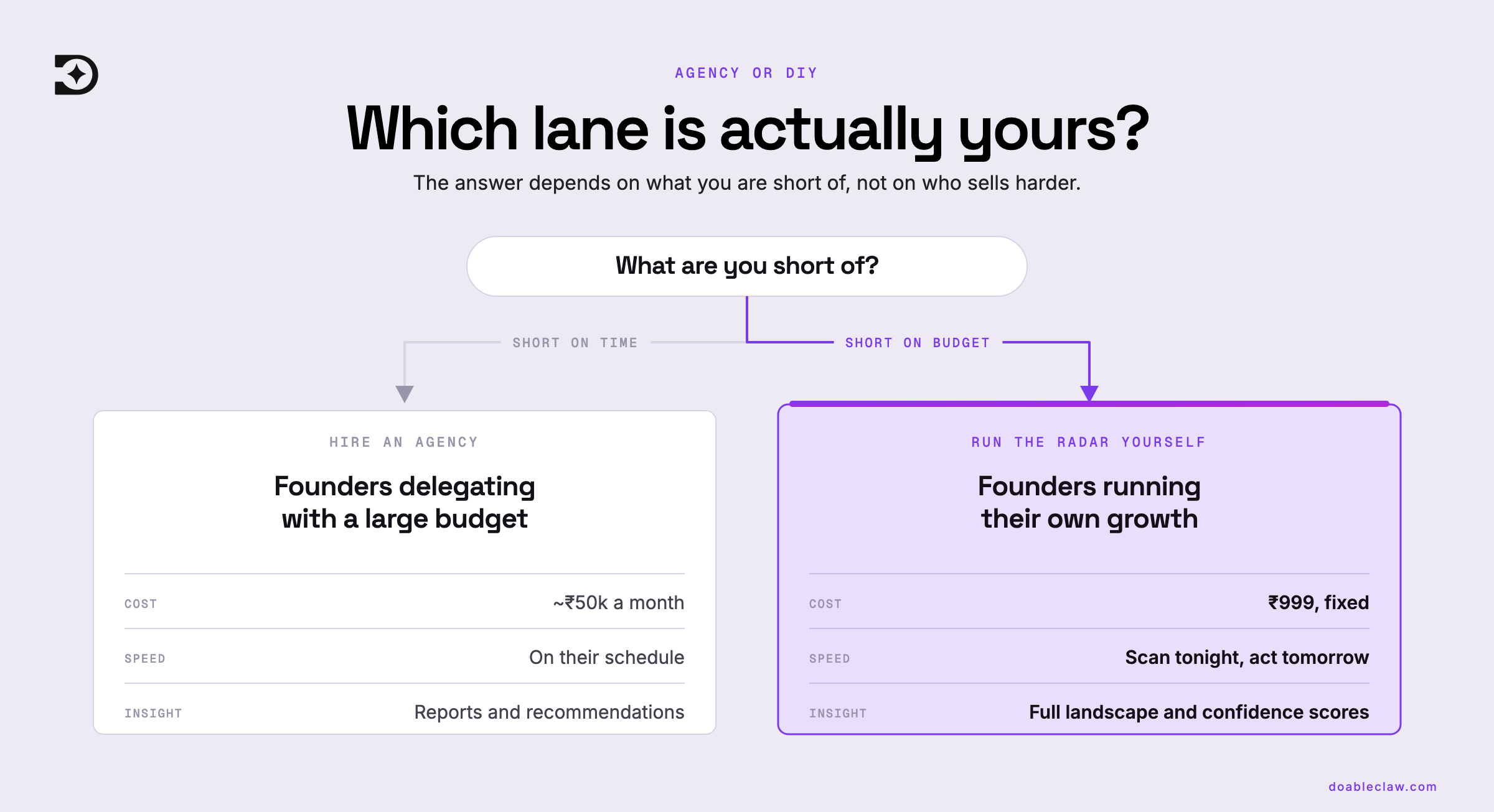
| Consideration | Generative Engine Optimization Agency (The Service Fee) | DIY Platform (The AI Search Radar) |
|---|---|---|
| Cost | Typically a 5-figure project fee or a retainer often starting at ~₹50k/month. You’re paying for their team’s time and overhead. | A fixed, low tool cost. DoableClaw, for instance, is ₹999. You pay for the radar, not the pilot. |
| Control & Speed | You’re on their schedule. Request a change, wait for the next sprint. | You run the scan tonight. You see a gap, you patch it in your CMS tomorrow. |
| Depth of Insight | You get reports and recommendations. The “how” and raw data often stays with them. | You see the full landscape—the weak sources, the competitor gaps, the exact credibility scores—yourself. The insight is transferred to you. |
| Best For | Founders with a consistent ~₹5L+ marketing budget who need to delegate entirely and for whom time is a scarcer resource than capital. | Founders doing their own growth, where capital efficiency is critical and you need to own the strategic insight, not just outsource it. |
When not to hire a generative engine optimization company
Don’t hire an agency if your content foundation is weak. Throwing ~₹1.5L at an audit and rewrite when 65% of your source material is low-credibility is a poor ROI. Fix the foundation first.
Don’t hire one if you, as the founder, don’t yet understand the core mechanism of how your customer uses AI to search for your solution. You’ll overpay for the education.
The pivot is here: skip the service fee, run the AI search radar. The “radar”—the tool that shows you the landscape—is what you actually need. The rest is execution, which you can do once you have the map. The leading generative engine optimization services for AI products sell you the mapped route and the driver. If you can drive, you just need the map.
Key takeaways
- Audit before you write — find out who AI already cites in your category
- Map entities and topics, not keywords; AI needs to know what you are
- Lead every page with the answer in the first 150 words
- Earn citations off-site, where the models actually read
- Re-scan on a schedule; a citation you won once is not a citation you keep
Conclusion
Before you brief an agency, run the audit yourself. Pick five questions your buyers actually ask, put each into ChatGPT, Gemini and Perplexity in a fresh session, and write down who gets cited. If your name isn't there, you have a gap you can finally measure — and you found it in an afternoon, not a quarter. Run the AI Search Radar if you want the same map in one pass. Then decide what's worth outsourcing.
People Also Ask About Generative Engine Optimization
How does generative engine optimization (GEO) rewrite the rules of search?
How does generative engine optimization work?
How do you implement generative engine optimization?
How do you measure generative engine optimization?
How do you improve generative engine optimization?
How does generative AI assist in search engine optimization?
How do you do generative engine optimization?
Find the exact growth leak in your business — in 2 minutes.
Paste your URL. Our AI agent crawls your site, diagnoses what's broken, and ships a step-by-step fix plan. Free, no signup.
Run free audit