voices quoted
Quoted in this piece
Why ChatGPT Doesn't Know You When Google Ranks You
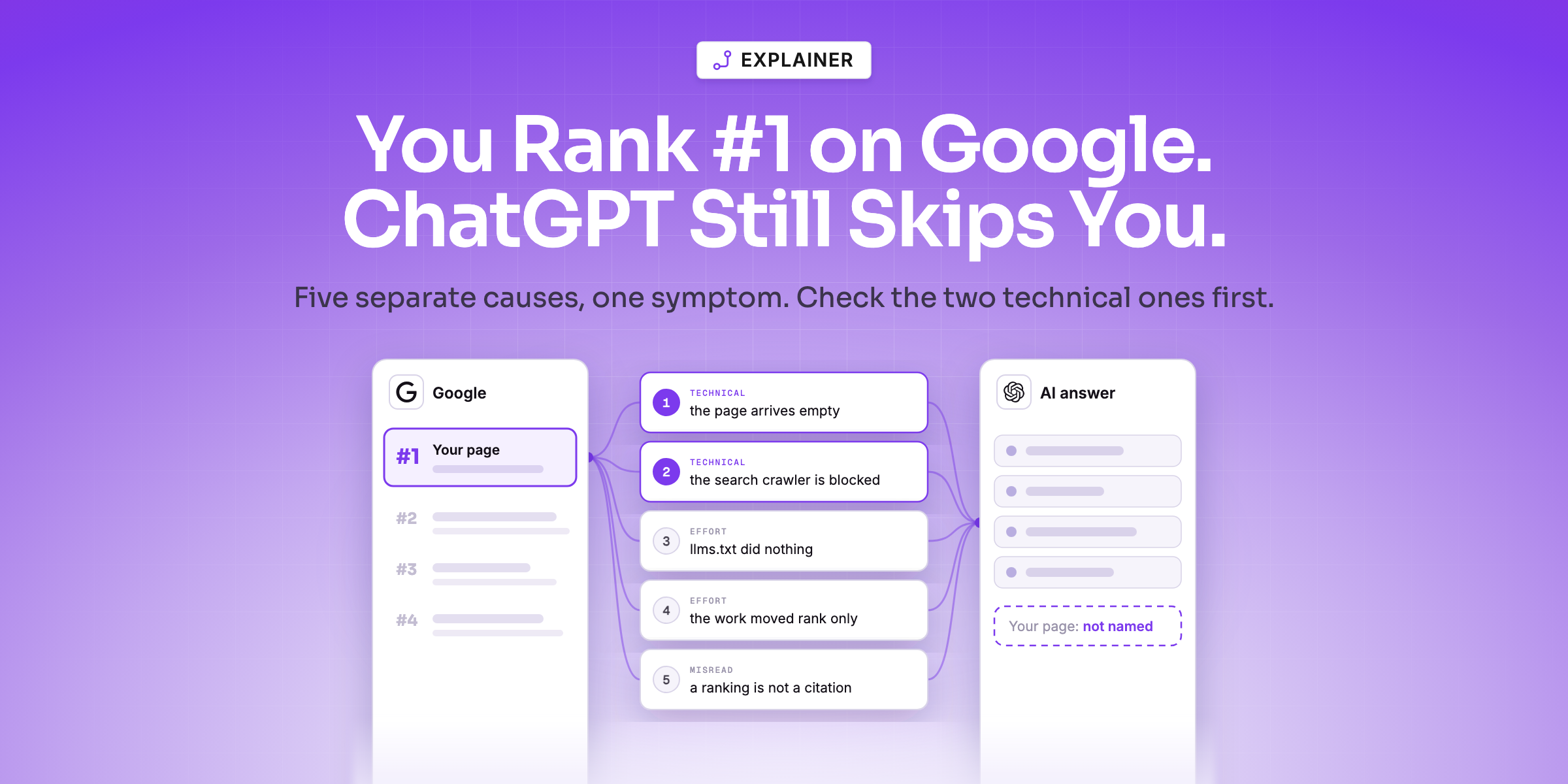
You rank on Google but ChatGPT never names you. Five separate causes produce that one symptom. Here is how far each is established, and what to check first.

The short version
If you rank on Google but ChatGPT never names you, there are at least five separate causes, and the fix for one does nothing for the others. The fetcher may receive an empty page, a crawler may be blocked in robots.txt or at your CDN, effort may have gone into llms.txt or ranking work that never reaches the page's content, or the ranking simply did not become a citation. Check the two technical causes first, because they are free, take minutes and invalidate everything downstream.
Key highlights
- 1 Ranking first and being cited are different events; the #1 result was cited in 14 of 23 AI Overviews we counted
- 2 Ranking is a comparison between pages; citation is a read of one page
- 3 A single-page app can send AI fetchers an empty shell while ranking fine on Google
- 4 One curl command shows whether your headline and content are in the raw response
- 5 Blocking GPTBot does not block ChatGPT search; OAI-SearchBot does that job
- 6 A CDN or firewall rule can refuse crawlers before robots.txt is ever read
- 7 Two vendor studies found llms.txt does nothing measurable for AI citation
- 8 Link volume and rank tracking move standing, not the document a model reads
- 9 Check in order: readability, access, baseline, then how your work is sorted
- 10 How common each cause is, and how fast a fix shows up, is still unknown
You rank on page one. Buyers find you on Google. Then someone asks ChatGPT the same question, and the answer names four companies that are not you.
The instinct is to treat that as one problem with one fix, usually "more content". It is rarely one problem. There are at least five separate causes that produce exactly the same symptom, they sit in different parts of your stack, and the fix for one does nothing for the others.
This page is current as of 14 September 2026. Each section below is one cause, and each one says how far it is actually established:
| The cause | Where it stands |
|---|---|
| ranking first is not the same event as being cited | Observed, including in our own count of 23 AI Overviews |
| the fetcher cannot read your page | Checkable on your own page in ten seconds; no trusted figure for how common it is |
| you blocked the crawler that feeds search | Settled in mechanism; one public count says it is rarer than people claim |
| llms.txt was expected to help | Observed at scale by two vendor studies that agree |
| the SEO work you funded does not carry | Settled in mechanism, argued in practice |
Two of those are technical and pass or fail. Two are about what you spent time on. One is a misunderstanding of what a ranking ever promised. The order you check them in matters more than any of them individually.
Ranking First is Not Being Cited
Start with the assumption underneath the question. A Google ranking and a citation inside a generated answer are related, but they are not the same event, and neither one guarantees the other.
We checked this rather than assuming it. Across 23 Google AI Overviews on 4 September 2026, the page ranked first organically was cited in 14 of the 23. In the other nine, the top result was on the page and missing from the answer. That is one category of searches, not the whole web, and the full method is in where ChatGPT gets its information.
Ranking is a comparison. Citation is a read. A ranking says your page won against other pages. A citation depends on whether the specific sentence a model needs is present in the page it retrieved, stated plainly, with evidence beside it.
So a strong ranking is real evidence of one thing and weak evidence of the other. The four causes below are the most common reasons the gap between the two is wider than it should be.
The Fetcher Cannot Read Your Page
This is the one to rule out first, because when it applies nothing else on this page can work.
A browser requests your page, receives a small file, runs the JavaScript in it, and assembles what you see. Many sites built as single-page apps send almost nothing in that first response:
When Google crawls my site, this is literally all it sees: <div id="root"></div> <script src="/assets/index.js"></script> […] the title, description, page content only appears after JavaScript runs in the browser. It indexes the empty shell and moves on.
Google runs a second pass and comes back to render pages like that, which is why they can still rank. The AI fetchers are not documented as doing the same, and the widely reported behaviour is that they take the first response and move on.
We are deliberately not putting a number on how many AI fetches run JavaScript. The figures that circulate do not trace to a study we have read, and you do not need one, because you can check your own page:
curl -s https://yoursite.com/your-page | less- Search the output for your headline. If the exact words are not there, they were not sent.
- Search for a distinctive sentence from the body. Same test, for the content a model would lift.
- Search for
application/ld+json. Structured data injected by a tag manager passes every validator and is absent here. - Check a deep page, not just the homepage. Many sites render landing pages properly and load the blog or docs in the browser.
The gap is silent. Your browser, your schema validator and Search Console all render the page first, so every tool you would normally check with reports that it is fine.
You Blocked the Crawler That Feeds Search
The second technical cause is access. An AI company typically runs more than one crawler, and they do different jobs:
GPTBot is training. That's the whole job. It collects stuff that might get used to train the models, and blocking it changes nothing about whether you turn up inside ChatGPT. OAI-SearchBot is the one feeding ChatGPT search.
| The agent | What it is for | What blocking it costs you |
|---|---|---|
| the training crawler | collecting material that may train future models | nothing about appearing in search answers |
| the search crawler | building the index behind the assistant's search | whether you can appear in those answers |
| the live fetcher | fetching a page because a person just asked | a page that cannot be read at the moment it was wanted |
The expensive mistake is blocking the middle row. It is worth saying that this happens less than the advice suggests: one operator who pulled robots.txt files from 109 well-known sites found that none had blocked the search crawler by accident while meaning to block training. One sample, not a census, but a useful check on the confident warnings.
The more common version of this cause is not in the file at all. A managed bot rule, firewall setting or security product at the edge can refuse crawlers before the request ever reaches robots.txt:
Our robots.txt allowed every AI crawler explicitly, by name but still had crawler issues. Cloudflare's managed AI-bot setting was returning a 403 at the edge, before anything reached the file. Ran like that for weeks in June. Nothing errored and nothing alerted and there's no gap in analytics to spot it because a crawler that gets turned away doesn't show up as anything at all. It just looks like a quiet month.
- Fetch your live robots.txt over the public internet, not the copy in your repository.
- Request a normal page with a crawler user agent from outside your network, and confirm you get a 200 rather than a challenge.
The full roster, and why the user agent in your log is not proof of who visited, is in which bot is which.

You Shipped Llms.txt, and Nothing Changed
This one is not a fault in your site. It is a recommendation that did not survive contact with the evidence.
Ahrefs analysed server logs across 137,000 domains and reported that 97% of published llms.txt files received zero fetches in the month measured. SE Ranking, looking at 300,000 domains, reported no measurable impact on how AI systems see or cite content. Both are vendor studies, neither has been replicated by a disinterested party, and they agree with each other.
If your own logs show requests for the file, read the user agent before celebrating. A separate 30-day audit of a thousand domains' CDN logs found no LLM-specific bots requesting it at all. The traffic came from Google's general crawler, which probes most root paths, and from SEO and AEO tools checking whether sites had followed the advice to add it.
- The file is harmless. It costs almost nothing to leave in place.
- It is not AI visibility work. Nothing measured it working, so it does not belong on a report as delivered effort.
- The time it absorbed is the real cost, because it felt like progress on the wrong layer.
Where the advice came from, and what to do with the file now, is in does llms.txt do anything.
You Did SEO, and That Was the Wrong Work for This
The last cause is the uncomfortable one for anyone who paid for a ranking. Most SEO work still works; a large share of it simply operates on the comparison between pages, and that comparison is finished by the time a model is reading yours.
One question sorts any tactic: does it change the document a fetcher reads, or only its standing against other documents?
- Link volume, keyword placement and rank tracking move standing. Keep them for the traffic they bring.
- Answering the question plainly and early changes the document, and pays on both surfaces.
- Evidence placed next to the claim changes the document, and is what a model checks before quoting.
- Content present in the raw response is the precondition for all of it, which is why the first technical check comes first.
The argument in full, with the tactics sorted into what carries over and what does not, is in does SEO still work for AI search.
Which Cause to Check First
The causes are not equally cheap to rule out, and the cheap ones invalidate the expensive ones. Work down the list and stop when one fails.
| Order | The check | Time | If it fails |
|---|---|---|---|
| 1 | fetch a content page without a browser | ten seconds | nothing downstream can work until this is fixed |
| 2 | fetch robots.txt live, then a page with a crawler user agent | two minutes | the crawler is being turned away |
| 3 | take a dated baseline of where you are named | an afternoon | you learn who is named instead of you |
| 4 | sort your current work by document or standing | twenty minutes | the effort was aimed at the comparison |
Read the table from the top. A rewrite aimed at a page that arrives empty changes nothing, and a baseline taken while the edge is blocking crawlers measures the block rather than your content.
Step three is a measurement question rather than a cause, and it has its own guide: how to check whether AI mentions your brand.
What Nobody Can Tell You Yet
Three things on this page have no defensible answer, including from us.
- How common each cause is. There is no representative count of how many ranking sites fail the rendering check or the access check. One public robots.txt sample exists, and it is small.
- What share of AI fetches run JavaScript. Figures circulate; none that we can trace to a study we have read.
- Whether fixing a cause produces a citation, and how soon. Removing a blocker makes appearing possible. It does not make it happen, and no one has published a controlled test of the timing.
Any supplier who answers all three confidently is telling you more than the evidence allows.
Conclusion
Do not start with more content. Fetch a page without a browser, confirm crawlers can reach you from outside your network, and only then take a baseline of where you are named. If the technical checks pass, sort your existing work by whether it changes the document or only its standing, and treat llms.txt as harmless rather than as progress.
Why ChatGPT Doesn't Know Your Brand: Frequently Asked Questions
Why does ChatGPT not mention my brand when I rank on Google?
Do AI crawlers run JavaScript?
Does blocking GPTBot keep me out of ChatGPT answers?
Can my CDN block AI crawlers without me knowing?
Is this a content problem or a technical problem?
What should I check first?
Find the exact growth leak in your business — in 2 minutes.
Paste your URL. Our AI agent crawls your site, diagnoses what's broken, and ships a step-by-step fix plan. Free, no signup.
Run free audit