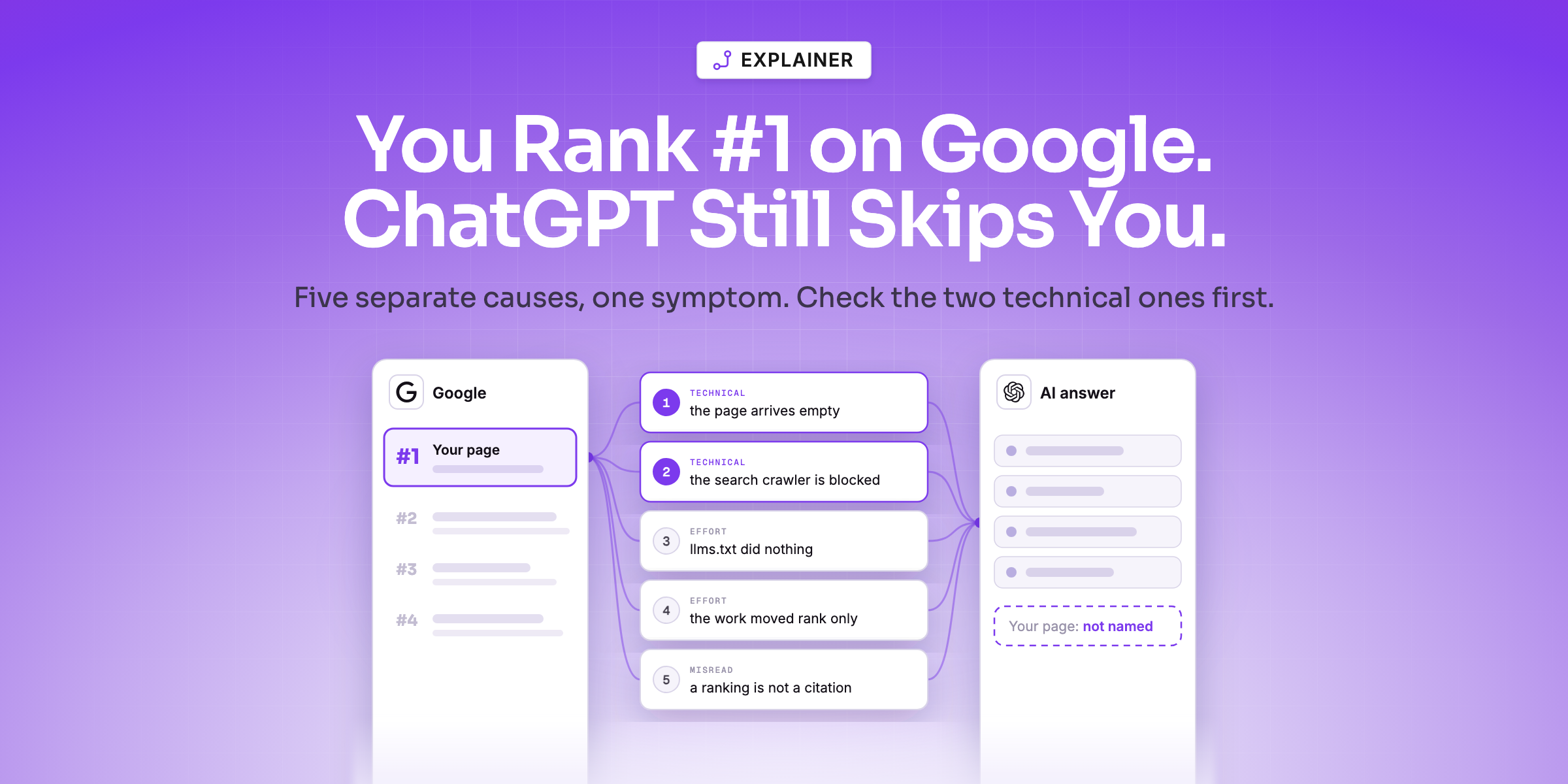
voices quoted
Quoted in this piece
Is AEO Worth Paying For? Three Questions That Decide
Is AEO worth paying for? A three-condition test that says no for a local coffee shop and yes for a B2B supplier, plus the free fixes to make before paying.

The short version
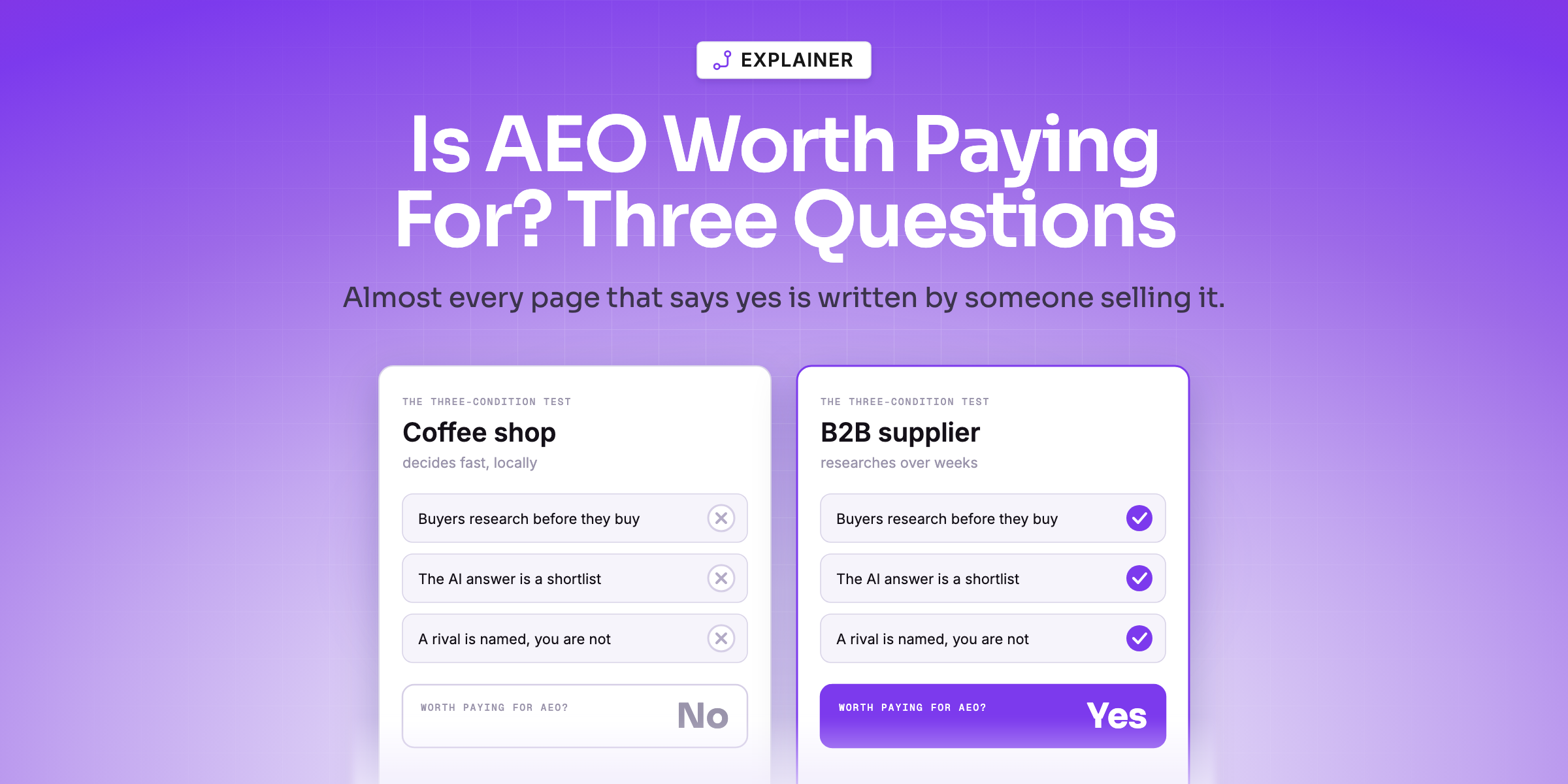
AEO is worth paying for only when three things are true: your buyers research before they buy, models answer your category with a shortlist of companies, and you can name a question where a competitor is named and you are not. A coffee shop being upsold AEO fails the first test; a B2B supplier often passes all three. Fix crawler access and robots.txt first, because both are free. Then buy in order: technical work, then content, then monitoring.
Key highlights
- 1 A local coffee shop being upsold AEO is the common case, and the answer is no
- 2 A B2B supplier whose buyers research with AI is the clear yes
- 3 The deciding factor is how your buyer decides, not company size
- 4 Check crawler access and robots.txt first; both fixes are free
- 5 AEO covers three purchases: monitoring, content retainer, technical fix
- 6 Buy technical work first, then content, then monitoring
- 7 Be wary of any promise that a named change will produce citations
- 8 Pay only if all three conditions in the test are true
- 9 Failing the test tells you where to spend instead
Every page answering this question says yes. That is worth noticing before you read another one, because almost all of them are written by people selling the service.
Here is a version with a documented no in it.
The Case Where the Answer is No
I have a coffee shop and I'm paying a marketing company to help me rank on Google. They did a good job but they've now recommended me another service that they offer which is called AEO (pretty much AI search). I haven't used such service before but I figured someone here did so please let me know if it's worth going for it or not thanks
Sixty-eight upvotes and a hundred and thirty-two replies, which tells you how many people recognised the situation.
For a coffee shop the answer is almost certainly no, and the reason is not that the service is bad. It is that nobody asks a chatbot which coffee shop to visit. They open a map, they look at the photos, they check whether it is open. The decision is local, immediate and visual, and none of that is a question a language model gets asked.
Spending on AI visibility here would be buying a channel that does not carry your buyers. The money is better spent on the map listing, the photos and the opening hours — which is unglamorous advice that no vendor is incentivised to give.
- The upsell is not dishonest. The agency sells a service and this customer is in front of them. That is how selling works.
- It is still the wrong purchase, and nobody in that commercial relationship is positioned to say so.
- This is common. Most businesses being sold this are closer to the coffee shop than to the case below.
The Case Where It is Obviously Yes
Now the opposite, and notice that this operator did not start from a tool:
We run 7 different B2B websites (furniture & interior design) and are ranking well with our main keyword. But we've just found out that our biggest competitor is pulling in more deals through ChatGPT than we through Google. That's a problem.
They started from lost deals. That is the correct entry point and it is the difference between the two cases.
A B2B furniture buyer researches for weeks before contacting anyone. They ask open questions about suppliers, capabilities and trade-offs, and they read a written answer that names a handful of companies. If yours is not one of them, you are eliminated before any conversation happens — and you will never see it, because there is no lost enquiry to count.
What Actually Separates the Two
Not company size and not budget. The shape of the purchase.
| Coffee shop | B2B supplier | |
|---|---|---|
| how the buyer decides | immediately, locally, visually | over weeks, with research |
| what they ask | "coffee near me" | "best supplier for X, given Y" |
| what the answer looks like | a map with photos | a paragraph naming three or four companies |
| is a model involved | rarely | often, early, before you hear from them |
| cost of being absent | negligible | the deal, invisibly |
The right-hand column is the whole case for this spend. Being absent from a considered purchase costs you deals you never learn about, and that invisibility is exactly why the metric is worth having.
The left-hand column is a business being sold a solution to a problem it does not have.
The awkward middle is where most businesses actually sit. A dentist, a regional accountancy firm, a mid-market SaaS with a short sales cycle — buyers who research a little, sometimes ask a model, and mostly decide on other things. For those, the answer is not no; it is "measure before you spend", and the measurement is free. Run the test below, find out whether a competitor is being named where you are not, and let that decide it rather than a proposal.
Do not let a vendor tell you which column you are in. They have a view and it is not a neutral one.
Do not assume ticket size settles it either. A high-value purchase decided on a personal referral is not an AI search problem.
The test is cheap enough to just run, which is why the rest of this page is about running it rather than about arguing over the category.
"Are my buyers researching, or deciding?" is the first question, and it settles most cases on its own.
Ticket size follows from it. A considered purchase is usually a larger one, which is what makes the spend defensible.
Local and impulse categories are largely out of scope, and saying so is not modesty. It is accuracy.
Two Things to Fix First, and Both are Free
Even in the yes case, do not spend yet. A B2B operator asks exactly the right question here:
another SEO stuff with new label slapped on. What is actually worth testing for tracking brand mentions, citations, prompts inside LLMs? Are they exist? Other important question - what would you fix in-house first before paying somebody? Entity pages, schema, comparison pages, PR mentions, Reddit/Quora, updating old content, industry citations?
That list is a content plan, and it is the second thing to do. Two checks come before all of it, both free, both settling in minutes.
- Can a crawler actually read your pages? Fetch a content page without a browser and look for your headline, your body text and your structured data in the raw response. If they are not there, they are not in what the crawler received, and no amount of content work operates until that is fixed.
- Are you blocking the wrong bot? Open your live robots.txt and check which agents are disallowed. A file blocking the search crawler while permitting the training one has the trade exactly backwards, and it is usually inherited rather than chosen.
Those crawlers are not one thing, and telling them apart changes what your file means. Both checks are free and both make every later pound measurable, because you will know the pages were reachable when you spent it.

What You are Being Sold, and What It Costs
"AEO" covers at least three different purchases at wildly different prices. Knowing which one is on the table changes whether the answer is yes.
| What is being sold | Roughly what it is | When it makes sense |
|---|---|---|
| a monitoring subscription | a dashboard reporting whether you get named | once you have your own prompt set and want the hours back |
| a content retainer | writing and restructuring pages to be citable | once you know the crawler can read you and you know which questions you lose |
| a technical fix | rendering, access, structured data in the raw HTML | first, always, and it is the cheapest of the three |
The third is usually a few days of engineering and it gates everything else. The second is where most retainers sit. The first is a tool decision and the smallest of the three cheques.
- Ask which one you are quoting for. A proposal bundling all three without separating them is hard to evaluate and easy to over-buy.
- Sequence them. Technical, then content, then monitoring — buying the dashboard first tells you a number you cannot act on.
- Be wary of the fourth thing, which is a promise that a named change will produce citations. Nobody has demonstrated that link.
The Three-condition Test
All three have to be true. Fail one and the money is better spent elsewhere.
- Your buyers research before they buy. They compare, they ask open questions, and there is a gap of days or weeks between first interest and purchase. If the decision is immediate or local, stop here.
- Your category gets answered with a shortlist, not a fact. Ask a model a real buying question in your category. If it names three or four companies, there is a position to compete for. If it returns a definition or a how-to with no vendors in it, there is nothing to win yet.
- You can name a specific question where a competitor is named and you are not. Not a suspicion. An actual question, asked, with the answer in front of you and somebody else's name in it.
The third condition is the one that makes this real, and it costs an afternoon to test. Write down ten questions a buyer would ask, run each a few times in a fresh chat, and record who gets named. If you are absent and a competitor is present, you have a documented business problem. If you are present most of the time, you have a monitoring requirement rather than a project.
- All three, or it is a maybe. Two out of three is a reason to re-test in six months, not a reason to sign.
- The test costs nothing and it is the same afternoon that produces your baseline if the answer turns out to be yes.
- Do it before the sales call, not during it. A vendor will not run condition two honestly if it disqualifies you.
If You Fail the Test
Then the answer is no, for now, and we would rather say so than take the money.
That is not a permanent verdict. Categories change as buyers change how they research, and a business that fails condition two today may pass it in a year when models start answering its questions with vendor shortlists. Re-run the three conditions in six months — it costs an afternoon.
Where the money goes better in the meantime depends on which condition you failed:
- Failed condition one — your buyers decide fast and locally. Spend on the surfaces they actually use, and on the basics of being findable and credible when they get there.
- Failed condition two — models answer your category with facts, not shortlists. Spend on the search channel that does return vendors, and keep watching.
- Failed condition three — you are already being named. You have a monitoring job, not a visibility problem. Establish a rate you can defend and watch it, rather than buying a remediation programme for something that is working.
And one honest caveat about the whole category, which applies to us as much as anyone: a supplier can measure where you stand. Nobody in this market can currently demonstrate that a specific change causes a specific citation. Buy the measurement on its merits, and treat any confident promise about moving the number as the sales claim it currently is.
Conclusion
Run the three-condition test yourself before any sales call. If your buyers decide quickly and locally, or models answer your category with facts rather than a shortlist, spend elsewhere. If all three conditions hold, fix access first, then pay for content, and buy monitoring last, once you have questions of your own to track.
Is AEO Worth Paying For: Frequently Asked Questions
Is AEO worth it for a small local business?
How do I know if AI visibility matters for my business?
My agency is recommending AEO. Should I say yes?
What should I fix myself before paying anyone?
Is AEO just SEO with a new label?
How much should AI visibility work cost?
Find the exact growth leak in your business — in 2 minutes.
Paste your URL. Our AI agent crawls your site, diagnoses what's broken, and ships a step-by-step fix plan. Free, no signup.
Run free audit