voices quoted
Quoted in this piece
What Is AEO? Answer Engine Optimization for B2B Teams (2026)
AEO, or answer engine optimization, gets your company named in ChatGPT and Google AI answers. What it is, how it works, and what B2B teams do first.

The short version
AEO, short for answer engine optimization, is the work of getting your company named inside the answers AI tools write, in ChatGPT, Gemini, Perplexity and Google's AI Overviews. SEO gets you a link on a results page. AEO gets you a mention inside the answer itself. Most of what decides that mention sits on other websites, not yours, so AEO is part writing and part showing up where AI reads. You measure it as a rate across many repeats, never as a rank. For a B2B company, it decides whether you're on the shortlist a buyer acts on.
Key highlights
- 1 AEO means answer engine optimization: getting named inside AI answers
- 2 AEO and GEO are the same idea with two names
- 3 AI tools build answers from pages they read, mostly on other websites
- 4 About 2 in 3 AI answers we collected cited a site like Reddit or YouTube
- 5 AEO builds on SEO; it doesn't replace it
- 6 For B2B teams, start with the questions buyers ask before they shortlist
- 7 Measure AEO as a rate across repeats, not a rank
- 8 Tools measure AEO; an agency or your team does the work
A buyer used to type three or four words into Google. Ten tabs later, a shortlist. Now lots of them just ask ChatGPT the full question and read whatever single answer comes back. That answer names a handful of companies. If yours isn't one of them, you're off the shortlist before anyone visits your website.
AEO is the name for doing something about that. The term gets used loosely, and a lot of what's sold under it is old SEO with a new label. So this page sticks to what AEO actually is, how AI tools pick the companies they name, and what a B2B team should do first.
What is Answer Engine Optimization (AEO)?
AEO is answer engine optimization. Plainly put, AEO is how your company ends up in the answer when someone asks an AI tool something. An "answer engine" is any tool that replies with a written answer instead of a list of links: ChatGPT, Gemini, Perplexity, Microsoft Copilot, and the AI summary Google shows above its normal results, called an AI Overview.
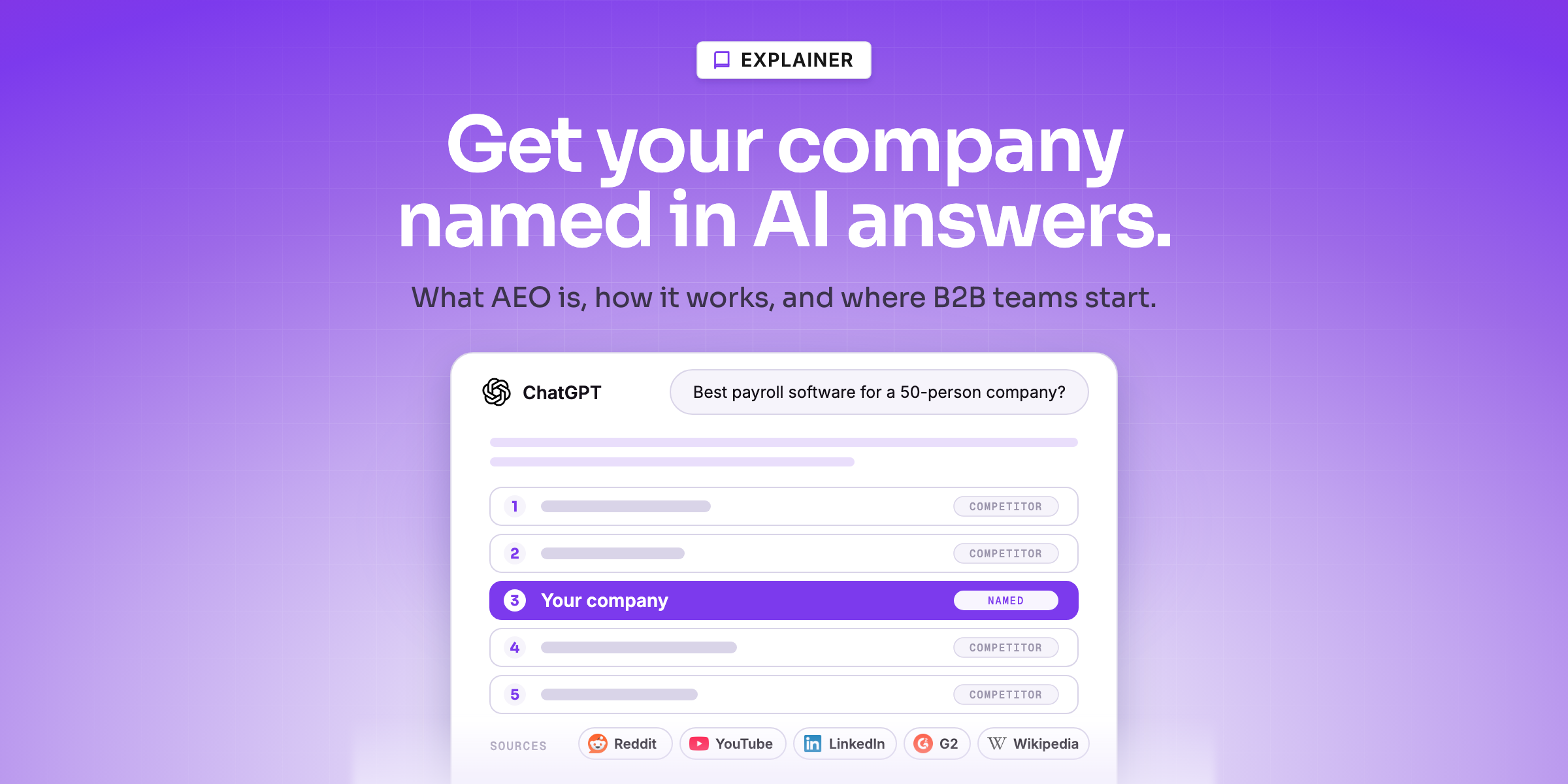
The goal is to be named. When a founder asks "which payroll software suits a 50-person company?", the AI writes a short answer and names three or four companies.
Being one of those names is called a mention. Being the source the AI links to is called a citation. AEO is the work that makes both more likely.
It matters most for B2B. Business buyers ask long, specific questions, because their situation is specific. Those are exactly the questions AI tools answer in full, so a B2B buyer often meets a shortlist in the answer before they meet a single vendor's website.
People ask this in the open all the time. This post on r/localseo drew 125 replies:
I want to understand that what is AEO and how it is works, and how to helps in Local SEO and what strategy need to implement please guide me.
What Does AEO Stand For, and is It the Same as GEO?
AEO stands for answer engine optimization. In marketing, that's the only meaning that matters. Outside marketing the letters mean other things, which is why searches for "AEO" turn up payroll and customs pages too.
GEO is the same idea. GEO stands for generative engine optimization. Some people use AEO, some use GEO, and many use both on the same page.
You'll also see AIO, which usually means optimizing for Google's AI Overviews specifically. The work underneath is the same: get named in AI answers.
If you want the full untangling of SEO, GEO, AEO and AIO, our guide to SEO vs GEO vs AEO vs AIO sorts all four into two ideas.
How Does AEO Work? How AI Tools Pick the Companies They Name
An AI tool doesn't know which company is best. It builds its answer from what has been written on the internet: articles, reviews, "best of" lists, forum threads and company websites. Some tools search the web live while answering. Others lean on what they read during training. Either way, the answer is assembled from other people's pages.
That has one big consequence. Most of what decides your mention sits off your own website.
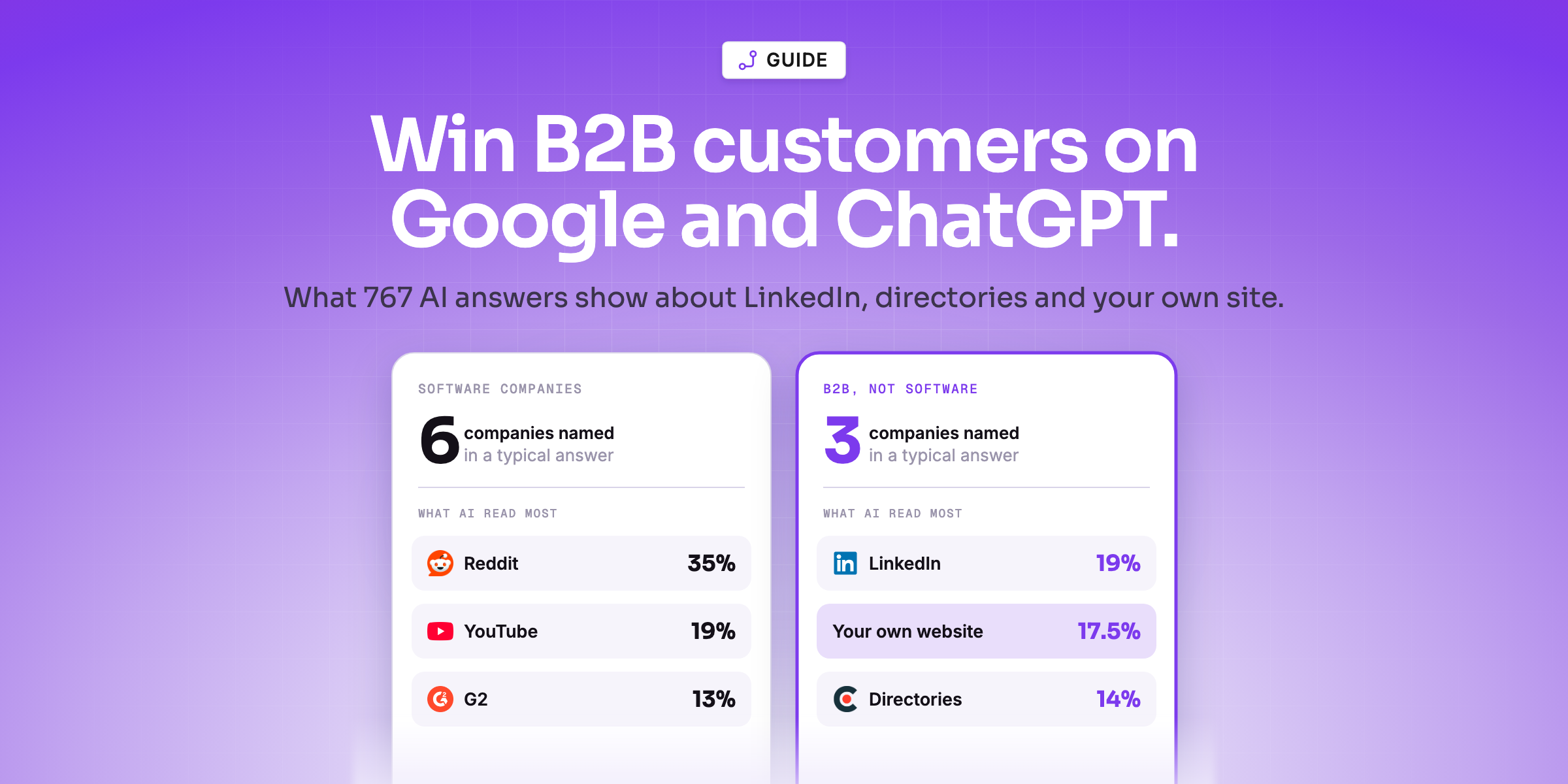
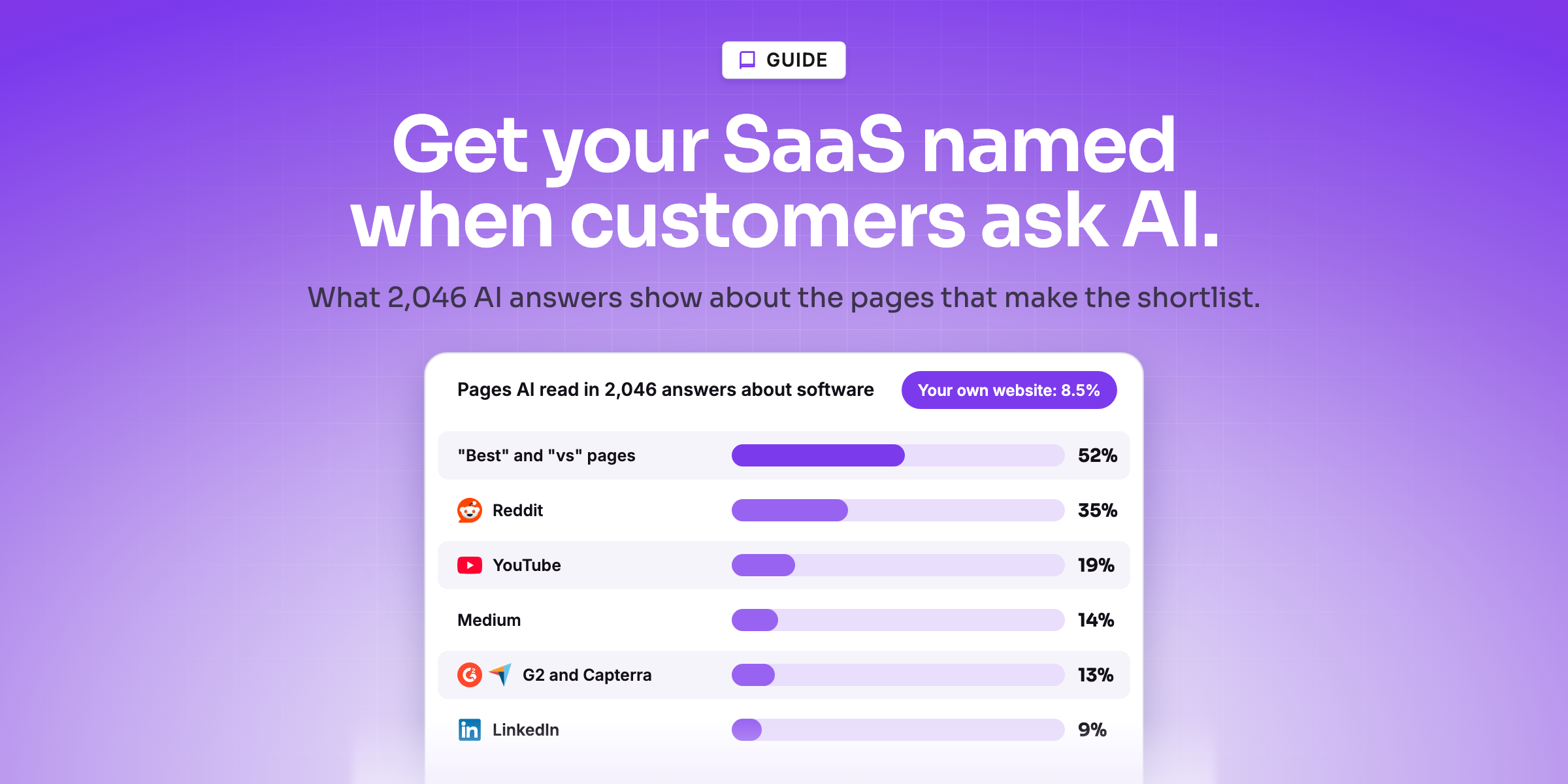
DoableClaw stores every AI answer it collects, along with the pages each answer read. Across 4,796 answers we collected for 55 companies, here's how often the AI cited an open platform, meaning a site where anyone can post:
| Open platform | Share of answers that cited it |
|---|---|
| Any open platform at all | 64% |
| 27% | |
| YouTube | 16% |
| LinkedIn posts | 9% |
We also looked at what a typical answer contains. Across 4,441 answers to buyer questions for 55 companies, collected between 26 August and 6 October 2026:
| What we checked | What we found |
|---|---|
| Companies named in one answer | 5, as the middle value |
| Answers that named 3 or more companies | 74% |
| Answers that showed the pages they used | 86% |
| Answers that cited the website of the company being asked about | 12% |
So a typical answer is a shortlist of about five companies, and about 2 in 3 answers leaned on a site where buyers and practitioners talk. Only about 1 in 8 cited the website of the company the buyer was asking about. A big company gets named often because it's written about everywhere. A smaller one gets named when its specific facts show up in the places the AI reads.
The scale is why this matters. SEO consultant Lily Ray ran the rough maths on X:
14 billion Google searches per day Let’s assume 40% of responses show an AI Overview (5.6 billion)
Her numbers are an estimate, as she says, but the order of magnitude is the point: billions of searches now end in a written answer.
The answer also changes every time you ask. In our runs, two Google AI Overview answers to the very same question named the same set of companies only 4% of the time. That's why one check proves nothing, and why AEO is measured over many repeats.
AEO vs SEO: What Changes and What Doesn't
AEO doesn't replace SEO. It sits on top of it. Practitioners are noticing that a top Google rank no longer guarantees attention, as in this LinkedIn post that drew 269 comments:
If you’re still celebrating ranking #1 on Google… You might already be invisible. Last quarter, a brand ranked #1. Traffic still dropped.
Here's the plain version:
| SEO | AEO | |
|---|---|---|
| What you're trying to win | A link on a results page | A mention inside a written answer |
| What you track | Your rank for a keyword | How often you're named across repeats |
| What decides it | Your pages, and links to them | Your pages, plus what other sites say about you |
| What still carries over | Fast, crawlable pages with clear answers | The same, because AI tools read pages too |
A page that ranks well on Google often helps with AEO too, because many AI tools search the web before they answer. But ranking first doesn't guarantee a mention. Our guide on whether SEO still works for AI search covers what carries over and what doesn't.
AEO Marketing for B2B Companies: What to Do First
You don't need a new team to start. Five steps cover most of it:
- Write down the questions buyers ask before they shortlist. Take them from sales calls, demo notes and support tickets, in the buyer's own words. "Best ERP for a 200-person manufacturer in Pune" beats "ERP software".
- Answer each one on a page of its own. Put the answer in the first lines, with specific facts: a city, a number, a named service. AI tools repeat specifics and skip praise.
- Show up where AI reads. Answer the same questions on Reddit, LinkedIn and YouTube, and get onto the "best of" lists for your category. That's where most cited pages live.
- Check first that AI tools can read your site at all. Some AI crawlers see a blank page when the content only fills in after the browser loads it.
- Check the same questions every few weeks. Keep the list fixed, so any change you see is real.
How to Measure AEO
- Count a rate, not a rank. Ask the same question several times on each AI tool and count how many answers named you. Five mentions in ten answers is a 50% rate, and that number holds up from month to month in a way a single "you're third" never does.
- Check each AI tool separately. ChatGPT, Gemini, Perplexity and Google's AI Overview read different pages, so they often name different companies. An average across all four hides where you're missing.
- Look at the pages behind the answer. A mention tells you where you stand. The pages the AI read tell you what to change.
Our guide on how to measure AI visibility walks through the method.
AEO Tools and AEO Services
AEO tools do the measuring. They ask AI tools your buyers' questions on a schedule and record who gets named. The useful ones also show the pages the AI read. Our comparison of the best AEO tools for B2B teams puts nine of them side by side.
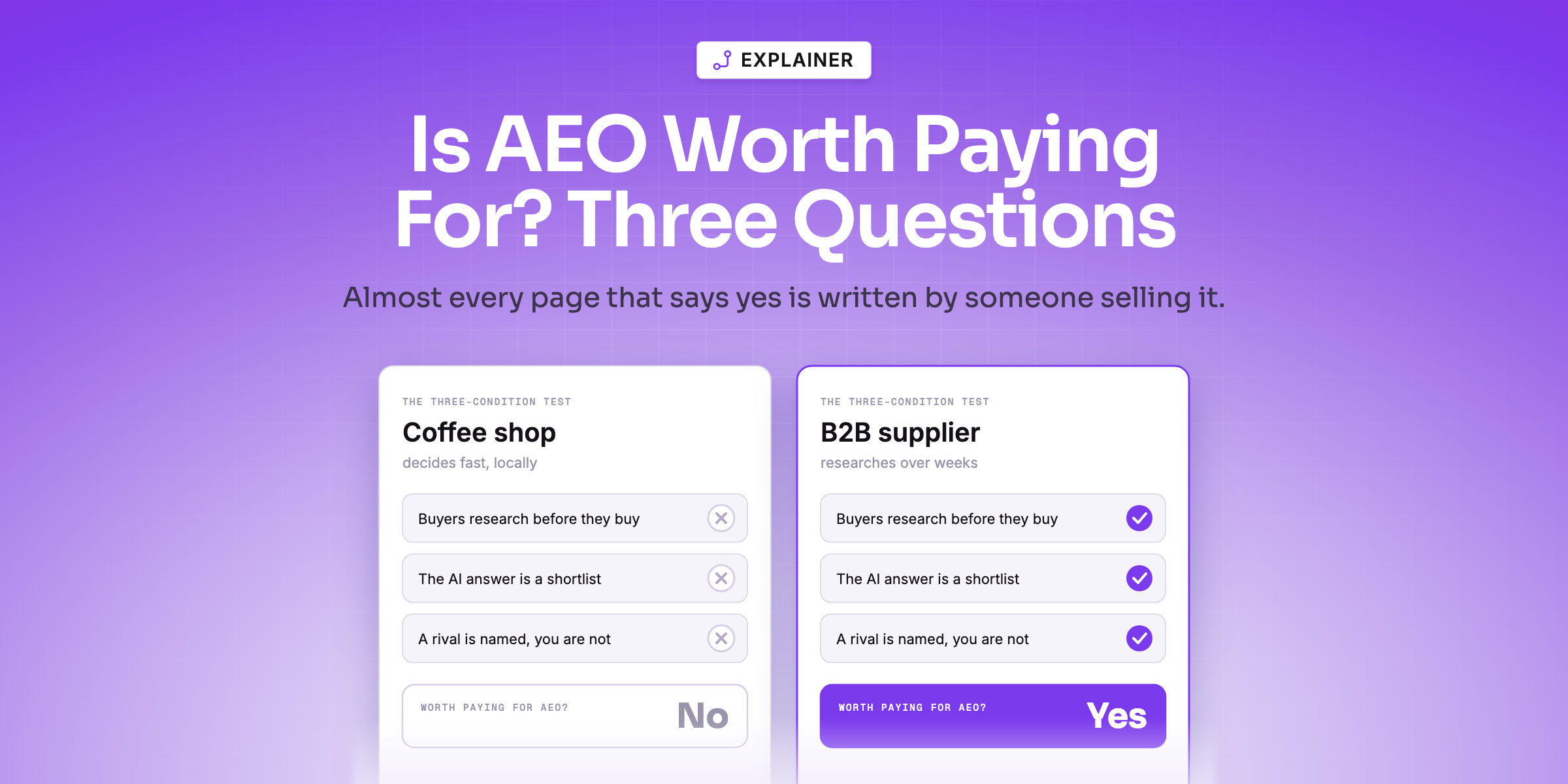
AEO services do the work. An agency writes the pages, gets you onto lists and answers in communities. Before you pay for one, read whether AEO is worth paying for. It sets out three questions that decide it.
Why You Can't See This on Your Own
Most B2B teams find out about AEO by accident, when a prospect says "ChatGPT suggested someone else". The usual tools don't show it.
Google Analytics and Search Console only count clicks and searches on Google. When an AI names a rival and nobody clicks anything, no tool records it.
Asking ChatGPT yourself gives you one answer on one day. Tomorrow the list may be different. One answer doesn't prove much.
Rank trackers follow keywords you picked. Buyers don't type keywords into AI. They ask full questions.
How DoableClaw Works
DoableClaw runs the same check behind the numbers on this page, for your company.
- You enter your website. DoableClaw reads the site, figures out what you sell and who buys it, then finds the questions those buyers put to AI. From roughly a thousand candidate questions, it keeps the five that matter most.
- It asks those five on four AI tools, three times each. That's ChatGPT, Gemini, Perplexity and Google's AI Overview. You get about 60 answers, in around 15 minutes.
- It shows who the AI named instead of you. Your rivals come from the answers themselves, including companies you didn't know about.
- It shows the pages behind every answer. For each answer you see which websites the AI relied on, and whether yours is one of them.
- It suggests what to publish next. Each gap becomes a page idea: which question to answer, and what that page needs to say.
The five questions stay locked, so next week's reading measures the same thing as this week's. Every answer is stored in full, so you can open it and check any number yourself.
Why DoableClaw
- It starts from real buyer questions, not keywords. The questions come from what people ask in forums, in searches and inside AI tools.
- Each question gets asked several times over. If a result doesn't hold up on repeat, don't act on it.
- It shows the proof. Every number links back to the real AI answers and the pages they used.
- It works for Indian companies. Questions and rivals are checked for the market you sell in.
- You finish with a to-do list. Not just a score. Every gap comes with the page to write and the question it answers.
Conclusion
AEO is getting your company named inside the answers AI tools write. AEO builds on SEO, it doesn't replace it. But whether you get mentioned depends mostly on other websites, the lists, threads and videos the AI reads. Start with the questions buyers ask before they shortlist. Answer each one plainly, get onto the sites AI reads, and measure how often you're named across repeats, not once. One answer, on one day, doesn't tell you much.
AEO: Frequently Asked Questions
What does AEO stand for?
What is AEO in AI?
Is AEO replacing SEO?
Is AEO only for big companies?
What is the first step in AEO?
Find the exact growth leak in your business — in 2 minutes.
Paste your URL. Our AI agent crawls your site, diagnoses what's broken, and ships a step-by-step fix plan. Free, no signup.
Run free audit