voices quoted
Quoted in this piece
SaaS SEO: How Software Companies Win on Google and ChatGPT (2026)
SaaS SEO for 2026: the five pages that bring software companies new customers, and what 2,046 AI answers show about where ChatGPT looks.

The short version
SaaS SEO gets a software company in front of people close to buying: on Google, and now inside ChatGPT, Gemini and Perplexity answers too. We studied 2,046 AI answers about software tools. Half of them cited a "best tools", "alternatives" or "X vs Y" page; about a third leaned on Reddit. The site of the company the question was actually about? Cited in just 8.5%. For 2026, build the comparison pages buyers search for. Then get your product onto the lists, reviews and threads AI reads.
Key highlights
- 1 SaaS SEO gets software found by buyers on Google and in AI answers
- 2 Half of AI answers about software tools cited a "best", "alternatives" or "vs" page
- 3 Only 8.5% cited the website of the company being asked about
- 4 Five page types bring SaaS buyers: comparisons, alternatives, use cases, integrations, pricing
- 5 AI tools search with a year, a use case and "pricing", so say those things plainly
- 6 A SaaS SEO checklist that covers Google and AI search
- 7 Match each funnel stage to a buyer question and a page
- 8 Decide on an agency only after you know which pages you're missing
- 9 Measure how often you're named, not just where you rank
Your potential customers used to search Google, open five vendor sites and book two demos. Today many of them ask ChatGPT "which scheduling tool is best for a 20-person sales team?" first, and the answer hands them a shortlist of about six products. The vendors on that list get the demos.
Most SaaS SEO guides still stop at Google rankings. This one covers both halves: the pages that rank, and where AI tools look when they build a shortlist, using what we saw across 12 software companies' buyer questions.
What is SaaS SEO?
SaaS SEO, or SEO for SaaS, is search engine optimization for software companies. SaaS means "software as a service": products you pay for monthly and use in a browser, like Zoho, Freshworks or Razorpay. SaaS SEO is the work of getting that software found when a potential buyer searches for a tool to solve their problem.
It's different from SEO for a shop or a blog. Almost no SaaS buyer signs up on visit one. They compare, ask colleagues, read reviews and book a demo. So the searches that matter most are comparison searches, like "Zoho vs HubSpot" or "best CRM for a small sales team", not broad ones like "what is a CRM".
In 2026, it covers AI answers too. Many buyers now type the same comparison question into ChatGPT. The AI replies with a short list of products.
Being on that list is part of SaaS SEO now, and the work to get there overlaps with, but isn't the same as, ranking on Google. That's why a product can rank on Google and still be missing from ChatGPT. Our explainer on what AEO is covers that second half in more depth.
Plenty of SaaS teams start this with no specialist at all. One engineer described it plainly on r/bigseo:
I’ve since transitioned into a B2B SaaS company, and over the past 9 months it’s become very clear we need SEO, and naturally, that’s landed on my plate.
Where ChatGPT Finds the SaaS Tools It Recommends: Our Study of 2,046 Answers
People choosing software do lean on these answers. SEO writer Alex Groberman summed up one survey on X:
69% of B2B buyers chose a different vendor than they originally planned based on what an AI chatbot told them.
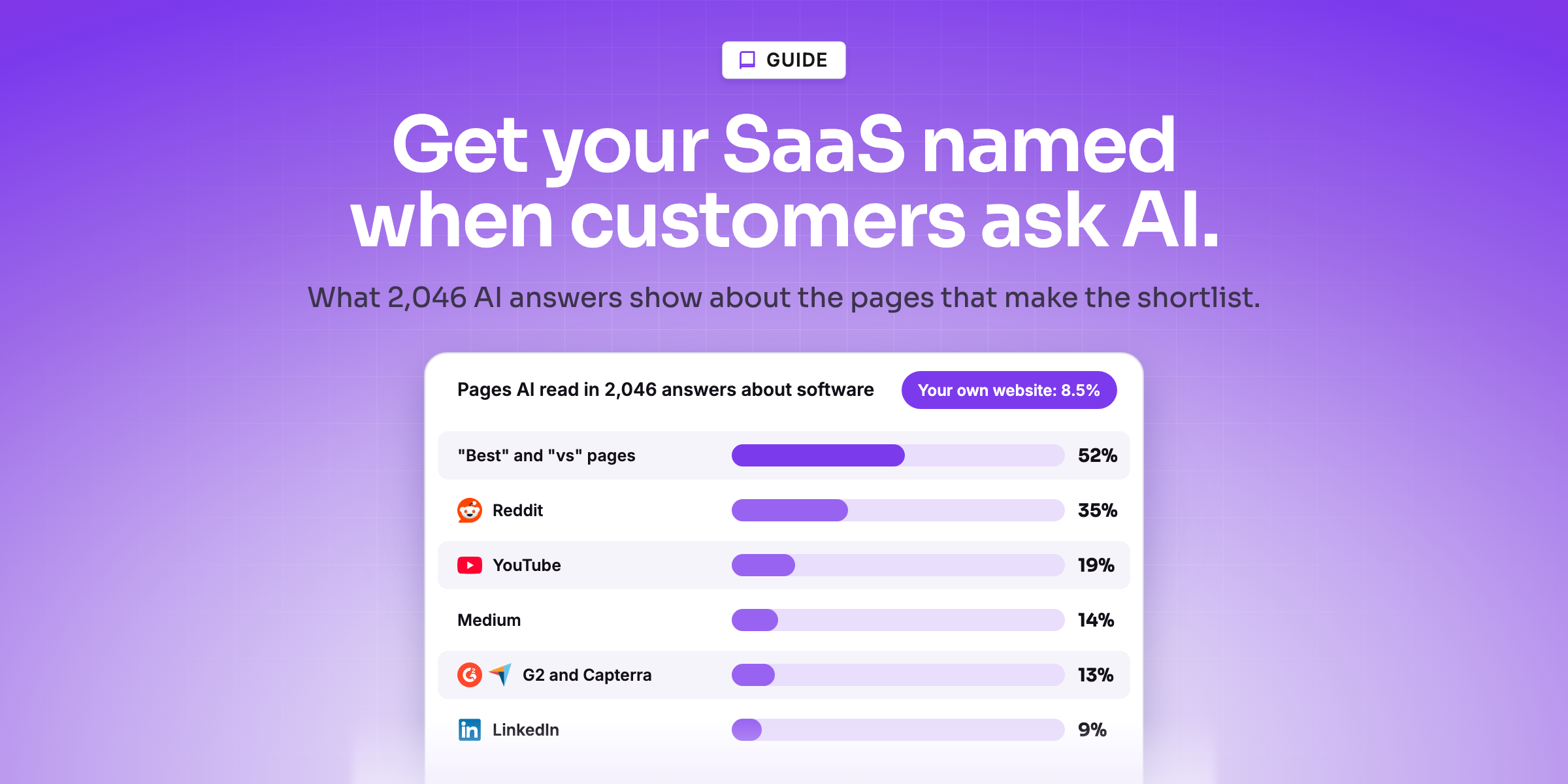
He was citing G2's 2026 Answer Economy report, a survey of 1,076 people who buy software for their companies. So we looked at what those answers are built from. DoableClaw stores every AI answer it collects, with the pages each one read. Between 26 August and 27 September 2026, we asked 85 buyer questions for 12 software companies, from scheduling and accounting tools to developer platforms, and collected 2,046 answers from ChatGPT, Gemini, Perplexity and Google's AI Overview.
| What the answers looked like | Share of the 2,046 answers |
|---|---|
| Cited a "best tools", "alternatives" or "X vs Y" page | 52% |
| Cited Reddit | 35% |
| Cited YouTube | 19% |
| Cited Medium | 14% |
| Cited a review site such as G2 or Capterra | 13% |
| Cited LinkedIn | 9% |
| Cited the website of the company being asked about | 8.5% |
A typical answer named six software products. Three things stand out for a SaaS team:
- Comparison pages carry the answer. Half of all answers leaned on a page that compares tools. Some were written by vendors, some by publishers.
- Communities matter more than you'd think. Reddit appeared in about a third of answers, more than any review site.
- Your own site is a small part of it. Fewer than 1 answer in 10 cited the website of the company the buyer was asking about. Mostly, the AI learns about your product from what other people write.
SaaS SEO Strategy: the Five Page Types That Bring Buyers
A SaaS SEO strategy is mostly a list of pages, each matched to a question a buyer asks right before they choose. These five do the heavy lifting on Google, and they're the same kinds of pages AI tools read.
- Comparison pages: "[Your product] vs [rival]". Buyers search these when they've narrowed it down to two. Be fair to the rival, show a clear table, and say who each product suits.
- Alternatives pages: "[Rival] alternatives". Buyers search these when they're unhappy with what they use. List real options, including yours, with an honest line on each.
- Use-case pages: "best [category] for [situation]". For example, "best invoicing software for freelancers in India". These match how people phrase questions to AI.
- Integration pages: "[Your product] + [tool they already use]". Someone who lives in Slack or Shopify wants proof you plug in.
- A clear pricing page. Buyers and AI tools both look for prices. Hide them and the page gets skipped; the AI quotes someone else's numbers.
Open each one with the answer, in specifics. Price. Team size it suits. Integrations. AI tools repeat specifics and skip praise.
How AI Tools Search Before They Recommend SaaS Tools
Before ChatGPT or Gemini answers a question about software, it often runs its own web searches. We store those searches too. Across the same study, the AI ran 1,705 of them, and they follow a clear pattern. Here are real ones it ran:
- "best ai agent observability tools 2025 2026"
- "pr monitoring tools healthcare hipaa compliant"
- "top enterprise media intelligence platforms 2025 2026"
The words it adds are the useful part: the year, "best" or "top", the use case, the industry, a compliance need, and "pricing", "free" or "comparison". A page that says those things plainly, in its title and first lines, matches what the AI goes looking for. So write "best scheduling tool for sales teams in 2026, with pricing", not "the scheduling platform that empowers modern teams".
A SaaS SEO Checklist for Google and AI Search
Use this as a working list. Most items take a day or less.
- Let crawlers read your docs and pricing. If those pages only fill in after they load in the browser, some AI crawlers see an empty page. Our guide to GPTBot, ClaudeBot and other AI crawlers explains which bot is which.
- Keep your G2 and Capterra profiles current. Review sites showed up in 13% of the answers we collected. An empty profile is a missed citation.
- Answer questions where buyers ask them. Reddit and YouTube appeared in 35% and 19% of answers. Useful, non-salesy answers from your team count.
- Get onto other people's "best tools" lists. Half of answers cited one. Reach out to the publishers who write them, with facts they can check.
- Don't block AI crawlers by reflex. Many teams block them to "protect" content. One LinkedIn post on SaaS AI visibility put the trade-off plainly:
Common belief: block AI crawlers, protect your content. Reality: it doesn't make your brand invisible to ChatGPT or Perplexity — it just means you lose control over how you're described.
A SaaS SEO Framework by Funnel Stage
The point of a framework here is picking what to build first. Stage by stage, line up the question buyers ask with the page that answers it.
| Stage | What the buyer asks | The page to build | Where AI also reads |
|---|---|---|---|
| Problem | "How do I stop double-booking meetings?" | A how-to guide | YouTube, Reddit |
| Options | "Best scheduling tool for a sales team?" | A use-case page, plus getting on others' lists | "Best tools" lists, review sites |
| Shortlist | "Calendly vs [your product]?" | A comparison page | Comparison posts, Reddit threads |
| Decision | "How much does [your product] cost?" | A clear pricing page | Your site, review sites |
Most SaaS teams start at the top, with blog posts about the problem. Start at the bottom instead. Shortlist and decision pages are closest to revenue, and they're the questions AI answers with a list of names.
SaaS SEO Agency or In-house?
In-house works if one person on the team writes clear comparison and pricing pages, and gets an hour a week for communities and review profiles.
An agency helps when the gap is outside your site: getting onto publishers' lists, earning coverage, and doing it steadily. Before you sign, know which of the five page types you're missing and which questions your buyers ask. Our guide on whether AEO is worth paying for sets out three questions that decide it.
How to Measure SaaS SEO in AI Search
Google rankings still matter. Search Console still measures them. AI answers need a different count: how often your product gets named when a buyer asks a buying question.
Ask the same questions several times on each AI tool and count the answers that name you. That's a rate, and it holds up from month to month in a way a single answer doesn't. Our guide on how to measure AI visibility walks through the method.
Why You Can't See This on Your Own
Most SaaS teams find out about AI search by accident, when a prospect says "ChatGPT suggested someone else". The usual tools don't show it.
Google Analytics and Search Console only count clicks and searches on Google. When an AI names a rival and nobody clicks anything, no tool records it.
Asking ChatGPT yourself gives you one answer on one day. Tomorrow the list may be different. One answer doesn't prove much.
Rank trackers follow keywords you picked. Buyers don't type keywords into AI. They ask full questions.
How DoableClaw Works
DoableClaw runs the same check behind the study on this page, for your product.
- You enter your website. DoableClaw reads it, works out what you sell and who buys it, and finds the questions your buyers ask AI. It starts with about a thousand possible questions and keeps the five that matter most.
- It asks those five on four AI tools, three times each. That's ChatGPT, Gemini, Perplexity and Google's AI Overview. You get about 60 answers, in around 15 minutes.
- It shows which products the AI named instead of yours. Your rivals come from the answers themselves, including ones you didn't know about.
- It shows the pages behind every answer. You see which lists, threads and review sites the AI relied on, and whether your site is one of them.
- It suggests what to publish next. Each gap becomes a page idea: which question to answer, and what that page needs to say.
Why DoableClaw
- It starts from real buyer questions, not keywords. The questions come from what people ask in forums, in searches and inside AI tools.
- It asks every question several times. A result is only worth acting on if it holds up across repeats.
- It shows the proof. Every number links back to the real AI answers and the pages they used.
- It works for Indian companies. Questions and rivals are checked for the market you sell in.
- You finish with a to-do list. Not just a score. Every gap comes with the page to write and the question it answers.
Conclusion
Two jobs, then, for SaaS SEO in 2026. One is still ranking on Google, with comparison, alternatives, use-case, integration and pricing pages built for buyers who are about to choose. The other is being on the shortlist AI tools hand those same buyers, which mostly comes from other people's lists, review sites and Reddit threads. Build the bottom-of-funnel pages first, get onto the pages AI reads, and measure how often you're named, not just where you rank.
SaaS SEO: Frequently Asked Questions
What is SEO for SaaS?
Is SEO still worth it for SaaS companies in 2026?
Which pages should a SaaS company build first?
Do G2 and Capterra reviews help with AI search?
What GEO strategies work for B2B SaaS?
Should a SaaS company hire a SaaS SEO agency?
Find the exact growth leak in your business — in 2 minutes.
Paste your URL. Our AI agent crawls your site, diagnoses what's broken, and ships a step-by-step fix plan. Free, no signup.
Run free audit