What AI SEO Services Actually Do (And What They Cost)
AI SEO services promise rankings inside AI answers. Here's what the work involves, which tools do it, and why a ₹999 scan matches a ₹5L retainer's findings.

The short version
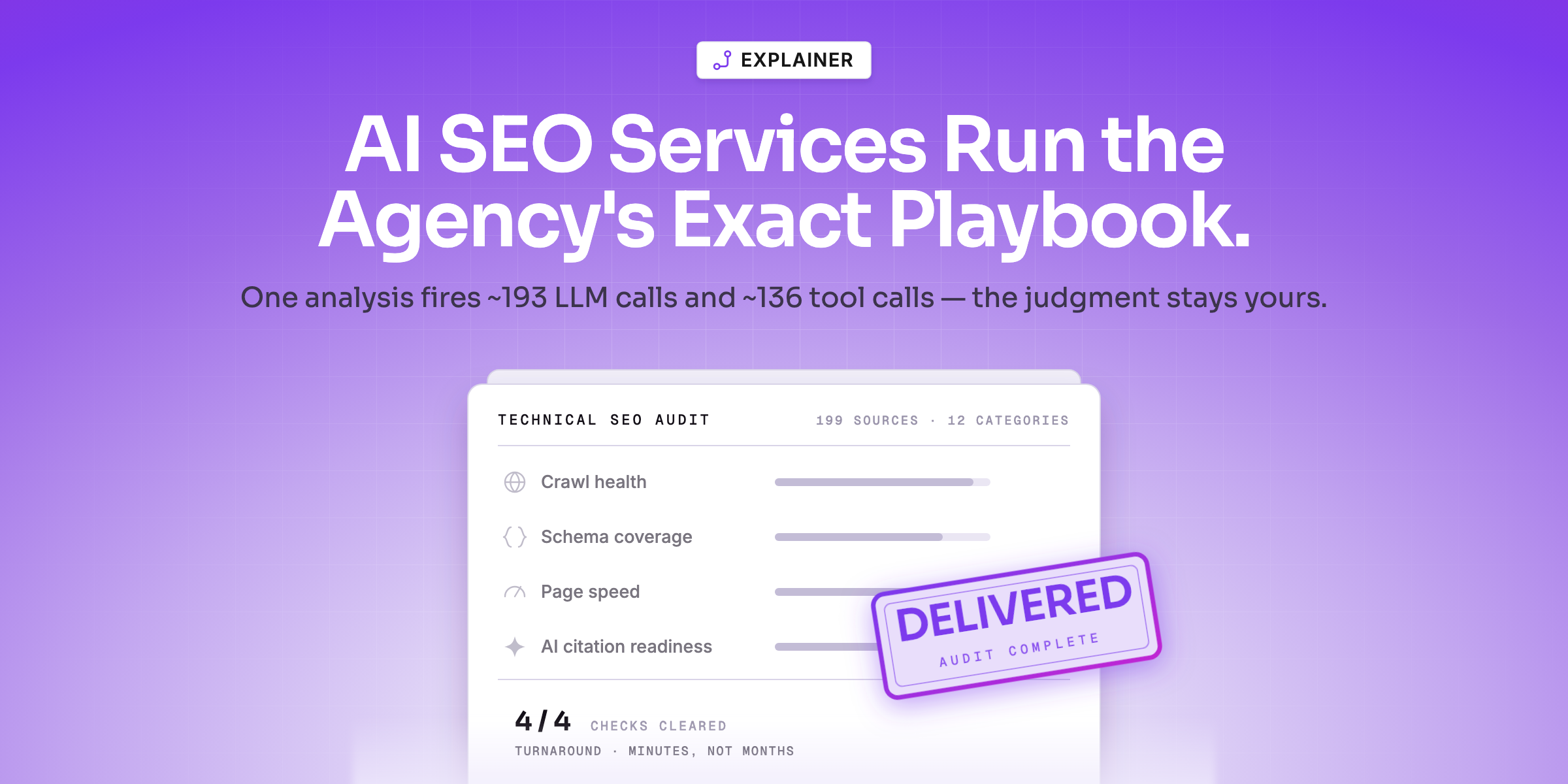
AI SEO services run the same keyword research, content briefs, technical audits and tracking an agency does by hand — compressed from a months-long retainer into software that finishes in minutes. The mechanism is identical; only who runs it changes. What AI still cannot do is check its own confidence, which is where every unverified report quietly fails.
Key highlights
- 1 What AI SEO services actually do
- 2 GEO, AEO and AI Overviews — what the acronyms mean
- 3 How ChatGPT and Perplexity decide whom to cite
- 4 What an agency retainer is really billing you for
- 5 Free tools, paid platforms, and which layer you need
- 6 How much of SEO an AI agent can genuinely run alone
- 7 The ten-step process for writing SEO content with AI
- 8 How to audit and track performance yourself
- 9 The six-step workflow, in the order the work happens
- 10 Building the strategy: keywords, local and video
What are AI SEO Services?
AI SEO services are tools or workflows that use artificial intelligence to handle keyword research, content briefs, technical audits, and performance tracking — the same tasks an agency does manually — but compressed into software that runs in minutes instead of a retainer that runs for months, at a fraction of the cost.
That's the plain answer. In practice, people search for this idea under a dozen names — ai tool for seo, seo ai tool, ai seo platform, seo optimizer ai, ai based seo, seo with ai — and they're all pointing at the same shift: software that used to just check your rankings now reasons about your business. An ai powered seo platform doesn't just tell you "add more keywords." It reads your site, your competitors, and your actual traffic data, then tells you which page is losing money and why. That's the real difference between an seo tool ai and the checklist-style SEO software from five years ago — the older tools reported; the newer ones diagnose.
Founders usually hit this term one of two ways: they're comparing seo ai tools before buying one, or they've been quoted a number by an agency and are Googling "what is ai seo" to see if they can skip the middleman. You can. The mechanism is the same whether an analyst or an algorithm runs it — crawl the site, benchmark against competitors, flag the gaps, prioritize by revenue impact. The only real question is who (or what) does that work, and what you pay for it.
We've tested this mechanism directly. In our own runs — 263 deep business analyses producing 591 structured reports over three weeks (DoableClaw internal data) — the pattern held: most of what an agency bills for in ai seo marketing work is repeatable diagnostic labor, not judgment calls. That's exactly the kind of task an ai seo optimization pipeline can do at scale, cheaply, without losing accuracy.
That's the gap DC's Organic Growth surface is built for: run the same seo and ai diagnostic an agency would sell you as a retainer, but as a ₹999 tool instead of a five-to-six-figure monthly fee. You still need a human to decide what to build next — but you shouldn't pay agency rates just to find out what's broken.
What Do You Call SEO for AI Search? (GEO, AEO & AI Overviews)

Nobody has agreed on one name yet, and that confusion is costing founders money. Ask five consultants "what is SEO for AI called" and you'll get five answers — AEO, GEO, AI-overview optimization, even "super intelligent AI-SEO" from agencies trying to sound cutting-edge. Here's the plain version: it's still SEO. The distribution channel just multiplied.
AEO and GEO: The New Acronyms
AEO (Answer Engine Optimization) means structuring content so an AI can lift a direct answer out of it — think featured snippets, but for chatbots. GEO (Generative Engine Optimization) is the broader cousin: getting your brand mentioned, cited, or recommended inside AI-generated answers, whether that's Google's AI Overview, ChatGPT, or Perplexity. Traditional SEO optimizes for a ranked list of blue links. Generative AI SEO optimizes for being the sentence an AI decides to quote. Same research, same technical groundwork (site speed, schema, backlinks) — different scoring system on top.
The reason this matters commercially: agencies now sell "GEO audits" as a new line item, often repackaging the same crawl-and-content review they were already doing, at a premium because the acronym is new. You don't need a new vendor relationship to handle this — you need the old SEO fundamentals plus a checklist for how AI systems extract and cite content.
Optimizing for Google AI Overviews and AI Mode
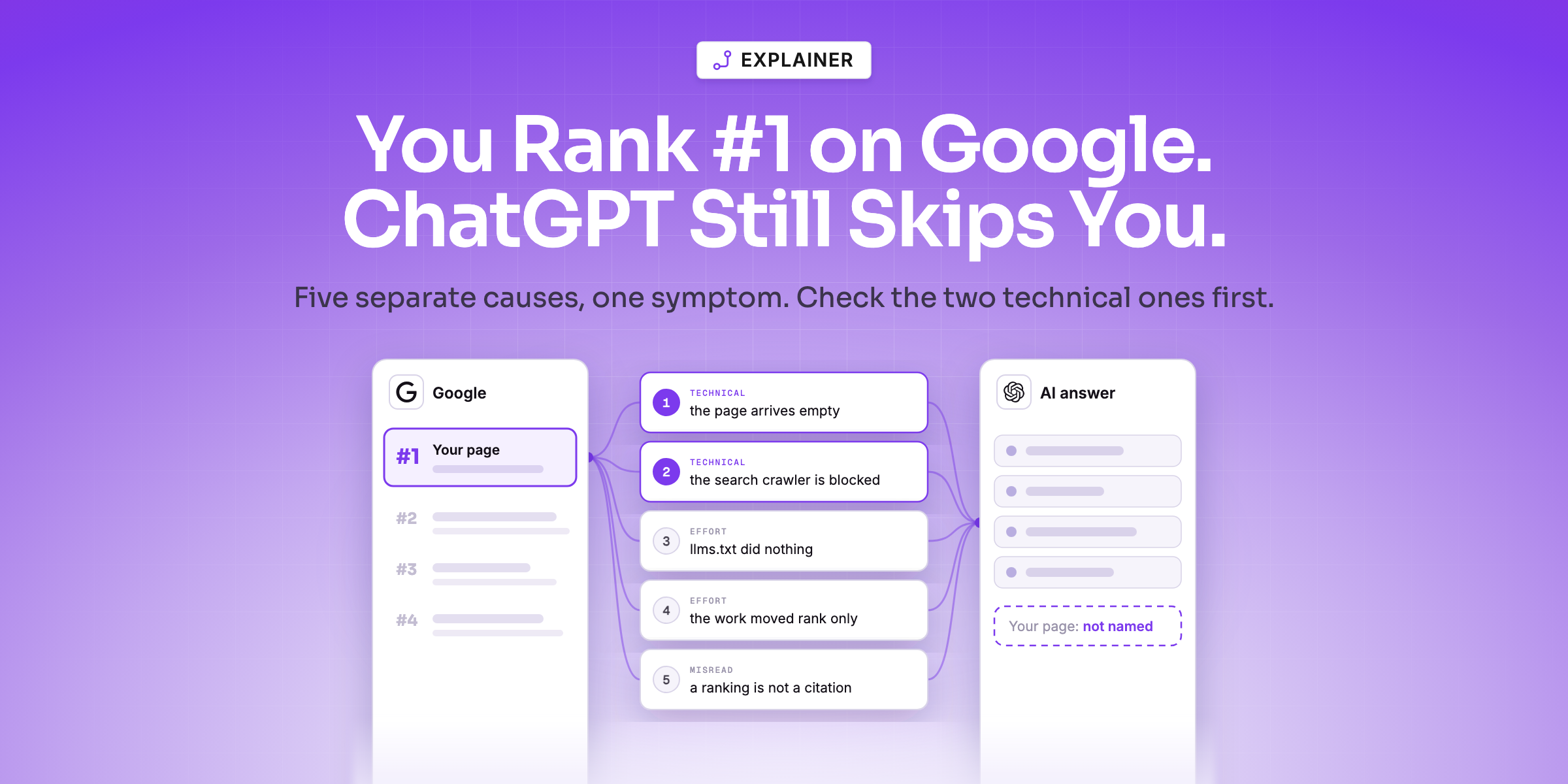
Google's AI Overview is the AI-generated summary box that now sits above the traditional results for many searches, and AI Mode is Google's fuller conversational search experience. Ranking #1 no longer guarantees the click — Google's AI can summarize your competitor's page and answer the query before the user scrolls to your listing.
The mechanism to optimize for is different from classic ranking factors: Google's AI Overview pulls from pages that clearly define an entity (a specific, named thing — your product, your city, your category) and answer a question directly in the first two sentences of a section. Vague, adjective-heavy copy doesn't get quoted. Specific, factual copy does.
SEO for ChatGPT, Perplexity and Other AI Search Engines
Perplexity and ChatGPT's search mode don't rank you — they cite you, or they don't. There's no backlink profile to game; there's a retrieval step where the AI decides which sources are trustworthy enough to quote, based on how clearly your content states facts, and whether other sources corroborate them.
This is also where AI research quietly breaks without oversight. In our own runs at DoableClaw, each AI-research pass synthesizes roughly 199 sources across about 12.2 categories, using five specialized agents (company-research, market-research, competitor-finder, sharkjaw, competitor-research) — depth no single human analyst matches in a ₹999 tool's timeframe. But across 115 of those reports, our verification layer flagged an average of ~34 claims per report as overstated or low-confidence, some running as high as 489. That's the part generic "just use AI for SEO" advice skips: raw AI output needs a fact-check layer before you publish it or let an AI search engine cite it as your brand's word. Under DC's Organic Growth work, that verification step is built in, not an afterthought you pay a five-figure retainer to catch later.
Why Does a ₹999 AI SEO Tool Beat a ₹5L Agency?
Most founders don't actually want an agency. They want the output an agency promises — a clear audit, a content plan, a fix list — without handing over their growth function to someone who's never run a P&L. That gap is the whole wedge.
The Real Cost of an SEO Agency, Consultant or Specialist in India
Ask any SEO agency in India for a proposal and you'll get a retainer, not a price. An ai seo consultant or specialist typically bills a monthly fee — often a five-figure sum at the low end, and well into six figures a month if you're talking to a "best ai seo agency" with a brand name and a Delhi office. Over a year, that's easily ₹5L or more, before you've seen a single ranking move. And you're not buying certainty — you're buying someone's time, and most of that time goes into research and reporting you could generate yourself if you had the right tool.
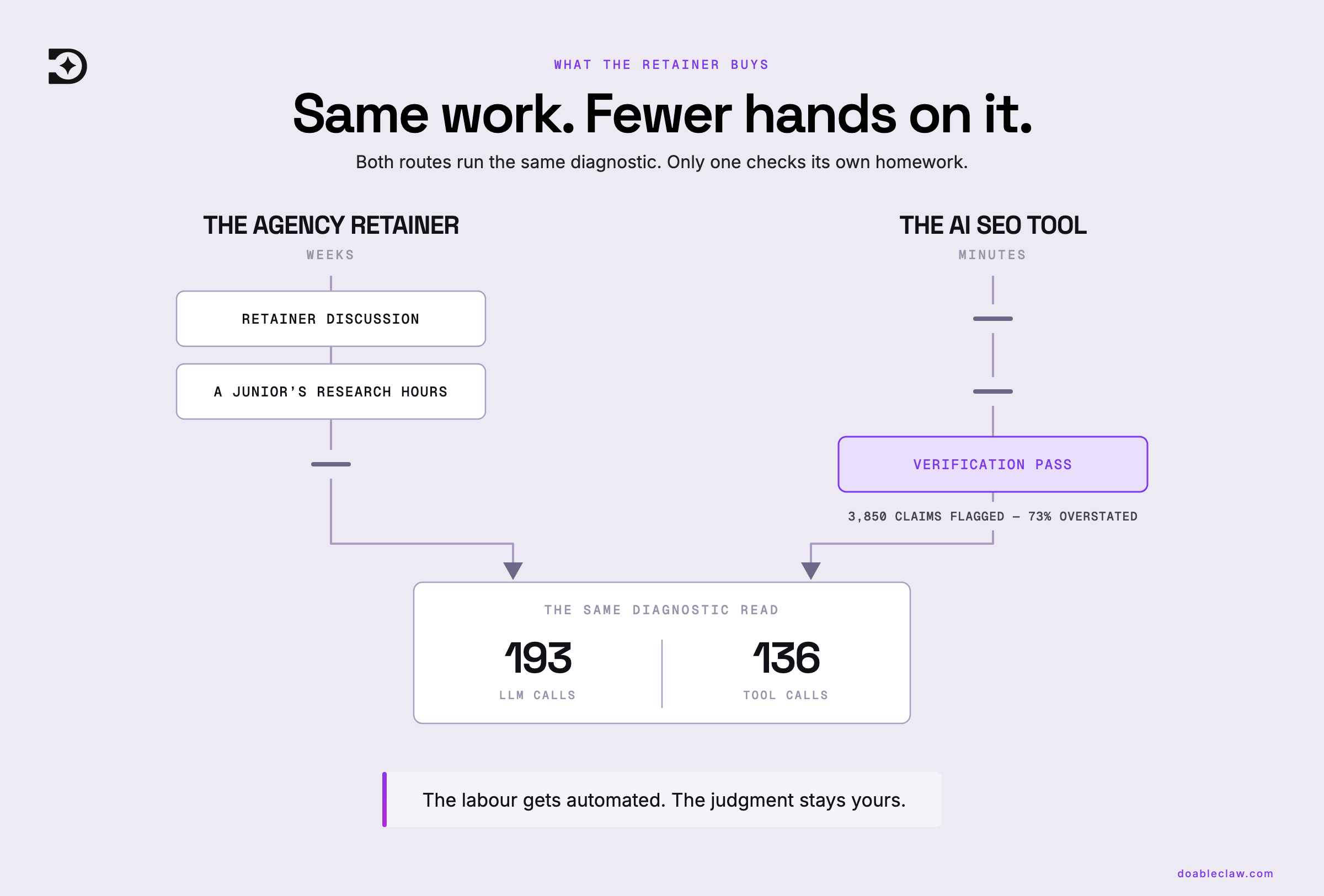
Here's the part agencies don't advertise: a chunk of what you're paying for is a junior analyst reading your website, competitor sites, and Search Console data, then writing up what they found. That's compute-heavy, repeatable work — not judgment. It's exactly the kind of task an ai-powered seo service can do in minutes, not weeks.
What an AI SEO Tool Does Instead of an Agency Retainer
An AI SEO tool doesn't replace a strategist's judgment — it replaces the labor-hours an agency bills you for gathering and structuring the inputs to that judgment. By our own count, one DoableClaw analysis fires roughly 193 LLM (large language model) calls and 136 tool calls under the hood — crawling pages, pulling data, cross-checking claims — the same grind an agency assigns to an analyst and bills you days of labor for. You get the audit output; you skip paying for the hours it took a human to produce it.
But raw AI output has its own failure mode, and this is where most "ai driven seo services" and DIY tools quietly cut corners: the AI states things with more confidence than the evidence supports. In our own runs, across roughly 3,850 flagged claims, about 73% of the ways AI research misled us were exactly this — overstated confidence, not outright fabrication — and about 88% of those were high-severity, meaning they'd change a real decision if you acted on them uncorrected. An ai seo company selling you a black-box report has no incentive to catch that. A ₹999 tool that verifies its own claims before handing them to you does.
That's the actual difference between an ai seo expert's deliverable and a self-serve ai seo tool: not intelligence, but whether anyone checked the intelligence's homework.
You don't need an ai seo agency in India to tell you your site has thin content and missing schema (structured data that helps search engines understand your page). You need that audit today, verified, for ₹999 — not a retainer discussion next Tuesday.
If you're doing your own growth and want the audit an agency would charge a lot more for, start with DC's Organic Growth tool and see what it flags in your own site before you sign anything longer than a month.
What are the Best AI SEO Tools in 2025 (Free and Paid)?

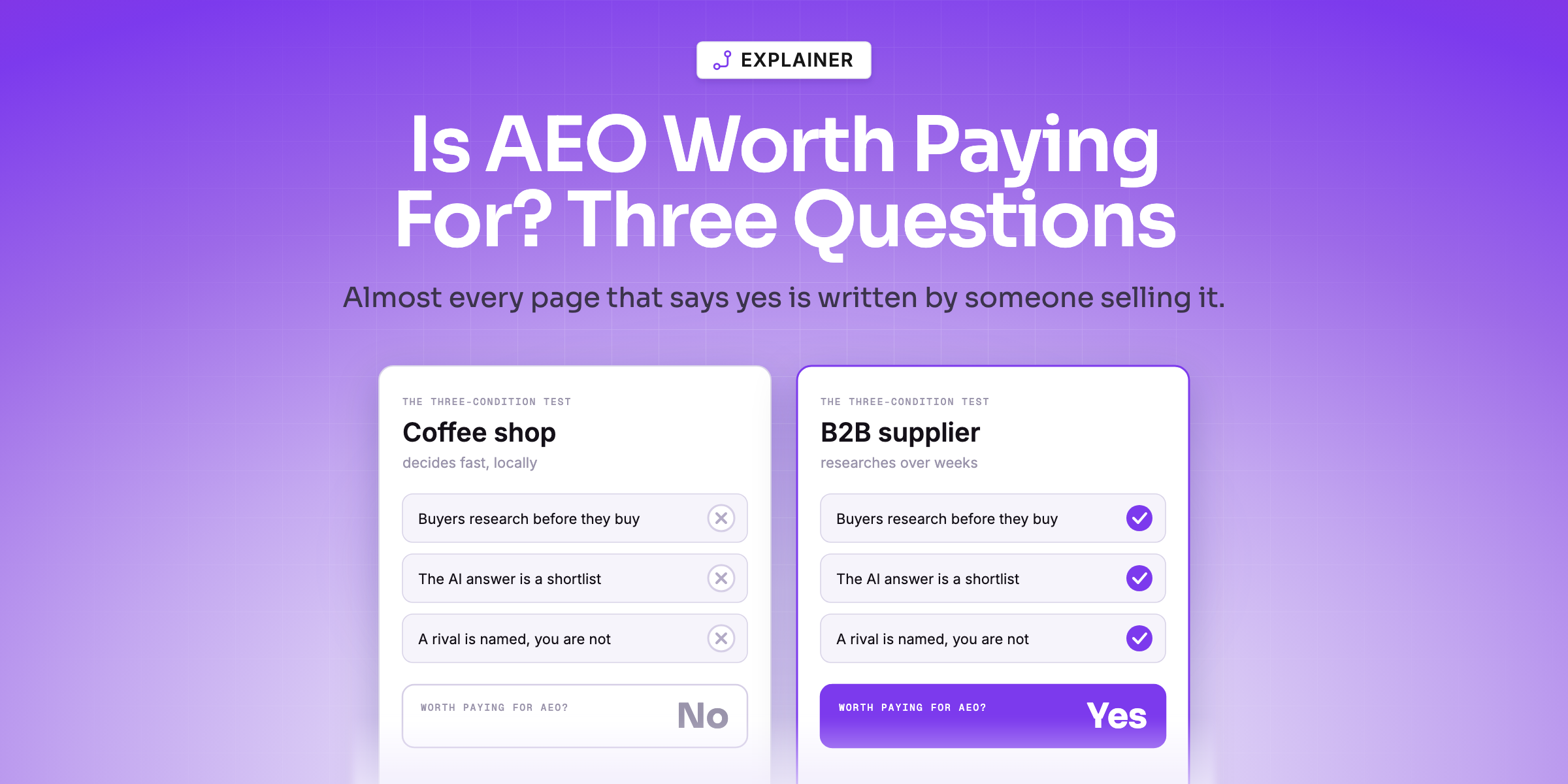
There's no single best AI SEO tool — there's a stack, and most founders buy the wrong layer first. The category splits into three jobs: finding what to rank for, writing and optimizing content, and checking whether AI engines even trust your site enough to cite it. Get the layers confused and you end up paying for a ₹5L-agency retainer to do what a free ai seo tool already does, or worse, skipping the one check that actually predicts whether ChatGPT or Google's AI Overviews will mention your brand.
Free AI SEO Tools
Google Search Console is still the best free ai seo tool for the basic question — what are people already finding you for, and what's the click-through rate telling you. Pair it with Google's own Keyword Planner and you have a free seo ai tools starter kit that costs nothing and covers indexing, impressions, and rough demand. Most GPT-based tools (ChatGPT, Gemini) also work as an ai seo app for outlines, meta descriptions, and FAQ drafts — free ai seo tools free-tier is genuinely usable for a solo founder, not just a teaser.
The gap: none of these free seo tools ai tell you whether your content is credible to an AI system doing retrieval — they tell you what humans search, not what machines trust enough to cite.
Best Paid AI SEO Platforms and Software
The best ai seo software for volume — Semrush, Ahrefs, Surfer — are ai driven seo tools built for keyword research, backlink audits, and content scoring at scale. They're built for agencies managing dozens of clients, which is exactly why the pricing sits far above what a single founder needs. If you're comparing best ai seo tools 2025 lists, most are ranking the same five platforms with different affiliate links — none of them ask whether you need enterprise tooling for a one-person growth function.
Where these platforms genuinely earn their price: technical audits at scale, competitor gap analysis across hundreds of pages, and rank tracking across markets. Where they don't: you're paying for capacity you'll never use if you're running SEO for one product, one market, one team.
AI SEO Tools for Small Business
This is the actual question most founders are asking when they search "best ai for seo" — not "which enterprise suite," but "which ai seo tools for small business won't cost more than my monthly revenue." The honest answer: most small-business use cases (10-30 pages, one core product line, no dedicated marketer) need maybe 20% of what an enterprise ai seo optimization tool does. Paying full agency or full-suite price for that is like renting a warehouse to store one shelf's worth of inventory — you're paying for square footage you'll never fill.
AI Visibility Platforms (GEO Tools) vs Traditional AI SEO Tools
Here's the distinction generic listicles skip: traditional ai based seo tools optimize for Google's ten blue links. AI visibility platforms — the GEO (generative engine optimization, i.e. showing up in AI-generated answers) layer — optimize for whether ChatGPT, Perplexity, or Google's AI Overviews cite you at all. These are different mechanisms. Traditional tools score keyword density, backlinks, and page speed. GEO tools score whether your content reads as a citable source to a retrieval system — structured facts, clear entity definitions, credible sourcing.
That last point matters more than most tool comparisons admit. In our own runs, DoableClaw's agents scored 158,102 sources for credibility on a 1-5 scale, and roughly 65% landed in the lowest tier (≤2) — meaning most of what AI engines actually pull from the web is weakly sourced to begin with. If most of your competitors' content is also low-credibility, ranking well in a traditional ai seo tool doesn't guarantee AI citation — it just means you beat other weak sources at a game that isn't the one being played anymore.
| Tool type | Best for | Cost pattern | What it misses |
|---|---|---|---|
| Free ai seo tool (GSC, Keyword Planner) | Basic visibility, demand check | ₹0 | No credibility/GEO signal |
| Enterprise seo ai tool (Semrush, Ahrefs) | Agencies, multi-market scale | High recurring, sized for teams | Overbuilt for one-founder use |
| GEO / AI visibility platform | Citation in AI answers | Varies, often bundled into agency retainers | Rarely standalone-affordable |
| DoableClaw (Organic Growth) | Founder-run audit + credibility scoring + playbook | ₹999 flat | Not a 24/7 dashboard — it's a decision, not a subscription |
The Edge
Most tool comparisons stop at features and price tiers. The real question is sequencing: you don't need every layer running simultaneously — you need to know, right now, which layer is broken. DoableClaw's Organic Growth audit runs the credibility check most stacks skip, tells you where your content sits against that 65%-low-credibility baseline, and hands you a playbook instead of another dashboard to babysit. At ₹999 against a ₹5L agency retainer, it's not competing on tool count — it's answering the one question the tool comparison charts never ask: is what you already have even trustworthy enough for AI to cite.

Can AI Agents Handle SEO Tasks Automatically?

Mostly yes for research and grunt work, no for judgment calls. An AI agent for SEO — software that runs a multi-step task on its own instead of waiting for you to prompt each step — can crawl your site, pull competitor data, and draft a keyword list while you're in a founder meeting. That's the pitch behind every "automated SEO AI" tool launching right now.
Here's what that automation actually looks like inside DoableClaw. Each research run isn't one bot doing one job — it's five specialized agents working in sequence (company-research, market-research, competitor-finder, sharkjaw, competitor-research), each handing off to the next. By our own count, a single run synthesizes roughly 199 sources across about 12.2 categories — a spread one human analyst, working alone, would take days to replicate manually.
But automated AI SEO has a failure mode nobody advertises: AI agents are confident even when they're wrong. In our runs across 115 AI-generated research reports, DoableClaw's own verification layer flagged an average of ~34 claims per report as overstated or low-confidence — in one case, 489. That's not a knock on AI agents for SEO specifically; it's why every AI SEO agent needs a fact-check pass before you act on its output, not after.
So the real division of labor: the seo ai agent handles source-pulling, pattern-spotting, and first-draft synthesis — the ₹999-tool part of the job. You handle three things no agent should own — deciding which claims are true, which recommendations fit your actual budget, and which risks you're willing to take. An agency selling "auto SEO AI" as fully hands-off is selling you the 199 sources and hiding the 34 flags. Buy the research. Keep the judgment call.
How Do You Use AI to Write SEO Content?
AI can write you a full blog post in ninety seconds. That's not the hard part. The hard part is making that post rank, and knowing where AI-generated content quietly breaks down. Here's the actual process, step by step.
AI for Blog Posts and Long-Form SEO Content
- Feed it a real angle, not a topic. An AI SEO writer given "write about email marketing" produces filler. Give it your customer's actual objection ("why my open rates dropped after adding a second CTA") and it has something to write about.
- Generate the skeleton first, draft second. Use any seo content ai tool to produce a heading outline before you ask for paragraphs. This is where you catch a generic structure before you've wasted a full draft on it.
- Draft in sections, not one long prompt. One 2,000-word prompt gives you 2,000 words of the same three sentence patterns repeated. Section-by-section prompting (intro, then each H2 separately) gets you more variation and lets you redirect early if the AI drifts off-topic.
- Insert your own numbers. AI-generated content for SEO defaults to vague claims ("many businesses struggle with..."). Replace every vague line with a real number from your own business — a conversion rate, a churn figure, a ₹ cost. This is the single biggest gap between content that reads like everyone else's and content that reads like it came from someone who runs the business.
AI Title and Meta Description Generators
An ai seo title generator is genuinely one of the better uses of AI in this whole workflow, because titles and meta descriptions are short, formulaic, and testable.
- Generate 8-10 title variants, not one. Any ai seo generator can produce a title. The value is in volume — generate a batch, then pick or blend based on which one states the specific outcome (a number, a timeframe, a price) rather than a vague benefit.
- Use the ai seo description generator output as a draft, not final copy. Meta descriptions don't directly move rankings, but a description that names the exact thing someone's searching for (their ₹ pain, their tool comparison, their timeframe) lifts click-through rate — which is a signal search engines do watch.
- Check length manually. AI tools routinely output titles and descriptions that get cut off in results. Fifteen seconds with a character counter avoids a truncated, confusing snippet.
Treat every statistic, every "studies show", and every named tool or company as unverified until you have checked it yourself. AI writing tools state numbers with total confidence whether or not they are accurate.
Quality Control: Making AI Content Rank
This is the step every "seo writing ai free" tutorial skips, and it's the one that actually matters.
- Fact-check every specific claim before publishing. AI writing tools state numbers and cause-effect claims with total confidence whether or not they're accurate. Treat every stat, every "studies show," and every named tool or company as unverified until you've checked it yourself.
- Run it past someone who'd actually catch a wrong claim. In our own research pipeline — 3,592 category-level briefs generated between July 5 and July 25 — average AI research confidence came out to 3.02 out of 5. That's solid directional coverage, not certainty. Content generation carries the same ceiling: an ai seo content generator gets you 70% of the way there reliably; the last 30% (accuracy, specificity, your actual voice) still needs a human pass.
- Rewrite the first and last paragraph yourself. These are where AI tone is most obvious — generic opener, generic wrap-up. A founder's actual sentence in those two spots does more for credibility than any prompt tweak.
The mechanism to remember: AI-generated SEO content ranks when it's a faster draft of something you were going to say anyway — not when it's a replacement for having something specific to say. If you want the research and structure done for you before you write, that's the gap DC's Organic Growth reports are built to close.
How Do You Audit and Track SEO Performance with AI?
An agency's "monthly report" is usually a screenshot of Google Search Console with a summary paragraph an intern wrote. You can generate the same thing yourself in under an hour, for free, on a schedule you control. Here's the actual workflow.
AI SEO Audit Tools
- Run a full-site AI SEO audit using a tool that crawls your pages and flags technical issues — broken links, missing meta tags, slow pages, duplicate content. This is what people mean by an ai seo audit tool: it replaces the manual checklist an agency junior would work through by hand and bills you for.
- Read the confidence, not just the verdict. Any AI seo checker is pattern-matching against thousands of sites, not personally inspecting yours. In our own runs generating category-level research briefs (3,592 of them, over three weeks), average self-reported confidence came out to 3.02 out of 5 — solid coverage, not certainty. Treat every ai seo check the same way: a strong first pass, not a final answer. Skim the top 5 flagged issues yourself before you act on any of them.
- Fix in priority order — crawl errors first (pages Google can't even index), then on-page gaps, then content depth. An ai seo analyzer will list twenty issues; three of them usually cause 80% of the damage.
Rank and SERP Checkers
- Track your core keywords weekly, not daily. An seo ai rank checker (or ai seo tracker) that pings positions every day mostly measures noise — Google's search results page (SERP) reshuffles constantly for reasons that have nothing to do with your site.
- Use an seo ai serp checker to see what's actually ranking above you — not just the position number, but whether the top results are AI Overviews, videos, or forum threads. This tells you what format Google wants for that query, which a plain rank number never shows.
- Check domain authority movement monthly. A seo ai domain authority checker won't move fast — it's a slow signal, built from backlinks over months. Checking it weekly just creates anxiety, not insight.
Free SEO Reports and Checkers
- Pull an seo audit report free from your crawler tool and a seo report free from your rank tracker, then combine both into one document. This is your seo report generator — an agency would charge a retainer to produce a shinier version of the same two exports.
- Run a google seo checker free pass on your homepage and top 3 landing pages monthly — page speed, mobile usability, indexing status. Google gives this away; nobody plausibly needs to pay for it.
- Log every audit in one sheet — date, tool, top 3 issues, action taken. This is the seo analysis free habit that agencies skip because a clean paper trail makes their monthly invoice harder to justify.
The mechanism worth understanding: AI SEO tools for analysis are good at breadth — scanning hundreds of pages faster than any human — but weak at judgment calls specific to your business (which keyword actually converts, which competitor is a real threat). DC's Organic Growth research runs this same audit-and-track loop for you on a schedule, then hands you the priority list — not a slide deck explaining what a crawl error is.
How Do You Actually Use AI for SEO, Step by Step?

Every generic guide tells you to "use AI for keyword research and content." That's not a workflow — it's a wish. Here's how to do ai seo as an actual sequence, in the order the work happens.
Step-by-Step: Using AI in Your SEO Workflow
- Audit first, generate nothing yet. Feed your site, category, and top 3 competitors into an AI research tool. You're mapping what's already ranking and why before you write a single line.
- Score the confidence, not just the output. Good ai software for seo gives you a confidence read on its own findings. In our runs across 3,592 category-level research briefs, average confidence sat at 3.02 out of 5 — solid coverage, not certainty. Treat anything below 4 as a hypothesis, not a fact.
- Prioritize by ₹ impact, not by keyword volume. Rank the gaps AI surfaces by what they'd cost you to ignore — a missing FAQ schema (structured data that helps search engines read your content) on a page driving inquiries is worth more than 20 low-traffic keywords.
- Draft with AI, edit for what only you know. Using AI for SEO optimization works best on structure and first drafts — pricing nuance, local context, and your actual customer objections still need a founder's edit.
- Automate the tracking, not the judgment. Set AI to monitor rankings, AI Overview appearances, and technical errors weekly. You review and decide; the tool just watches.
- Re-audit monthly. AI-driven SEO isn't a one-time setup — search results shift, so the research brief from step 1 has a shelf life of weeks, not quarters.
This is exactly the loop DC's Organic Growth surface runs — audit, score, prioritize, track — packaged so you're not stitching five tools together.
Will AI Replace SEO Entirely?
No — and that 3.02/5 confidence number is the proof. AI's impact on SEO is real for research speed and pattern-spotting, but it still gets a third of its own conclusions only "probably right." Judgment on what to actually ship stays yours. That's the whole reason a ₹999 tool beats a ₹5L retainer: it hands you fast, honest-confidence research — not a black-box promise of certainty.
How Do You Build an AI SEO Strategy? (Keywords, Local & Video SEO)
A blog post is one input. An actual AI SEO strategy also needs keywords, your Google Business Profile, and — if you sell anything visual — YouTube. Here's the build order.
Run every shortlisted keyword through one filter: would you pay ₹999 to rank first for it next month? If the honest answer is no, it is a vanity keyword. Cut it.
AI Keyword Research
- Dump your category into an AI tool for SEO keyword research (ChatGPT, Perplexity, or a paid keyword tool) and ask it to cluster terms by buyer intent — "ready to buy," "comparing options," "just learning" — instead of sorting by search volume.
- Verify volume with a real data source. AI tools for SEO keyword research are good at clustering and bad at guessing exact traffic numbers — they'll invent a plausible-sounding figure. Cross-check anything you plan to spend money chasing against Search Console or a paid tool's actual data.
- Filter with a spend test. For every ai seo keyword on your shortlist, ask: "would I pay ₹999 to rank #1 for this next month?" If the honest answer is no, it's a vanity keyword — cut it.
One honest caveat here: across 3,592 category-level research briefs we've run, average AI research confidence came out to 3.02/5 — decent coverage, not certainty (DoableClaw internal data). Treat AI keyword clusters as a strong first draft a founder still eyeballs, not a finished plan.
AI for Local and Video SEO (YouTube)
- For ai local seo, feed your Google Business Profile description, category, and top-3 competitor listings into an AI tool and ask it to draft FAQ content and service-area copy that fills the gaps competitors already rank for.
- For youtube seo ai, paste your video transcript into an AI keyword generator to supercharge YouTube SEO — it'll surface title, tag, and description variants your target buyer actually searches, not just what you'd type from memory.
- For ai video seo beyond YouTube, reuse the same transcript-to-keyword step for video schema and on-page video descriptions on your own site.
This is exactly the layer DC's Organic Growth workflow is built for — turning scattered AI outputs into one prioritized, ₹999 action list instead of five open tabs.
Key takeaways
- Audit first, generate nothing yet — map what already ranks before you write
- Score the confidence, not just the output; treat anything below 4 as a hypothesis
- Prioritise by ₹ impact, not by keyword volume
- Draft with AI, edit for the pricing, local context and objections only you know
- Automate the tracking, never the judgment
- Re-audit monthly — a research brief has a shelf life of weeks, not quarters
Conclusion
Before you sign anything, take the five questions your buyers actually ask and put each one into ChatGPT and Perplexity in a fresh session. Write down which brands get cited. That is your real starting position and it takes twenty minutes. If your name is missing, the gap is citation rather than ranking — a different problem, and not the one most agency proposals are scoped against.
AI SEO Services: Frequently Asked Questions
Is AI-generated content good for SEO?
What is SEO called for AI?
What do you call SEO for AI?
How is AI changing SEO?
Can AI do SEO?
How to use AI in SEO?
Is AI content bad for SEO?
Is SEO dead with AI?
Find the exact growth leak in your business — in 2 minutes.
Paste your URL. Our AI agent crawls your site, diagnoses what's broken, and ships a step-by-step fix plan. Free, no signup.
Run free audit