How to Check AI Mentions, and What Stays Unknown
Eight questions people ask about checking AI mentions. Four are settled, one is only observed, three nobody can answer. Here is where each stands.


The short version
"Does AI mention us?" is not one question. It is eight, and only five of them have an answer anybody can defend. Two of them you can check today, for free, with files you already own. This page is the map: every question people actually ask, where each one stands, and which three nobody — including us — can answer yet.
Key highlights
- 1 A mention is your name inside a generated answer, not a link or a rank
- 2 Being named once is not being recommended, and they should not be counted together
- 3 Ask the same question twice and the answer changes, so a "position" is variance
- 4 Measure how often you appear across repeated runs, not where you appear
- 5 GA4 and your raw server log already hold the first real evidence
- 6 A bot visit is not proof of a mention, and much of that traffic is you
- 7 Many widely repeated statistics in this field trace back to nothing
- 8 Nobody can honestly tell you what a normal number looks like yet
Your buyer asks a chatbot the question they used to type into Google. They get one written answer naming a handful of companies, and if you are not among them the shortlist is set before anyone visits a website.
So you want to know where you stand. That turns out to be eight separate questions rather than one, and most of the confident advice in this field answers all eight as though they were equally settled. They are not. Four are settled, one is only observed, and three are open — which means a page that gives you eight clean answers is selling you three of them.
Everything below is current as of 8 September 2026. Each section is one of those questions, and each links down to the piece that works it out in full:
| The question | Where it stands |
|---|---|
| What counts as an AI mention | Settled. Definitional, and we have written it out. |
| Why your existing tools report zero | Settled. Follows from what each tool counts. |
| Why the number moves between runs | Observed by many practitioners; no agreed magnitude. |
| What unit to measure instead | Settled in method, contested in practice. |
| What you can check for free | Settled. Two checks, both first-hand. |
| Whether the engines agree with each other | Open. We have not run it. |
| What a normal number looks like | Unknown. No benchmark exists. |
| How long a change takes to appear | Unknown. Treat any confident answer as a sales figure. |
What "AI Mentions Me" Actually Means
Almost every wrong answer downstream starts here. A mention is your brand named inside the answer a chatbot writes. It is not a backlink, not a search ranking, and not a session in your analytics — which is why the zero you are looking at is so consistent.
| Instrument | What it counts | Why an AI mention reads as zero |
|---|---|---|
| Google Analytics 4 | sessions | a mention with no link produces no click, so no session |
| Google Search Console | impressions on Google surfaces | it reports Google's own surfaces only; ChatGPT is not one |
| Rank tracker | a position in a list | a generated answer is prose, so there is no position to report |
| Backlink tool | links pointing at you | most mentions are unlinked text |
All four are working correctly. None of them was built for this.
There is a second distinction underneath it, and it is the one that changes what you do next. Being named in a lineup of four options is not the same event as being the answer, and a report that adds them together is averaging two things a buyer does not experience the same way.
Both of those are worked out in full elsewhere: what an AI mention actually is, and why being named is not being recommended.
Why the Number Moves When You Did Not Move
Run the same prompt twice and you will often get two different sets of cited sources. Not two different phrasings of the same answer — different sources.
This is the fact that breaks the instinct to report a position. If a number changes when the input did not, you are looking at variance and calling it a rank. Two accounts from practitioners, neither a controlled study:
- A practitioner writing on LinkedIn, August 2026 — a client's rankings shifted by as much as ten places across repeated runs of a single prompt.
- A thread on r/aeo, February 2026 — ten people ran one identical query at the same time; only three received the same answer.
Both are the category working out in public that the metric itself is the problem.
We are not going to hand you a number for how much it moves. Our own figure for that has no published methodology behind it, so it does not appear on this page.
What follows from the instability is not despair — it is a different unit of measurement.
Measure a Rate, Not a Position
If one run is unreliable, the answer is more runs. Ask the same question ten times and count how many of those answers name you. That fraction — appearances over runs — survives re-running in a way that a position never does.
Three things decide whether that fraction means anything:
- How many times you ran it. One run is an anecdote.
- How many different questions you asked. A single prompt measures a single prompt.
- Who chose those questions. This is the trap in most commercial tools.
The third is the one nobody sells you on. A rate is a fraction, and if the vendor picked your prompt set, the vendor picked your denominator. Two tools can report two different numbers for the same brand and both be arithmetically correct.
The fix is unglamorous. Write your own list of the questions a buyer would actually ask, freeze it, and measure against that. The list is the asset; the score is just this month's reading of it.
This section has no piece yet. The two that will fill it are cut and sourced, not written.
Check It with What You Already Own
Before you pay anyone, there are two places to look, and you already have both.
The first is Google Analytics, where referrals from ChatGPT, Perplexity and the rest do show up once you know what you are looking for. The second is your raw server log, where the AI crawlers announce themselves by name.
Then the qualifications start, and they matter more than the how-to:
- One operator runs several bots. The roster is larger than most people expect, so "did GPTBot visit" is a narrower question than it sounds.
- A user agent can be forged, and so can an IP. The visitor may not be what the log says it is.
- A fetch is not a citation. Retrieval and citation are separate events, and the gap between them is wide.
- Most of it is you. Especially in the first weeks — your own monitors, preview deploys and test scripts land in the same log.
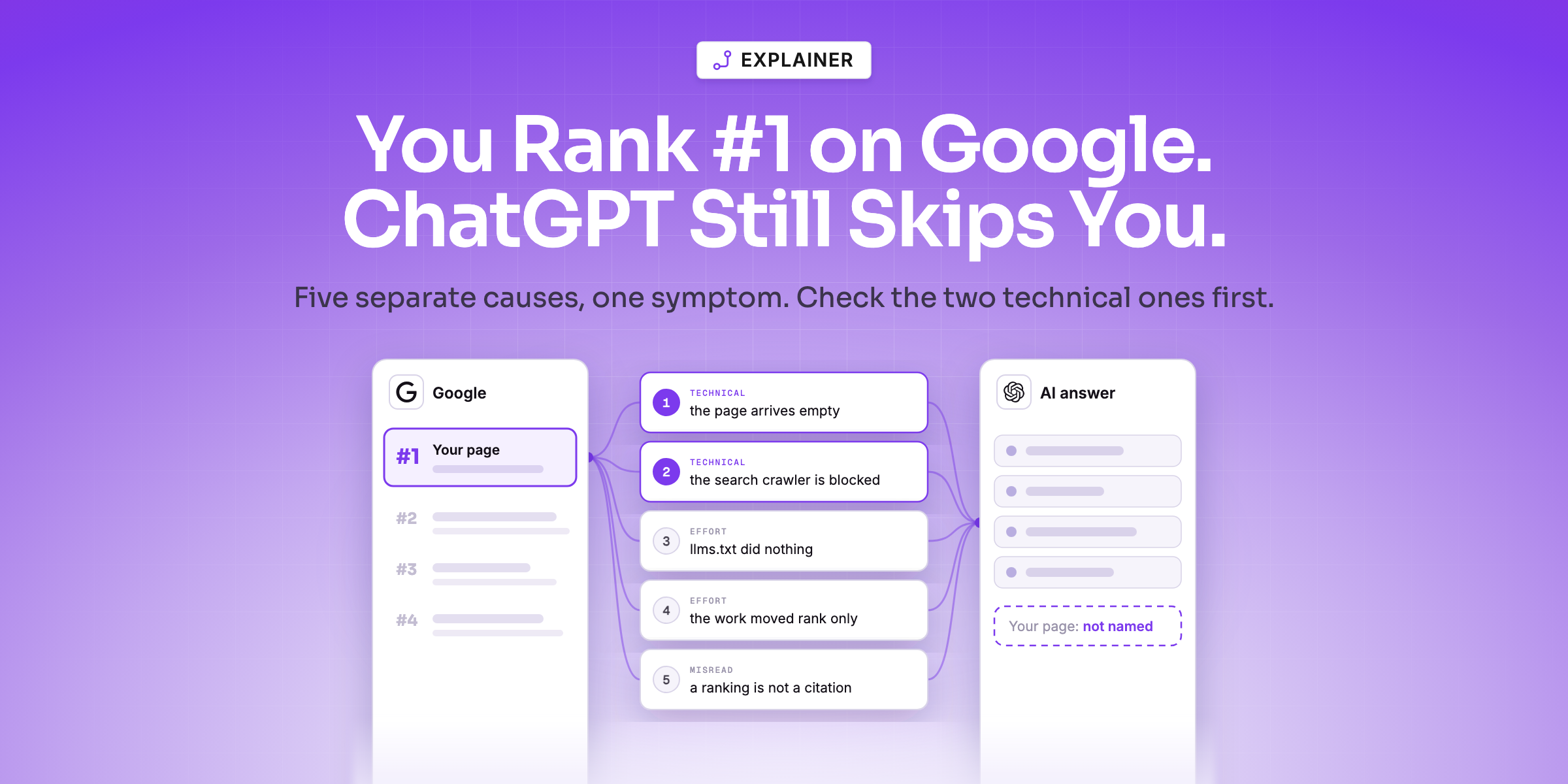
We checked this rather than assuming it. Across 23 Google AI Overviews on 4 September 2026, we recorded every source cited and compared it to the same search's organic results:
| What we measured | Result |
|---|---|
| Citations drawn from the top 10 organic | 90 of 147 · 61% |
| Citations from domains outside the top 20 | 32 of 147 · 22% |
| Top-10 domains that were actually cited | 90 of 223 · 40% |
| Searches where the #1 result was cited | 14 of 23 · 61% |
Read that last pair together: ranking first failed to earn a citation in nine of twenty-three searches, and 60% of page-one domains were never cited at all. This is one category, not the whole web — the method and the full workings are in where ChatGPT gets its information.
- Seeing AI traffic for free, in GA4 and your server log
- Which bot is which — GPTBot, ClaudeBot, PerplexityBot and the rest
- Why the user agent and the IP are both costumes
- Where ChatGPT actually gets its information, and why being read is not being cited
Half the Statistics in This Field are Wrong
A great deal of what circulates as established fact about AI search is one study being paraphrased past what it measured, or a precise-sounding number with no source at all.
We are not exempt. An audit of our own working corpus found:
- Fourteen precise statistics carrying no source at all.
- One figure credited to our own research that exists only in the two internal documents asserting it.
That second one is not stated anywhere in this guide, for that reason.
The teardown that belongs here has not been written. When it is, it audits our numbers before anyone else's.
What Do I Put in the Monthly Report?
This is the question that actually gets asked out loud, usually by someone who has to defend a retainer. It has no piece yet, and deliberately so: a reporting format is downstream of having a unit worth reporting, so it waits on the measure-a-rate work.
What can be said now is what not to do:
- Do not report a blended "mention rate" without stating what counted as a mention.
- Do not report a position. There isn't one.
Do the Engines Even Agree with Each Other?
Evidence from practitioners suggests they largely do not. One team posting to r/GEO_optimization in July 2026, working across eight B2B projects, reported that the share of retrieved sources actually cited ran at roughly 77% in Google AI Overviews, 48% in Perplexity and 41% in ChatGPT, and that any two engines answering the same prompts in the same month overlapped on only a small fraction of cited domains.
We have not run this ourselves, and it is not a claim we are willing to make on someone else's dataset. It is the open experiment on this hub.
How Long Should Any of This Take?
Nobody can honestly answer this yet, including us.
One team posting to r/aeo in April 2026 ran 400 queries daily for 42 days and reported that about 60% of newly cited sources dropped out within two weeks, while the remaining 40% stayed cited for the full six weeks, with little in between. That is one team's dataset on one query set, not a benchmark, and there is no established normal for how long a change takes to appear in a generated answer.
Treat any confident timeline you are given as a sales figure until someone shows you the method behind it.
Conclusion
Three moves, in order:
- Fix the definition. A mention is not a rank, a link or a visit.
- Read your own log before you buy anything — and discount it heavily for your own traffic and for forged agents.
- Measure a rate over repeated runs, against a question list you wrote yourself.
Everything past that point is contested. This page will keep saying which parts.

Checking AI Mentions: Frequently Asked Questions
Can I check if AI mentions my brand for free?
Why do Google Analytics and Search Console show nothing?
Is there a normal or good AI visibility score?
Why do two tools give me different numbers?
Does ranking first on Google mean AI mentions me?
Does a bot visiting my site mean I was mentioned?
Find the exact growth leak in your business — in 2 minutes.
Paste your URL. Our AI agent crawls your site, diagnoses what's broken, and ships a step-by-step fix plan. Free, no signup.
Run free audit