voices quoted
Quoted in this piece
GEO vs SEO: Mostly a Rename, With One Exception
GEO vs SEO: most of what GEO sells was already good SEO. The one real exception, what changes in the day-to-day work, and a split you can defend.

The short version
GEO is mostly SEO with a new name: clear writing, structure, authority and a crawlable site were already the job. The one genuine exception is that success can now happen without a click, which breaks every instrument built to count clicks. Some old work also changed in value without changing at all, with server rendering the clearest case. In practice, check access and readability first, take a baseline, then aim editorial work at the questions you actually lost.
Key highlights
- 1 Most of what GEO sells was already good SEO practice
- 2 The terms arrived with the products, which explains most of the noise
- 3 The one real exception: being named in an answer produces no click
- 4 Attribution, testing and reporting quietly break without a click
- 5 Some old work kept its form but changed in value, like server rendering
- 6 How much your day-to-day work changes depends on whether pages arrive readable
- 7 Claim density now matters more than page length
- 8 Plan a sequence, not a ratio: access, baseline, then editorial
- 9 Ask a supplier what they will measure that your tools cannot see
You have been doing this for years and somebody is now selling you a new discipline that looks a great deal like your job. The suspicion is reasonable and it is widely shared.
Is anyone actually doing GEO right, or is it just SEO with a new name?
A hundred and thirty-eight replies, and a second post carrying nearly the same title drew several dozen more. Practitioners are not agreeing with each other, which is what an unsettled question looks like from the outside.
Here is an answer that concedes first, because the concession is the price of being believed about the part that is not a rename.
Most of It is a Rename
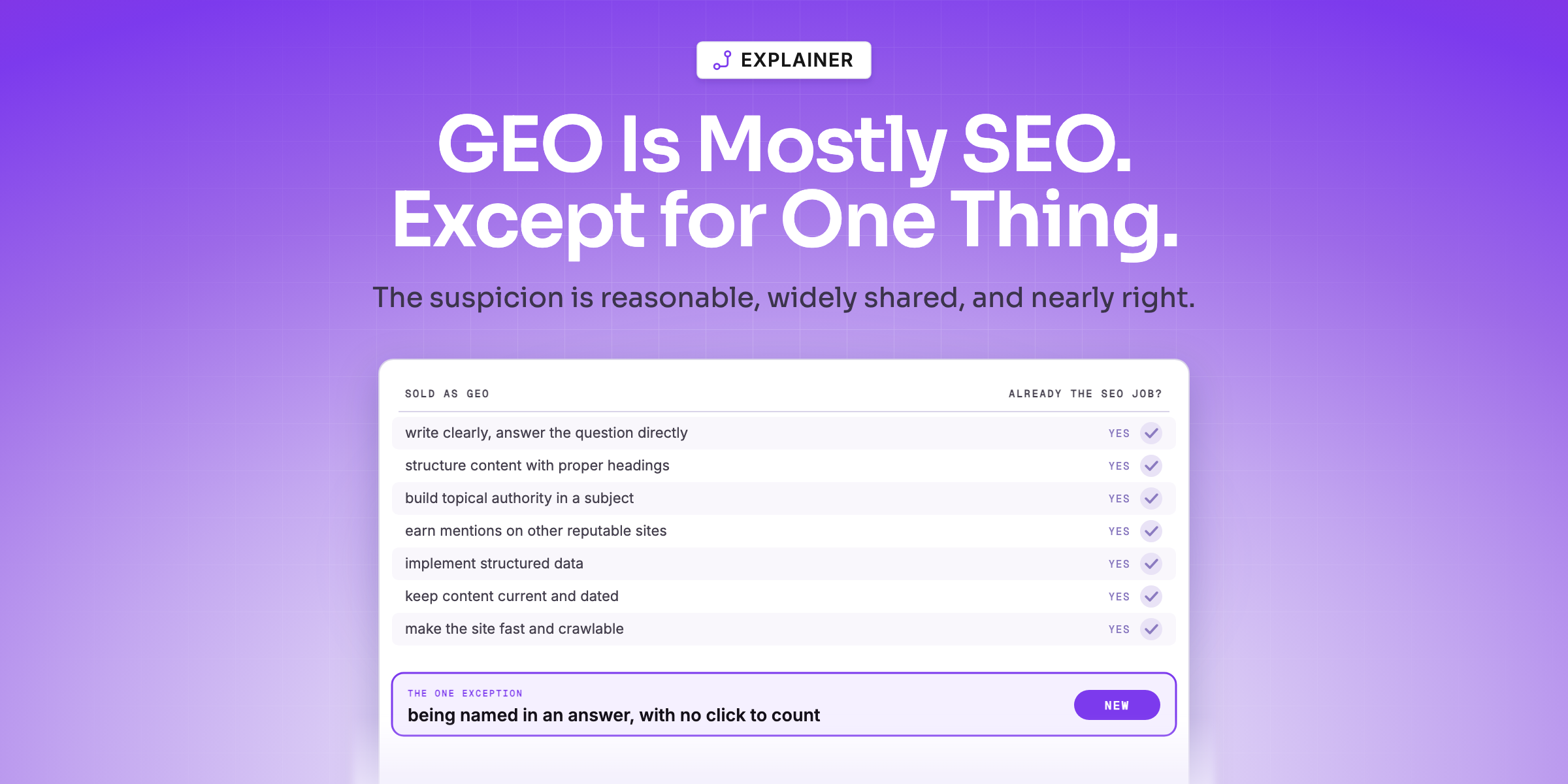
Take the standard list of what GEO involves and check it against what you were already doing.
| Sold as new | Was already the job |
|---|---|
| write clearly and answer the question directly | yes, for a decade |
| structure content with proper headings | yes |
| build topical authority in a subject | yes |
| earn mentions on other reputable sites | yes |
| implement structured data | yes |
| keep content current and dated | yes |
| make the site fast and crawlable | yes |
Every row is genuine best practice and none of it is new. A good SEO in 2019 was doing all of it, for reasons that had nothing to do with language models.
- The advice did not change. The justification did. Which is a marketing shift rather than a technical one.
- Most "GEO audits" are a technical SEO audit with different section headings and a higher price.
- That is not fraud, and it is worth being fair about it — the work is right even when the framing is inflated.
If a supplier's proposal is entirely rows from that table, you are being sold your own job back. Say so, and price it accordingly.
There is a fair counter-argument worth stating, because dismissing it is how this piece would become unfair. Most sites were not actually doing all seven rows well. "It was already best practice" and "it was already happening" are different claims, and the second one is usually false — plenty of teams shipped client-rendered pages, left structured data to a tag manager, and never wrote a direct answer to anything. If a new name gets that work finally funded, the name has earned something even while describing nothing new.
So audit before you dismiss, because advice being old does not mean it was taken. A rename that unlocks a budget is not worthless, it is just not a discovery, and it should be bought at the price of the work rather than the price of a new discipline.
Why the Vocabulary Arrived When It Did
Can someone explain GEO and AEO in a simple way? These new buzzwords are killing me.
The terms arrived with the products, and that ordering explains most of the noise. A word that names a service has a commercial interest in sounding new, because "we will do the thing you already pay for, slightly differently" is a difficult sale.
It is also how a whole advisory industry re-established a reason to be called. That is not cynical — it is what happens whenever a channel shifts, and it happened with mobile, with video and with social before this.
There was also a genuine vacuum. Search traffic started falling, nobody could explain where it went, and a vocabulary that named the new place was going to be adopted whether or not it described new work.
- Fatigue with the terms is not scepticism about the shift. Both can be true, and for most practitioners both are.
- The people most annoyed by the words are often the ones already doing the work, which is why the annoyance reads as expertise rather than resistance.
- A new name for old work is still useful if it gets the old work funded. That is a real benefit and it is worth saying out loud.
The One Thing That is Genuinely Not a Rename
Here it is, and it is the only entry on the list.
The old work assumed a person would eventually open your page. The new surface assumes a machine reads it and the person may never arrive at all.
That sounds like a small change and it is not, because it breaks the measurement rather than the craft. Every instrument you own counts a click: sessions, impressions, positions, conversions. A mention inside a generated answer with no link attached produces none of those. It influences a decision and leaves no trace anywhere you look.
So the exception is not a new tactic. It is a new failure mode of your existing dashboard.
| Old surface | New surface | |
|---|---|---|
| what success looks like | a visit | being named in an answer |
| does it produce a click | yes, by definition | often not |
| can your analytics see it | yes | no, unless a link was attached and clicked |
| what you can act on | traffic, rankings, conversions | whether you appear, and who appears instead |
- The craft mostly survives. Clear writing, real expertise and a technically sound site were always the answer and still are.
- The instrumentation does not. That is the genuine discontinuity and it is where the honest new work lives.
- This is why "is it a rename" gets argued endlessly. The people saying yes are talking about the craft and they are right. The people saying no are talking about the measurement and they are also right.

The Second-order Consequence
Once success can happen without a click, several habits quietly stop working, and none of them announce it.
- Attribution breaks first. A buyer who arrived already knowing three vendors, one of which was you, looks like direct traffic or a branded search. The influence happened somewhere you have no record of.
- A/B testing has nothing to test. You cannot run a controlled experiment on whether a page gets cited, because you cannot see most of the citations.
- Reporting cadence stops matching reality. Monthly traffic reports describe the surface that still produces clicks, which is increasingly the smaller half of the story.
- "Traffic is down and rankings are fine" becomes a common and unresolvable finding. It has an explanation now, and the explanation is not visible in the tools that produced the finding.
The uncomfortable one is the first. A meaningful share of what looks like direct traffic or branded search may be people who were told about you inside an answer weeks earlier. You cannot separate that from the rest, which means both the optimists and the pessimists in your organisation can argue from the same numbers indefinitely.
None of that is fixed by better content, and none of it is what a GEO retainer usually contains. It is a measurement problem, and it needs a measurement answer — which is a smaller, duller job than the vocabulary implies, and the only genuinely new one on the list.
The Part That is Neither New nor a Rename
There is a third category the argument keeps missing, and it explains a lot of the disagreement: old work whose value changed even though the work itself did not.
| The work | Was it new | What changed |
|---|---|---|
| server-rendering your content | no, it is years old | the penalty for skipping it is now total, not gradual |
| structured data in the raw HTML | no | a validator that renders will pass markup a fetcher never sees |
| earning mentions on other sites | no | those pages are now documents a model reads directly |
| answering the question early on the page | no | it is now the sentence that gets lifted, or not |
| keeping content dated and current | no | freshness weighting differs sharply between engines |
Nothing in the middle column says yes. Everything in the right column is a real change in consequence.
That is why "is it a rename" is the wrong question to argue about. A tactic can be twenty years old and have become far more important, or far less, without becoming a new discipline. The useful question is not whether the work is new — it is whether its payoff has moved.
- Rendering is the clearest case. A client-rendered page used to rank eventually, because Google came back to render it. To a fetcher that does not render, the same page is empty. Same old advice, completely different penalty.
- Link building is the most contested. It still moves rankings. It does very little at the moment a model is weighing your page against the question in front of it.
- The reweighting is the story, and no acronym captures it, which is part of why four of them exist.
What Changes in the Day-to-day Work
The vocabulary question matters less than the one that costs money: where the hours go this quarter.
How different is SEO vs GEO (generative engine optimization) actually?
Seventy replies and no settled answer, because the honest answer depends on something about your site that nobody in the thread could know: whether your pages arrive readable to a machine at all.
- A server-rendered site already answering questions directly changes very little. You are largely doing it.
- A server-rendered site with keyword-shaped, vague content changes editorially, not technically.
- A client-rendered app that assembles content in the browser changes almost everything, and none of it is editorial yet.
- A site blocking the wrong crawler in robots.txt changes nothing else until that is fixed. Telling the crawlers apart is the check.
Once a machine can reach and read your pages, the editorial change is real but smaller than the vocabulary suggests.
| The work | Before | Now |
|---|---|---|
| where the answer sits on the page | anywhere, as long as the page ranked | early, in a liftable sentence |
| how many claims a page carries | one thesis, at length | several, each evidenced separately |
| what evidence is for | credibility with a reader | the thing a model checks before quoting |
| page length | longer tended to win | length is neutral; claim density is not |
The page-length row is the one that changes commissioning. A single 4,000-word guide with one argument gives a model one thing to cite. The same material as four focused pieces, each carrying two or three evidenced claims, gives it eight or twelve. That is a briefing change rather than a skills change.
Some work stops paying on the second surface. None of it stops working for ranking, so cut by reason rather than by activity:
- Chasing long-tail keyword variants. A model rewrites the question before it searches, so one page answering it properly covers variants that used to need separate pages.
- Thin comparison pages built for volume. A page listing competitors without a real position on them has nothing quotable in it.
- Word-count targets. Padding a 900-word answer to 2,000 words makes the answer harder to extract, not easier.
A Split You Can Defend
If somebody needs a number for a plan, argue for a sequence rather than a ratio.
- First fortnight: access and readability. Open your live robots.txt, then fetch a content page without a browser and look for your headline in the raw response. This is engineering time, and for a lot of sites it is the entire finding.
- Then a baseline. Ten to fifteen real buying questions, run by hand a few times each, recorded with a date.
- Then the editorial work, aimed at the questions you actually lost. Not a content calendar generated from keywords.
- Keep the existing search work running throughout. Nothing about it stopped producing traffic, and most of the overlap pays twice.
There is no percentage in that, on purpose. Steps one and two frequently reveal there is no editorial problem to solve yet, and a plan that pre-committed forty per cent of the quarter to content would have spent it before finding out.
Take the readability finding to engineering as a defect, not a project: "our content pages return an empty document to non-browser clients" is a bug report and gets treated like one. And do the measurement in-house even if the content is outsourced, because the baseline is the number you will be arguing from later.
What to Say to a Supplier
Three questions sort a proposal quickly, and none of them is hostile.
- "Which of this were we not already doing?" If the honest answer is "not much", that is fine — but it should be priced as the work it is, not as a new discipline.
- "How will we know if it worked?" This is where a proposal either becomes real or becomes vague. If the answer is traffic, they have not understood the problem they are selling into.
- "What will you measure that our current tools cannot see?" The correct answer names appearances in generated answers and who is being recommended instead of you. Anything else is the old reporting with a new cover.
A fourth question is worth holding in reserve: "what would make you tell us this is not worth doing?" Anyone selling a discipline should be able to describe the customer it is wrong for. A supplier with no such customer is describing a product category rather than a fit.
A supplier who concedes that most of it is familiar work, and is precise about the one part that is not, is more trustworthy than one insisting everything changed. The second position is easier to sell and much harder to defend six months in, when the reporting still has nothing new in it.
If you want the measurement side settled before any of those conversations, it starts with definitions rather than tools — the difference between being mentioned, being cited and being visited is where most of the confusion in a supplier pitch lives. What actually gets a page picked is a separate question again, and we counted twenty-three AI Overviews to look at it.
Conclusion
Treat GEO as the work you already know, priced as that work, plus one genuinely new job: measuring appearances your analytics cannot see. Fix access and readability first, take a dated baseline of where you are named, point editorial work at the questions you lose, and keep the search work running because most of it pays on both surfaces.
Is GEO Just SEO: Frequently Asked Questions
Is GEO just SEO with a new name?
Do I need to learn GEO as a separate skill?
Why is everyone arguing about whether GEO is real?
Should I pay for a GEO audit?
Should I split my budget between SEO and GEO?
What is the single most useful thing to do first?
Find the exact growth leak in your business — in 2 minutes.
Paste your URL. Our AI agent crawls your site, diagnoses what's broken, and ships a step-by-step fix plan. Free, no signup.
Run free audit