voices quoted
Quoted in this piece
Does llms.txt Do Anything? Two Large Studies Say No
Two large studies found llms.txt does nothing for AI citation, and 97% of files were never fetched. Keep the file, but stop counting it as AI visibility work.

The short version
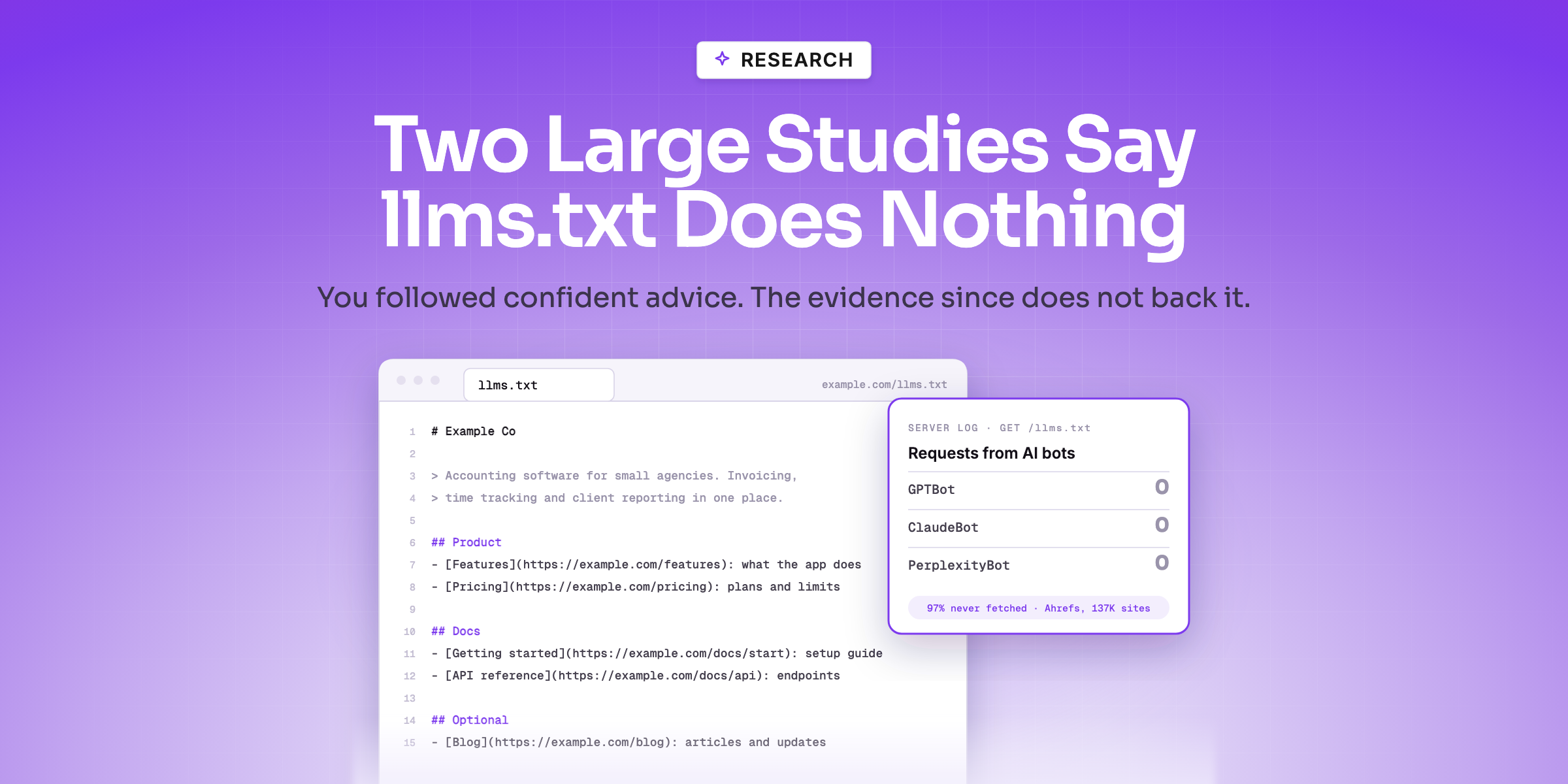
On the evidence published so far, llms.txt does nothing for AI citation. Ahrefs found 97% of published files received zero fetches across 137,000 domains, and SE Ranking found no measurable impact across 300,000. The requests that do arrive come from Google's general crawler and SEO tooling, not AI fetchers. Keep the file, because it costs nothing, but stop counting it as AI visibility work.
Key highlights
- 1 Ahrefs: 97% of llms.txt files got zero fetches across 137,000 domains
- 2 SE Ranking: no measurable impact on AI citation across 300,000 domains
- 3 Two independent vendor studies agree, and neither has been replicated
- 4 The requests you see come from Google's crawler and SEO tools, not AI bots
- 5 Two Google pages said different things, and the permissive reading won
- 6 Agentic browsing and citation retrieval are different jobs
- 7 A root-level file never enters the retrieval step that picks citations
- 8 Four questions sort the next recommendation like this one
- 9 Keep the file, stop maintaining it by hand and stop reporting it as work
You added the file because every guide said to. It took twenty minutes, it sits at the root of your site, and nothing has changed since.
You were not stupid and you were not scammed. You were following advice that was repeated confidently by a lot of people, and the evidence that has since arrived does not support it.
Here is that evidence, where the recommendation actually came from, and what to do with the file now — which is not delete it.
The Largest Sample: 97% Were Never Fetched
Using Ahrefs Web Analytics and Bot Analytics, we analyzed the server logs and live traffic of 137K domains […] 28% of the 137K domains using Ahrefs Web Analytics publish an llms.txt file. 97% of those files received zero traffic in May 2026.
That is Ahrefs' log study of 137,000 domains, run through their own analytics product. It is their dataset, published by a company with an interest in being read, and we have not reproduced it. It is also, as far as we can find, the largest sample anyone has published on this question.
Read the finding precisely, because the precision is the point. The files were not ranked low. They were not weighted lightly or read and ignored. They were never requested. Nothing came to the door.
Eighty upvotes and over a hundred replies on that thread — recognition rather than argument.
One caveat worth stating before you build anything on it. A file getting zero fetches tells you nothing was requesting it during that window on those domains. It does not tell you no engine will ever read one, and it does not distinguish between "this mechanism does not work" and "this mechanism has not been adopted yet". Those are different futures. What the study does rule out is the version of the claim everybody was making — that publishing the file was doing something for you now.
A Second Study, 300,000 Domains, Same Answer
One vendor study is a starting point. Two independent ones agreeing is the strongest evidence this field currently produces on anything.
Our analysis of 300,000 domains shows that LLMs.txt doesn't impact how AI systems see or cite your content today.
Different company, different sample, different method, same conclusion. Between them the two samples cover more domains than most published research in this field looks at combined. Neither is ours, both have a commercial interest in publishing something, and they were not coordinated.
| The study | Sample | What it reported |
|---|---|---|
| Ahrefs | 137,000 domains | 97% of published files got zero fetches in the month measured |
| SE Ranking | 300,000 domains | no measurable impact on how AI systems see or cite content |
- Two large independent samples agreeing is not proof, and neither study has been replicated by a disinterested third party.
- It is much better evidence than the recommendation ever had, which was zero studies and a lot of confident blog posts.
- Both describe today. If an engine starts reading these files next year, both findings become history and the file is already in place.
Something is Hitting the File. It is Not What You Think
If you have looked at your logs and seen requests for /llms.txt, do not celebrate before you read the user agent.
LLM-specific bots stayed away. No GPTBot, ClaudeBot, PerplexityBot, or similar were seen at all. […] Google still probes everything. Its desktop crawler accounted for 95% of all hits. […] SEO tools inflated the logs.
That is a 30-day audit of a thousand domains' raw CDN logs. No LLM-specific bot appeared at all. A separate analysis found roughly an eighth of all llms.txt fetches came from GEO and AEO tooling — the industry that recommended the file, checking whether you took its advice.
So the traffic is real and it is circular:
- Google's general crawler requests it the way it requests most things at a root path.
- SEO and AEO tools fetch it to audit you, or to report that you have one.
- The AI fetchers themselves did not show up in that sample.
If your only evidence that llms.txt is working is that something requested it, you are looking at a measurement artefact — and a slightly absurd one, since a good share of those requests exist because somebody built a tool to check whether you had followed the advice. Telling the crawlers apart by user agent is the check, and it takes one grep.

Why Every Guide Told You to Add It
This is the part nobody explains, and it is the most useful thing on the page.
Google Search Central says you don't need special AI files like LLMs.txt to appear in generative AI search, but Chrome Developers says LLMs.txt can help agents understand a site's structure.
Two Google properties, two different messages, one enormous advice industry in between.
Search Central is explicit that no special AI file is required to appear in generative search. A Chrome developer page discusses the file in the context of agentic browsing — software navigating a site on a user's behalf, which is a different job from a search engine deciding what to cite.
Those got flattened into one recommendation, and the permissive reading won for an obvious reason:
- The permissive version was actionable. "Add this file" is a deliverable. "You do not need to do anything" is not.
- It was cheap to recommend and cheap to follow. Nobody was going to be angry about twenty minutes.
- It arrived when everybody needed something to sell, into a market with real anxiety and no established playbook.
- There was no log data yet. The studies came later, and by then the advice was everywhere.
None of that requires bad faith from anyone. It is what happens when a plausible idea meets an urgent question and no evidence, and it is worth recognising because the next recommendation will arrive the same way.
Two Different Jobs Got Confused
The clearest way to hold this straight is to notice that the file was being discussed for two unrelated purposes, and only one of them was ever about getting cited.
| The job | What it means | Does a root-level file plausibly help |
|---|---|---|
| agentic browsing | software navigating your site on a user's behalf, needing a map | plausibly yes — that is a navigation problem |
| citation retrieval | an engine deciding which page answers a question | no — it already has an index and a query |
An agent trying to complete a task on your site benefits from being told where things are. An engine choosing what to cite is not browsing your site at all; it is searching an index it already built and reading the pages it retrieved. A file listing your structure does not enter that process at any point.
Once you see the two jobs separately, the studies stop being surprising. They measured the second job, found nothing, and that is exactly what the mechanism would predict.
- The advice was not obviously wrong when it was given. It was an untested extrapolation from one job to the other.
- It became wrong when it was repeated as established, without anyone checking which job they were describing.
- This is worth carrying forward, because the same extrapolation will happen again with the next proposed file or tag.
How to Judge the Next Recommendation Like This One
Something else will be recommended shortly, with the same confidence and the same absence of evidence. Four questions sort them quickly, and they cost nothing to ask.
- What is the mechanism? Not "it helps AI understand your site" — which step of retrieval does it change, and how would that step even see it? If nobody can answer, that is the answer.
- Who is recommending it, and what do they sell? A recommendation that produces a deliverable is more attractive to a supplier than one that does not, regardless of whether it works.
- Is there a log study? Server logs settle whether a file is being requested. Everything short of that is inference, and inference is what produced this.
- What is the cost if it does nothing? Twenty minutes is a fine bet. A sprint is not, and neither is a line on a client report claiming work you cannot evidence.
llms.txt passes the fourth question comfortably, which is why the honest verdict is "keep it" rather than "you were had". It failed the first three, and it took a year and two log studies before anyone checked.
- Treat cheap-and-harmless differently from cheap-and-reported. The file is fine; billing for it is not.
- The absence of a study is not neutral, in a field where studies are easy to run and nobody has run one.
What to Actually Do with the File
Keep it. That is the honest answer and it surprises people who expected an argument.
The file costs almost nothing, does no harm, and if an engine ever does start reading it you are already there. What has to change is what you count it as.
| What people did with it | What it is worth |
|---|---|
| shipped it and reported it as AI-readiness work | not defensible — nothing measured it working |
| spent a sprint curating and maintaining it | the sprint was the cost, and it bought nothing |
| left it in place, unmaintained | fine, and roughly correct |
| skipped it entirely | also fine, on current evidence |
The real cost was never the twenty minutes. It was the month, because the file was a satisfying thing to do instead of the unsatisfying thing.
That substitution is the thing worth guarding against, and it is not specific to this file. Work that is cheap, visible and completable will always beat work that is expensive, invisible and open-ended — even when only the second kind moves anything. A checklist item you can tick is more comfortable than a rendering change you have to argue for with an engineering team, and comfort is a poor guide to what is actually blocking you.
- Stop maintaining it manually. Generate it if your stack does that for free, and otherwise leave it.
- Stop putting it on a client report as work delivered. No measurement supports the line.
- Go and check whether the crawler can read your actual pages, which is the same question one layer down and the one that decides everything.
- Watch for a change in the evidence, not for another round of the same advice. If a study shows fetches rising, that is new information; another blog post recommending it is not.
If you did the llms.txt work and nothing moved, the next place to look is whether your pages arrive as readable documents at all — and that one is checkable in ten seconds with curl. It is the less exciting answer and it is usually where the wound actually is.
Conclusion
llms.txt is cheap and harmless, and on current evidence it is not doing anything for how AI engines cite you. Leave it where it is, take it off the client report, and spend the time on the check that decides everything: whether your actual pages arrive as readable documents when a crawler fetches them.
Llms.txt: Frequently Asked Questions
Does llms.txt actually work?
Should I delete my llms.txt file?
Do ChatGPT or Claude read llms.txt?
Why is something requesting my llms.txt then?
Why did everyone recommend llms.txt?
What should I do instead of llms.txt?
Find the exact growth leak in your business — in 2 minutes.
Paste your URL. Our AI agent crawls your site, diagnoses what's broken, and ships a step-by-step fix plan. Free, no signup.
Run free audit