voices quoted
Quoted in this piece
Which AI Visibility Tool to Buy? Ask This First
Three checks separate AI visibility tools: cited sources, engine coverage and competitor rank. Why prices run $15 to $455, and what to decide before any demo.


The short version
There is no best AI visibility tool until you have decided which engines matter and which questions you care about. One practitioner who ran several names three things that separate the products: cited sources, engine coverage and a competitor rank rather than a score. Prices run from roughly $15 to $455 a month because the label covers four different products. Own your prompt set and your definition of a hit first, then buy the cheapest tool that does the job you need.
Key highlights
- 1 The question goes unanswered because everyone replying has something to sell
- 2 Cited sources, engine coverage and a competitor rank separate good tools from bad
- 3 A mention count is the cheapest thing to build and the least useful to own
- 4 Monthly prices run from roughly $15 to $455 for products that sound identical
- 5 Own the prompt set and define a hit before you look at any tool
- 6 Six demo questions separate products faster than a comparison table
- 7 The label covers four products: counter, citation tracker, competitor tracker, recommender
- 8 Recommendations are usually generic best practice, not derived from your data
- 9 Buy when running the checks costs more hours than the licence
The question gets asked constantly and almost never answered. Search for it and you will find a dozen threads with hundreds of replies between them, and the top comment is reliably somebody's own product.
Saw a post on r/SEO on this but there were 100 spam comments and no clear answer lol. So thought I'd try it myself on here!
That thread went on to collect a hundred and sixty comments. You are not short of options. You are short of a way to tell the options apart, and the listicles are not going to give you one because they are written by the people being listed.
This is the shorter, less satisfying version: what actually differentiates these products, what the category charges, and the two decisions that have to happen before any of it matters.
Why Nobody Answers It
Three reasons, and none of them is that the question is stupid.
- Everyone answering has something to sell. The reply rate on these threads is high precisely because they are lead generation. A recommendation from a founder is data about their roadmap, not about your needs.
- The products describe themselves identically. Every one of them tracks brand mentions across AI engines. Read five landing pages and you cannot tell them apart, because the differences are two layers below the marketing.
- The right answer depends on things the asker has not decided yet. Which engines matter for their buyers, which questions they care about, and what they will do with the number. Nobody can recommend a tool without those, so the honest replies look unhelpful and get buried.
The result is a market where price varies thirty-fold for a job everyone describes in the same sentence.
It is worth saying plainly that the threads are not useless. Buried under the vendor replies there is usually one person who has actually run four or five of these and will tell you what broke. That reply is what you are looking for, and it is findable — sort by controversial, or read the replies with three upvotes rather than the ones with thirty.
The Three Things One Buyer Says Separate Good From Rubbish
The most useful reply in that thread came from someone who had actually run several of them:
The difference I've found in what makes a tool "good" and "rubbish" comes down to three things: 1/ Citation data not just mention counts: knowing you showed up in an AI answer means nothing if you don't know which sources powered it and whether your own content was one of them. 2/ Multi-model tracking: ChatGPT, Perplexity, Gemini and AI Overviews all behave completely differently. A tool tracking one or two platforms is giving you a false picture. 3/ Visibility rank not just visibility score: score can go up for everyone at once. Rank tells you where you actually stand relative to competitors.
That is one practitioner's account rather than a study, and it is the sharpest set of criteria published anywhere we can point to. Each one is worth restating as a test you can run on a demo.
| What to check | Why it decides everything downstream |
|---|---|
| does it show the cited sources, or only that you were mentioned | a mention count cannot tell you what to change; a source list can |
| does it cover every engine you care about, or one or two | the engines behave differently, so a partial view is a wrong view |
| does it report a rank against competitors, or a score | a score can rise for everybody at once and mean nothing |
The third is the one people miss, and the poster's reason for it is the best line in the thread: a visibility score can go up for everyone at the same time. If the whole category gets more visible because an engine started citing more sources, your number improves and your position has not.
Two things follow that the listicles will not tell you:
- A mention count is the cheapest thing to build and the least useful to own. It is what you get at the bottom of the price range, and it is a number without a next action attached.
- Engine coverage is a hard cost, not a feature flag. Running real queries across four engines repeatedly is what the money is actually buying. A tool covering one is not a discount version, it is a different product.
What the Category Charges
A community-compiled list in early 2026 put monthly prices across the category between roughly $15 and $455, for products that describe their job in the same sentence.
Take that as one poster's compilation on one date, not as a price list we stand behind — these move constantly and any specific figure here will be wrong by the time you read it. The spread is the finding, not the rows.
- A thirty-fold price range means the job is not standardised. In a mature category, comparable products converge on comparable prices. This one has not, because "AI visibility tool" describes several different products sharing a label.
- The bottom of the range is usually mention counts on one or two engines. Genuinely useful for a first look, and not the same purchase as the top of the range.
- The top is usually citation-level data across every engine, at volume. Whether that is worth five times the money depends entirely on whether you will act on the extra detail.
- Price is not one of the three criteria above, and that is deliberate. Work out which product you need first, then find the cheapest one that does it. Sorting by price first gets you the cheapest thing in a category you have not defined.

The Two Decisions That Come Before the Tool
Here is the part that changes the outcome, and it costs nothing.
Every one of these products reports a fraction. Appearances over runs. Somebody had to choose which questions get asked, and somebody had to decide what counts as an appearance. Buy first and you inherit both decisions from a vendor. Their questions become your denominator, their definition of a mention becomes your metric, and your number is no longer comparable to anything except itself.
So make both decisions before you shop:
- Own the prompt set. Ten to twenty real buying questions, written from sales calls and support tickets rather than from keyword tools. Freeze the list and date it. This is the asset; the score is a by-product of it.
- Define what counts as a hit. Named in the conclusion with a reason, listed among options, and cited without appearing in the answer text are three different outcomes. Write your rule down before anybody runs anything.
With those two in hand, tool selection becomes a much smaller question: which of these will run my list, across the engines I care about, and show me the sources. Without them, you are not buying a measurement, you are buying somebody else's opinion about what to measure.
There is a useful side effect. Once you own the list, what a mention actually is stops being a definitional argument with a vendor and becomes a decision you have already made.
What to Ask on the Demo
Six questions. They take ten minutes and they separate the products faster than any comparison table.
- "Can I upload my own prompt list, unchanged?" If the answer involves their suggested prompts or their keyword expansion, you are getting their denominator.
- "Show me the cited sources for one answer." Not the mention count. The actual URLs the engine used.
- "Which engines, and which modes?" Web-search mode and memory-only mode are different measurements. A tool that will not say is measuring something it has not defined.
- "How many runs per prompt, and can I change it?" One run per prompt per day is a sample of one repeated daily. It is not a rate.
- "What exactly counts as a mention here?" If the definition is not written down, your number is not reproducible.
- "What do I do with this on Monday?" Ask it plainly. The answers are revealing, and most of them describe a state rather than an action.
That last one is the whole category's weak point, and it deserves its own honest answer rather than a dodge — including from us.
The Four Things All of Them are Actually Selling
"AI visibility tool" is a label over at least four different products. Working out which one you are being shown explains most of the price spread and most of the disappointment.
| What it really is | What you get | Who it suits |
|---|---|---|
| a mention counter | did your name appear, across one or two engines | a first look, a sanity check |
| a citation tracker | the source URLs behind each answer, across every engine | anyone who needs to know what to change |
| a competitor tracker | your rank against a named set, over time | agencies reporting to clients |
| a content recommender | a list of things to change, generated from the above | be careful — see below |
The first three describe something that happened, and say so. The fourth asserts a cause, and that is the one to interrogate hardest, because the link between a specific change and a subsequent citation has not been demonstrated by anyone.
- Most products are one of the first three with a thin layer of the fourth on top. The recommendations are usually generic best practice, not derived from your data.
- The price mostly tracks engine coverage and run volume, not intelligence. Running real queries repeatedly across four engines is the actual cost base.
- Ask which of the four you are being sold, in those words. A vendor who can answer plainly is easier to trust than one who says all of it.
Being named and being recommended are different outcomes too, and very few of these products distinguish them — which means a rising mention count can hide a falling recommendation rate.
When a Tool is Genuinely Worth Buying
There is a real moment for this, and it is later than the sales cycle suggests.
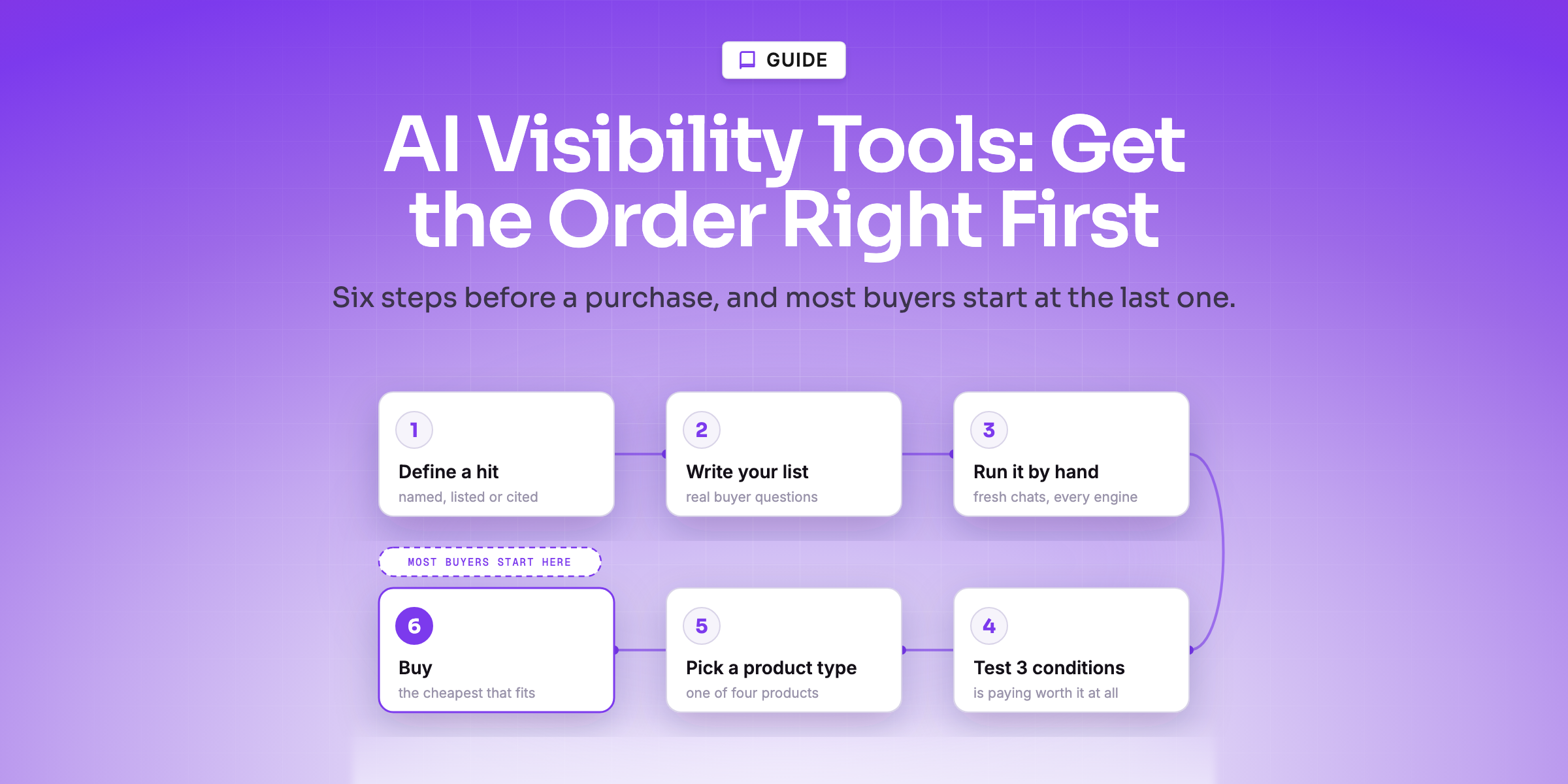
Buy when the running is the cost, not the deciding. If you have a frozen list of twenty questions, a definition of a hit, and you are running them across three engines ten times each every month by hand, you are spending real hours on mechanical work — and that is exactly what automation is for.
- Before that point, a spreadsheet produces a better number than a subscription, because you chose the questions and you can re-derive every figure in it.
- At that point, a tool buys back the hours and adds engine coverage you would not sustain manually.
- Never buy it to find out what to measure. That is the one job on the list that cannot be outsourced, because the answer depends on your buyers.
- Budget for the running, not the licence. Someone still has to read the answers, apply your hit rule and write the summary. The subscription removes the typing, not the judgement.
- Re-check the decision every couple of quarters. This category is young enough that both the products and the prices move faster than an annual contract.
The uncomfortable version, which applies to every vendor in this category including the people writing this: a tool can tell you where you stand. Whether anything you do next moves that number is a claim nobody in this market can currently support with evidence.
Conclusion
Do not start by comparing tools. Write your own buying questions, decide what counts as a hit, and run them by hand until the hours hurt. Then ask each vendor which of the four products they are selling, insist on uploading your own list, and buy the cheapest one that shows cited sources across the engines your buyers use.
Choosing an AI Visibility Tool: Frequently Asked Questions
What is the best AI visibility tool?
How much do AI visibility tools cost?
Do I need a tool to track AI mentions?
What should an AI visibility tool actually show me?
Why do two tools give me different numbers for the same brand?
Can any AI visibility tool tell me what to fix?
Find the exact growth leak in your business — in 2 minutes.
Paste your URL. Our AI agent crawls your site, diagnoses what's broken, and ships a step-by-step fix plan. Free, no signup.
Run free audit