voices quoted
Quoted in this piece
AI Visibility Tools: What They Do, When to Buy
What AI visibility tools actually measure, the four products behind one label, why none can tell you what to fix, and when buying one is worth it.

The short version
AI visibility tools run a list of questions through AI engines and report whether your brand was named, but the label covers four different products. None of them can tell you what to change, because monitoring is counting and fixing needs evidence nobody has yet. You can run the same check by hand first, and three conditions decide whether paying for any of it is worth it for your business. Decide what you are measuring before you compare a single price.
Key highlights
- 1 AI visibility tools record AI answers and report whether you were named
- 2 One label covers four products: counter, citation tracker, competitor tracker, recommender
- 3 Three checks on any demo: cited sources, every engine, a competitor rank
- 4 Prices ran from roughly $15 to $455 a month in one early-2026 compilation
- 5 A dashboard describes where you are; it cannot tell you what to change
- 6 Run the check by hand first, with questions from real buyer conversations
- 7 Paying makes sense only if all three buyer conditions hold
- 8 We publish no tool ranking and no accuracy figures, and say why
- 9 Buy in order: define a hit, write your list, run it, then choose a product
You searched for AI visibility tools and found a page of "best tools" lists, most of them written by companies that sell one. Every product on those lists says it tracks your brand across ChatGPT, Perplexity, Gemini and Google's AI Overviews. Prices run from pocket money to a junior salary.
The lists answer "which ones exist". They do not answer the question you actually have, which is whether you need one, which kind, and what it can and cannot do for you once you are paying.
This page is the map for that decision, current as of 14 September 2026. Each section is one of the questions buyers ask, where it stands, and a link to the piece that works it out in full:
| The question | Where it stands |
|---|---|
| What these tools actually measure | Settled. Four product types share one label. |
| How to tell a good tool from a weak one | Observed. One practitioner's three criteria, widely echoed. |
| Whether a tool can tell you what to fix | Settled, and the answer is no. Monitoring is counting; fixing needs evidence nobody has. |
| Whether you can do it without a tool | Settled. Yes, by hand, for a small question list. |
| Whether the spend is worth it for your business | Depends on three conditions you can test yourself. |
| How the tools compare on accuracy | Open. We have not run a documented teardown, so we make no claim. |
Two of those six are settled against the buyer's hopes, and one is open for everybody, including us. A page that ranks the tools for you is answering the open question as though it were settled.
What AI Visibility Tools Actually Do
An AI visibility tool runs a list of questions through one or more AI engines, records the answers, and reports whether your brand was named. That is the whole core. Everything else is what gets built on top of the recording.
The trouble is that "AI visibility tool" covers several different products sharing one sentence on their landing pages:
- A mention counter tells you whether your name appeared, usually across one or two engines. It is the cheapest thing to build and a reasonable first look.
- A citation tracker records which source URLs an engine used for each answer, across every engine you care about. This is the one that points at something you could act on.
- A competitor tracker reports your standing against a named set of rivals over time. Agencies reporting to clients tend to want this.
- A content recommender turns the readings into a list of suggested changes. It is usually a thin layer on one of the other three.
Working out which of the four you are being shown explains most of the price spread and most of the disappointment afterwards. None of them can do the one thing the category is quietly assumed to do, which is covered two sections down.
Which Tool Should You Buy?
The question gets asked constantly on marketing forums and almost never answered, because most of the replies come from people with a product to recommend:
Saw a post on r/SEO on this but there were 100 spam comments and no clear answer lol. So thought I'd try it myself on here!
The most useful reply in that thread came from someone who had run several of them, and it reduces to three checks you can apply on any demo:
- Does it show the cited sources, or only that you were mentioned?
- Does it cover every engine your buyers use, or one or two?
- Does it rank you against competitors, or give you a score that can rise for everyone at once?
That is one practitioner's account rather than a study, and it is still the sharpest set of criteria we can point to.
Price is not one of the three. A community-compiled list in early 2026 put monthly prices across the category between roughly $15 and $455. Treat that as one poster's compilation on one date, because the figures move constantly. The spread is the useful part: a thirty-fold range means the job is not standardised, and the cheap end and the expensive end are usually different products rather than better and worse versions of one.
The demo questions, the four product types in detail, and the moment a purchase actually makes sense are all in which AI visibility tool to buy.
A Dashboard Describes Where You Are, Not What to Change
This is the gap most buyers discover around month three. The tool updates every week, the charts are clean, and nothing about the position has moved.
After the advent of LLM Search, I see dozens of tools offering LLM Monitoring. Sort of like "ahrefs, semrush for GEO". But when using these tools, I just surface-level information like "is your brand mentioned", "rank with respect to competitors", "most used sources" etc. I might be using these tools wrong, but are you ppl able to get any action-worthy data points from these tools?
The poster is not using them wrong. Every item on that list describes a state, and acting needs a cause.
| What the dashboard reports | What you would need before acting |
|---|---|
| you appeared in a share of answers | which answers you lost, and what won them instead |
| a competitor is named more often | why that source was picked over yours, per question |
| these sources are cited most | whether appearing on them is achievable at all |
| the number fell this month | whether anything you control caused it |
Monitoring is arithmetic. Fixing is a causal claim. To say "change this and the citation follows" you would need a baseline, one isolated change, a re-measurement after the engines have re-crawled, and a control set of questions you did not touch. Engines, indexes and competitors all move inside that window, so the evidence for a confident fix list does not exist yet.
That does not make monitoring worthless. It earns its cost on a defensible baseline, catching a drop early, and naming who is recommended instead of you. The case for and against, and how to get more out of a subscription you already pay for, is in why AI visibility tools monitor but none of them fix.
You Can Run the Check by Hand First
Before pricing a subscription, run the same measurement yourself once. It costs an afternoon and produces the same unit the tools sell.
- Write 10 to 15 unbranded buying questions, taken from real sales calls and support tickets rather than a keyword tool.
- Run each one several times per engine, in a fresh chat, because a logged-in account carries months of history that tilts the answer.
- Record who else was named, not only whether you were. The competitor column is usually the most useful output of the whole exercise.
The hand version has one advantage no tool can match: you chose the questions. Every product in this category reports a fraction, and whoever writes the prompt set chooses the denominator. When a vendor supplies the questions, two tools can give you two different numbers for the same brand and both be correct.
Buy when the running is the cost, not when the deciding is. Once your list is stable and the monthly runs genuinely eat hours, a tool buys those hours back. Before that, a spreadsheet produces a better number. The full method, including the four common ways a hand check goes wrong, is in how to check your AI visibility by hand.
Is Any of This Worth Paying For?
For a lot of businesses being sold AI visibility work, no. For some, clearly yes. The difference is not company size or budget.
Three conditions decide it, and all three have to hold:
- Your buyers research before they buy. They compare options over days or weeks rather than deciding on the spot.
- An AI engine answers your category with a shortlist of companies, not a fact or a map. Ask a real buying question and see.
- You can name a specific question where a competitor is named and you are not, with the answer in front of you.
A local coffee shop being upsold "AEO" by its marketing agency fails the first condition, and that settles it. A B2B supplier whose buyers ask a model for recommendations weeks before making contact often passes all three.
Even in the yes case, do not spend yet:
- Run the two free checks first. Can a crawler actually read your pages, and is your robots.txt blocking the wrong bot?
- Then buy in order. Technical fixes before content, and content before monitoring, because a dashboard bought first reports a number you cannot act on.
The test, both cases in full and what each kind of purchase really is, are in whether AEO is worth paying for.
What This Page Will Not Tell You
A hub about buying tools has an obvious conflict of interest when the company writing it also builds one. So here is what we are deliberately leaving out, and why.
- No ranking of named tools. We have not run a documented, dated teardown of the products against the same question set, so any league table from us would be a guess dressed as a comparison.
- No accuracy figures for the category. Numbers of that kind circulate widely and almost none come with the list of tools, the runs and the dates behind them. A count without a list does not appear here.
- No current price table. The only spread we quote is one dated compilation, and it is labelled as that.
- No exemption for our own tool. It monitors. It does not tell you what to change either, and the standard in the monitoring section applies to it in full.
If you want to check the measurement ideas underneath all of this before looking at any product, what "AI mentions me" actually means, and which parts are still unknown is the place to start.
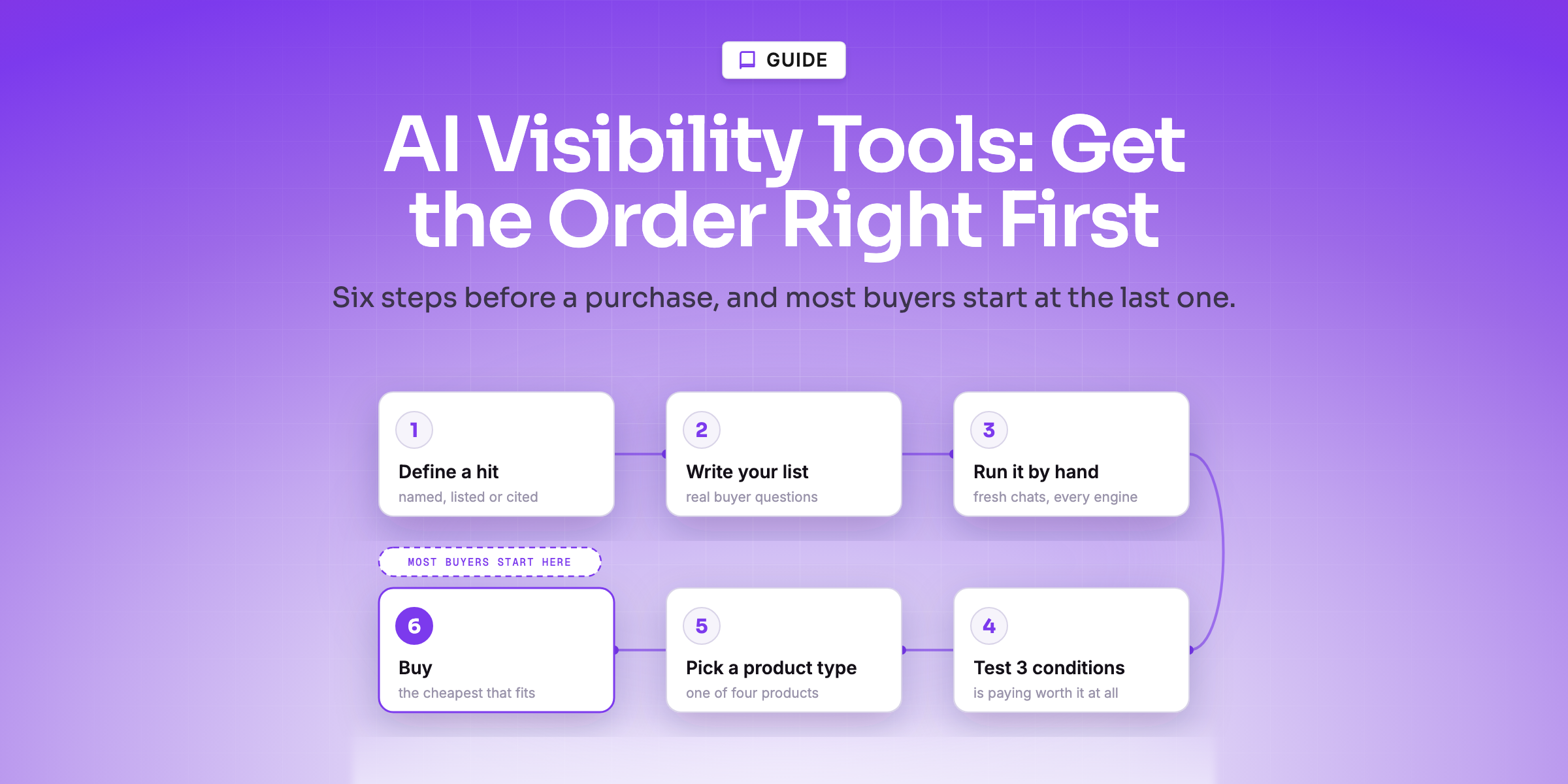
A Sensible Order for Buying
Put together, the sections above give a sequence rather than a shortlist:
- Decide what counts as a hit — named with a reason, listed among options, or cited without being named.
- Write and freeze your own question list from real buyer conversations.
- Run it by hand once, and read the answers rather than only counting them.
- Test the three conditions to see whether paying makes sense at all.
- Work out which of the four products you need, then take the three checks into every demo.
- Buy the cheapest one that does that job, and insist on uploading your own list unchanged.
Most buyers reverse that order and start at step six. That is why so many subscriptions end up producing a number nobody acts on.

Conclusion
Do not start with a list of tools. Decide what counts as a hit, write your own buying questions, and run them by hand once. If your buyers research, AI answers your category with a shortlist and you can name a question you are losing, then pick the product type you need, take the three checks into the demo, and buy the cheapest one that does that job.
AI Visibility Tools: Frequently Asked Questions
What do AI visibility tools actually do?
What are AI visibility services?
Is an AI visibility tool the same as an SEO tool?
Are free AI visibility checkers worth using?
Who should not buy an AI visibility tool?
What should I have ready before a vendor demo?
Find the exact growth leak in your business — in 2 minutes.
Paste your URL. Our AI agent crawls your site, diagnoses what's broken, and ships a step-by-step fix plan. Free, no signup.
Run free audit

